High school students interested in learning college-level material, boosting their GPAs, and even earning college credit well before getting their acceptance letters should consider taking Advanced Placement (AP) courses or signing up for the International Baccalaureate (IB) Diploma Programme (DP) if their schools offer them.
High scores on AP and IB exams strengthen college applications and place students in more advanced courses across most undergraduate degree programs, but they come at the cost of rigorous coursework. This article breaks down what students and parents need to know when applying to high schools and deciding between academic programs, including:
- Advanced Placement (AP) tests and AP Test Dates
- The International Baccalaureate (IB) Diploma Programme (DP) and Career-related Programme (CP) and Test Dates
- Which Texas universities offer credit for AP/IB scores
- How to maximize your GPA with AP & IB courses
- Houston schools offering AP & IB
Advanced Placement (AP) Courses & Exams
Administered by College Board (the makers of the SAT), Advanced Placement courses and exams give students the opportunity to do college-level learning while in high school and earn credit towards their future college degree. The 40 AP courses span six disciplines (in addition to the AP Capstone Diploma Program), meaning that any student can find an AP course aligned with their favorite school subject(s).
 AP Subjects
- English
- World Languages and Cultures
- History and Social Sciences
- Sciences
- Math and Computer Science
- Arts
Students can usually choose which AP classes they wish to take. Science lovers can take the full suite of AP science classes (biology, chemistry, environmental science, and 4 types of physics—two algebra-based, one based on electricity and magnetism, and one based on mechanics), and even those who prefer the arts have plenty of options (2-D art, 3-D art, drawing, art history, and music theory).
While most high schools don’t offer all 40 AP courses, many offer a wide range across both core subjects and electives that ambitious students can pick from. Many Houston high schoolers take a mix of AP courses, often choosing AP versions of their core classes and one or two AP electives. Jump to AP offerings in Houston.
AP Exams and the 2026 AP Testing Schedule
The primary reason for students to take on the much higher workload of AP classes instead of Pre-AP or on-level equivalents is that good AP scores can award college credit. In order to reap the benefits of an AP course, one must take and score well on its corresponding exam at the end of the school year.
The format of each AP exam is designed around its subject matter, but most contain a multiple choice section and a free response section. English and History AP tests will have at least one essay involved, and AP foreign language tests involve recordings of students’ spoken answers to free response questions.
AP exams are graded on a scale of 1 to 5. Many colleges will grant credit and/or advanced placement for scores of 3 to 5, but more selective ones will only grant credit for scores of 4 and above. Each year, AP testing takes place in schools on designated days over the course of two weeks in May:
2026 AP Test Dates
| Date | Morning (8:00am) | Afternoon (12:00pm) |
|---|---|---|
| May 4, 2026 | Biology, Latin | European History, Microeconomics |
| May 5, 2026 | Chemistry, Human Geography | United States Government and Politics |
| May 6, 2026 | English Literature and Composition | Comparative Government and Politics, Physics 1: Algebra-Based |
| May 7, 2026 | Physics 2: Algebra-Based, World History: Modern | African American Studies, Statistics |
| May 8, 2026 | Italian Language and Culture, United States History | Chinese Language and Culture, Macroeconomics |
| May 11, 2026 | Calculus AB, Calculus BC | Music Theory, Seminar |
| May 12, 2026 | French Language and Culture, Precalculus | Japanese Language and Culture, Psychology |
| May 13, 2026 | English Language and Composition, German Language and Culture | Physics C: Mechanics, Spanish Literature and Culture |
| May 14, 2026 | Art History, Spanish Language and Culture | Computer Science Principles, Physics C: Electricity and Magnetism |
| May 15, 2026 | Environmental Science | Computer Science A |
International Baccalaureate Programs & Exams
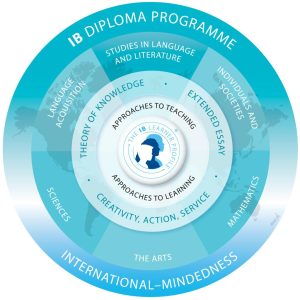
The International Baccalaureate Diploma Programme (IB DP) is different from traditional high school programs in that it’s a comprehensive curriculum for juniors and seniors that encompasses at least six courses per year.
The IB Diploma curriculum thematically connects six subjects and three core components. Many courses among the subjects are divided by difficulty into standard level (SL) and higher level (HL).
 IB DP Subjects
- Studies in language and literature
- Language acquisition
- Individuals and societies
- Sciences
- Mathematics
- Arts
The DP Core
- Creativity, activity, service: Projects of the student’s creation that combine creativity, activity, and service in a meaningful way.
- The extended essay: A deep, self-driven research process that culminates in a 4,000-word essay.
- Theory of Knowledge: A course on the theory of learning & knowledge, with assessment done through an exhibition project and a 1,600-word essay.
As you can see, the IB Diploma Programme is rigorous—and meant to be adapted to each student’s interests and desires. On top of the DP Core, IB students must take exams for all of their IB courses and score well to earn the IB Diploma.
The IB diploma is highly regarded by college admissions offices, but it isn’t the only reason to score well on IB tests. Getting the diploma and even just scoring well on certain IB exams can earn students college credits.
The IB Career-related Programme (CP)
Students who don’t want IB to consume their coursework and are interested in a stronger real-world connection to their education pursue the IB Career-related Programme (CP). This career-related learning is a three-part curriculum combining career-related projects and studying with at least two IB Diploma Programme courses. Scoring well on these courses’ exams can also earn students college credit.
IB Exams & 2026 IB DP Testing Schedule
Getting good IB test scores, like AP scores, can grant students full college course credits once they’re enrolled. Each DP assessment is scored between 1 and 7, and students must earn at least 24 minimum points across their exams in order to earn the IB diploma.
Every year, IB testing occurs across three weeks in April-May—in 2026, testing starts on Friday, April 24 and ends on Wednesday, May 20.
How IB Students can Double-Dip into Testing for College Credit
Many AP & IB courses cover similar material, especially ones for core subjects. As such, many schools give their IB students the opportunity to take the AP tests aligning with their classes. Considering IB tests are more difficult, requiring extensive free-response, taking the corresponding AP test is a backup way for IB students to score well and qualify for college credits if their IB score falls short.
Do Texas Universities Grant College Credit for AP/IB Scores?
Earning college credit while in high school can help students finish college faster (saving thousands of dollars on tuition) and knock core requirements out of the way. Good thing Texas colleges recognize good scores on AP & IB exams!
AP Scores that Earn College Credit in Texas
All Texas public universities must grant course credit for AP scores of 3 and above by law (as a part of 2016’s Texas House Bill 1992). Typically, scoring a 3 on an AP test earns students credit for lower-level or introductory courses while scoring a 4 or higher grants additional or higher-level credits. This means that earning a 3 will count towards the number of credits required for a degree and fulfill low-level requirements in core subjects, but it often won’t grant credit for the specific courses needed for a given major.
Top Texas private colleges like Rice, Baylor, SMU, and Trinity require a 4 or 5 on the AP exam in order to earn college credit. However, these credits may only earn “general hours” that don’t necessarily count towards a student’s graduation requirements. The less selective Texas Christian University (TCU) awards credit for AP scores as low as a 3.
IB Scores that Earn College Credit in Texas
Good IB Diploma Programme exam scores will also be granted credit at Texas public universities. According to state law, “Texas institutions of higher education must award 24 hours of course specific college credit in subject appropriate areas of all IB exam scores of 4 or above as long as the incoming freshmen have earned an IB diploma.” 24 hours of credit is massive—at schools like UT and A&M, that is almost two full semesters of courses.
What if a student misses the mark for the IB diploma but still does well on a handful of IB exams? Scores of 4 and above on any IB test will generally grant college credit for similar courses at Texas public universities. Scores of 5-7 on IB exams in foreign languages will generally grant additional or higher-level credits for those languages.
As with AP scores, Texas private universities are more selective with the credits they will award for IB scores. TCU & St. Edward’s accepts scores of 4 and above, while Baylor and Trinity accept scores of 5 and above. Rice will only grant credit for students who have the full IB diploma or who have a 6 or 7 on individual exams.
Boost Your GPA with AP & IB Courses
In schools that use weighted GPAs, AP and IB courses are graded on a 5.0 scale.This means that students with As in a few AP classes can earn pretty high GPAs. IB Diploma Programme students with six 5.0 courses can also earn impressive GPAs—so long as their grades don’t slip.
AP & IB coursework is measured on this higher scale to demonstrate their academic rigor. Because a student challenges themselves by taking a tougher class with higher expectations, their “B” is equivalent to the “A” they would’ve gotten in an easier version of the class. Students looking to maximize their GPA and deciding between AP & IB should weigh the aggressive 6-course IB workload (PLUS the expectations of the DP core) and its major GPA boost against however many AP classes they would take and the smaller (but still significant) GPA boost.
AP & IB Programs Across Houston
Your AP and IB opportunities are limited by the classes your school offers. Motivated students can self-study for AP exams that aren’t provided by their school, then take them at schools that do offer those subjects.
High schools throughout Houston’s school districts generally offer AP, but only a few offer IB.
Houston AP Programs
AP is pretty much ubiquitous throughout Houston high schools.
Schools typically register their students for the tests they will be holding, but the process varies by school. An AP exam costs $99 (although some schools cover the cost). “Qualifying students” of CEP or Title 1 schools and districts in Texas can get their AP fees reduced to $27.
Most HISD, SBISD, & FBISD high schools have this standard slate of AP courses:
- English: AP English Language & Literature.
- History: AP Human Geography, World History, & US History.
- Math: AP Precalculus, Calculus AB, & Statistics.
- Science: AP Biology, Chemistry, and/or Physics 1. (Not all 3 are always offered.)
- AP Macroeconomics & US Government.
- AP Spanish Language & Literature.
Top high schools typically also offer one or both AP Computer Science and APs for all their foreign language classes. A few have greater AP variety than most:
Houston ISD
- Bellaire HS offers 32 AP courses. Its World Language Program includes all eight foreign language APs, and it offers Art History, Art Studio, Music Theory, and AP Research & Seminar (the AP Capstone).
- Carnegie Vanguard HS has close to 30 AP courses, and they are the focus of the school. Carnegie’s core subjects are all either Pre-AP & AP—no “on level” because it’s a 100% Vanguard magnet campus. Students are required to take 11 designated AP courses in order to graduate, including the AP Capstone.
- DeBakey HS offers about 25 APs, including the Capstone and a suite of STEM courses to support its focus on health sciences (notably Calculus AB & BC and Physics 1 & 2).
Spring Branch ISD
As a district, Spring Branch ISD offers a slate of around 35 AP courses, including the AP Capstone and the less common STEM and arts AP courses. Due to its large student body and continued academic achievement, Memorial HS is said to offer the very niche AP Comparative Government.
Fort Bend ISD
31 AP courses are offered from FBISD, but there is more variation in the AP subjects schools teach.
- Stephen F Austin HS has a wide range of 27 AP courses, including some rarer ones: Spanish Literature, European History, and Chinese.
- Dulles HS has almost as wide a range of AP offerings as Stephen F Austin, but it offers Art History instead of AP Euro and Spanish Lit.
- Clements HS is the only FBISD school teaching AP courses in Microeconomics, Music Theory, Japanese, Latin, & German.
International Baccalaureate (IB) Programs in Houston
It takes a lot for a school to be IB-certified, so IB is not nearly as widespread as AP.
Fort Bend ISD offers no IB programs. Spring Branch ISD has only one: Westchester Academy for International Studies (WAIS), a public charter where all students participate in the Middle Years Programme (MYP) before opting-in for the Diploma Programme (DP) or Career-related Programme (CP).
In HISD, a handful of schools offer the IB Diploma Programme:
- Lamar HS is Houston’s flagship IB school, where ALL 9th and 10th graders participate in the IB MYP before choosing the DP or CP.
- Bellaire HS has a 9th-12th IB program, so students anticipating the Diploma Programme take Pre-IB courses in grades 9-10. Its program is historically successful with a diploma-earning rate of 90%+.
- Heights HS & Chavez HS foster smaller IB communities than at the schools above, offering all 3 programs alongside their existing AP & dual credit programs.
- Sharpstown International School offers IB (MYP & DP) as part of its school-wide focus on international studies.
How to Succeed in AP & IB
AP and IB exams are intensive evaluations of a student’s abilities in a college-level course, so scoring well on either test is a feat that requires dedicated studying! AP/IB students should also have solid understandings of the format of their test and the expectation when it comes to free-responses well ahead of their IB or AP test dates.
General Academic’s team of brilliant tutors can help students with their AP/IB coursework and test prep, as well as with SAT/ACT prep and the college application process. We meet students where they are and help them plan out their journey to that high score and college credit.
Whether you’re intimidated by IB Mathematics coursework or want support studying for the AP Physics 2 test, just give us a call at (713) 838-7774 or fill out our tutoring request form.