Executive functions are the suite of cognitive abilities that allows students to plan, focus, manage tasks, and regulate behaviors. Developing these skills is necessary for both academic success and lifelong adaptability. Parents seeking effective support strategies for their students should fully understand how these skills can evolve and enhance their child’s learning experience.
What Is Executive Function?
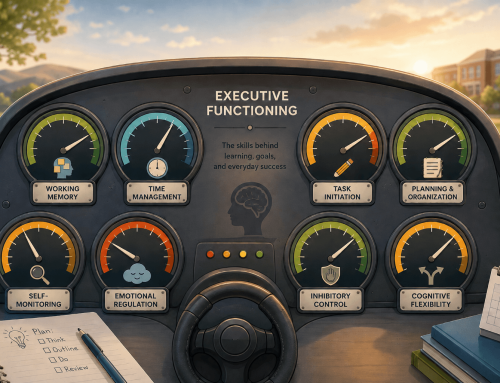
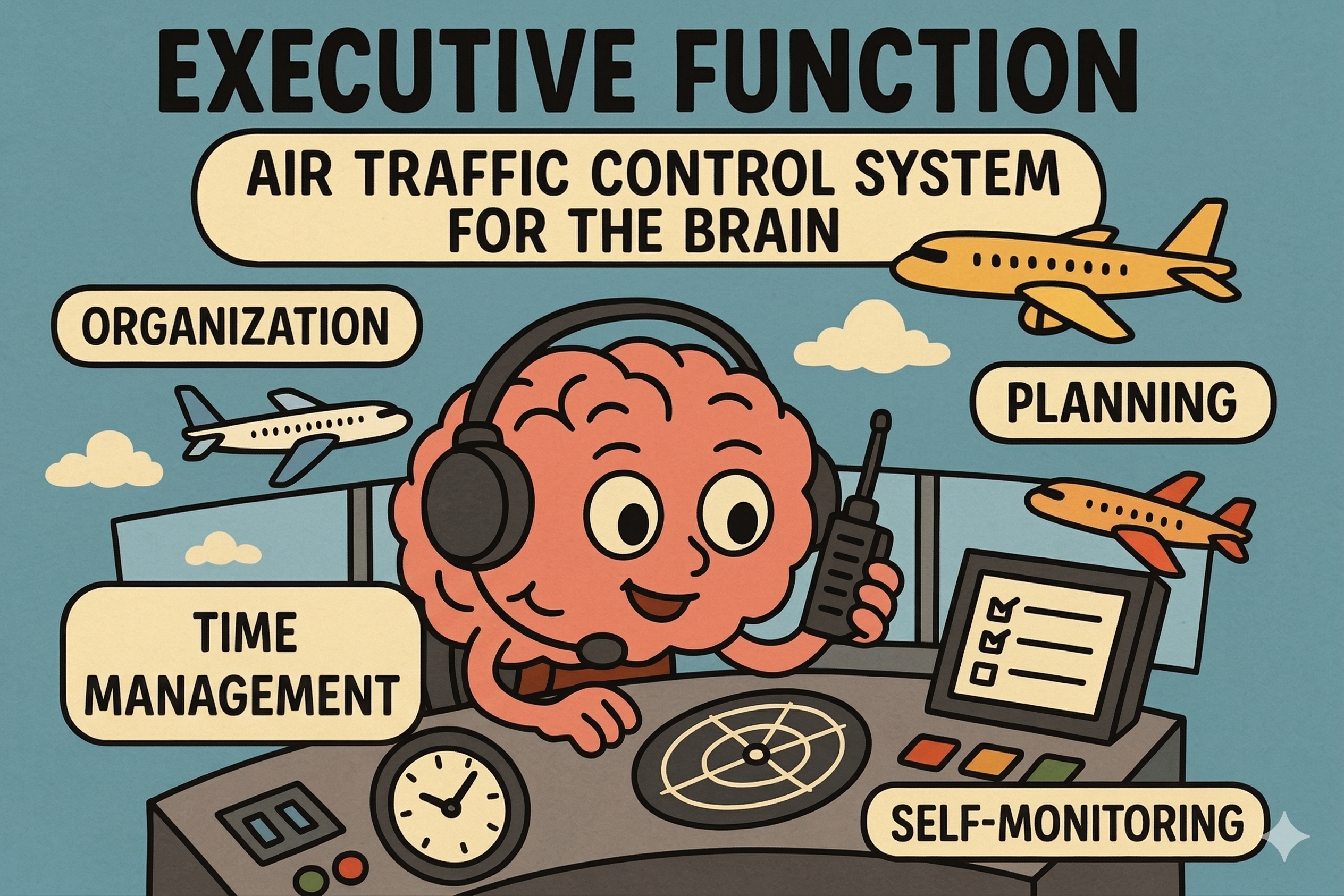
Executive functions act as the brain’s “air traffic control system,” coordinating thought processes, managing incoming information, adapting to shifting goals, and maintaining focus amid distractions. According to Harvard’s Center on the Developing Child and Brown University Health, these skills include:
- organization,
- planning,
- task-switching,
- attention regulation,
- emotional control, and
- self-monitoring
None of these skills are innate but can be developed over time, and each is vital to children growing into functioning, future executives!
Why Executive Function Matters for Students
Executive function refers to a set of mental skills that allow students to plan, focus, remember instructions, and manage multiple tasks. These include abilities like time management, organization, self-control, and task initiation.
In practical terms, executive function is what allows a student to:
- Start an assignment without procrastinating
- Keep track of deadlines across multiple classes
- Break large projects into manageable steps
- Study effectively instead of cramming
- Follow through and actually submit completed work
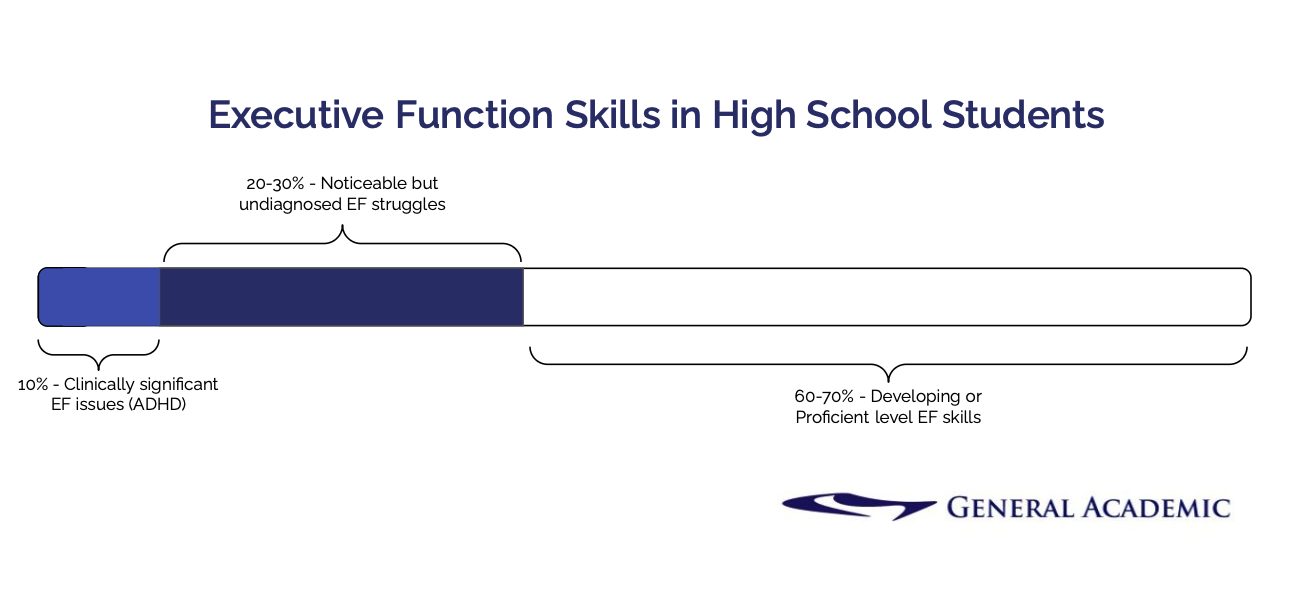
Executive function challenges are far more common than most people realize. Large-scale studies show that roughly 1 in 10 students exhibit clinically significant attention and self-regulation difficulties, such as ADHD. These students overwhelmingly struggle with executive function skills like working memory, organization, and impulse control.
But the issue extends well beyond formal diagnoses. Research suggests that a much larger portion of students—often 20–30% or more in typical classrooms—experience meaningful challenges with planning, time management, and follow-through, even if they are never formally identified.
The reason is simple: executive function skills develop slowly, often continuing into early adulthood. That means many capable, intelligent students are still learning how to manage their workload, prioritize tasks, and stay organized—without ever being explicitly taught how.
Executive Function Can Be Developed
Executive functions are not fixed—they are trainable, especially when supported by structured practice, feedback, and strategy instruction. Students can strengthen these skills over time especially when grouped into these four buckets:
- organization,
- planning,
- time management, and
- self-monitoring.
Each of these executive functions is achieved by taking certain steps to build an air-tight routine:
1. Organization
Organization involves keeping track of materials, information, and responsibilities. Disorganization often leads to lost homework, misplaced notes, or wasted study time. This is one of the more important executive functions, as it acts as the backbone to routine building in having everything aligned for completion.
Steps to Develop Organization Management Skills—
- Set up a color-coded folder system or digital filing method for each subject or standardized test.
- Implement a 5-minute daily “reset” to tidy backpacks, desks, and digital files. Small, consistent habits prevent clutter and keep resources accessible when needed.
- Learn to work around unexpected clutter. Having iron-clad organization skills prepares for mishaps and unknowns by having everything in-line.
2. Planning
Planning is the ability to set goals, outline steps, and map out how to reach them. Without it, students may dive into assignments without direction and lose track midway, or feel overwhelmed by multiple tasks in short periods of time.
Steps to Develop Planning Skills—
- Outline tasks before starting. For example, if writing an essay, begin with a bulleted plan of introduction, body points, and conclusion.
- Break large projects into smaller, manageable parts by using checklists or weekly planners.
- Set aside a certain time each week/daily to work on subjects you may be lacking in.
3. Time Management
Time management means estimating how long tasks will take, allocating time wisely, and sticking to a schedule. Students who lack these skills may procrastinate or rush, and inevitably fall behind without a routine to hold them accountable.
Steps to Develop Time Management Skills—
- Use timers or alarms for study sessions, aiming for 25–30 minutes of focused work followed by short breaks (Pomodoro method).
- Practice estimating task times, then compare to your reality, refining the sense of how long work really takes.
- Create a study schedule to adhere to weekly, and learn how to be flexible in abiding by it so you’re able to complete what you need to with changing weekly activities.
4. Self-Monitoring
Self-monitoring is the skill of checking one’s own performance and making adjustments. Students with weak self-monitoring may finish tasks without noticing errors or whether they’ve met the assignment requirements
Steps to Develop Self-Monitoring Skills—
- Encourage your student to pause before calling a task “done” and review with a checklist: “Did I follow the directions?” “Does my work meet the rubric?”
- Reading work aloud or using peer/parent review can also strengthen the habit of double-checking.
- Don’t let brain fog cut productivity: learn when to step away from an assignment and come back to it when you’re more level-headed so there isn’t any discrepancies.
How General Academic’s Services Promote Executive Function
General Academic offers two primary services that can assist students with improving their executive function skills:
- Executive Function Self-Assessment – an online 88-question test that will identify areas where students need to improve to develop strong EF skills
- Private Tutoring – students meet 1 to 1 with a tutor at home or in-office usually for one to two hours a week
- Study Lounge – students work independently for two hours with the guidance and support of a tutor at the start and as-needed
- Executive Function Summer Course – an advanced Summer Intensive focused on leadership and real-world project execution
Through both content mastery and executive function skill development, students become more resilient, proactive, and independent learners.
Executive Function Self-Assessment
We’ve developed a detailed, 88-question online assessment (takes about 20–30 minutes) that helps pinpoint exactly where a student is struggling.
The assessment evaluates eight key areas:
- Working Memory
- Inhibitory Control
- Cognitive Flexibility
- Planning and Organization
- Self-Monitoring
- Emotional Regulation
- Task Initiation
- Time Management
Instead of guessing what’s wrong (“They just need to try harder”), families walk away with a clear diagnostic profile. This allows us to target support where it will have the greatest effect.
Private Tutoring
At General Academic, Private Tutoring doesn’t just cover subject matter—it trains students in these cognitive skills behind academic success:
- Organization: Tutors guide students in tracking assignments, evaluating their progress, and adapting strategies when something isn’t working.
- Strategic Planning: Tutors help students map out study sessions, organize content, integrate note-taking, and break large tasks into manageable steps.
- Time Management: Students learn to prioritize assignments and spread study sessions ahead of deadlines rather than resorting to last-minute cramming.
- Self-Monitoring: Promoting the use of planners, calendars, and organizational applications or appliances is key to self-actualization of these functions; tutors look for results when students take on what they’ve learned and continue on their own motivation.
Study Lounge
The Study Lounge offers structure and accountability for real-time application of executive functions:
- Students engage in focused 2- or 4-hour sessions where tutors assist in setting priorities and managing progress.
- Tutors monitor, redirect, and support focus during study, intervening when distractions arise.
- After each session, parents receive a comprehensive summary highlighting accomplishments and recommended next steps.
The Study Lounge serves as a practical arena for students to apply these skills under guided practice and build productive habits:
- Organization: Study Lounge ensures a student is keeping a single assignment tracker and calendar, plus a consistent folder/binder system for papers and digital work. Every session ends with a recap of accomplishments and how to prepare for their next steps.
- Planning: A visible priority system (Must/Should/Could) keeps a student’s study plan realistic and sequenced. When students are feeling overwhelmed or stuck, tutors can help map what path to take for maximum productivity and progress.
- Time Management: Sessions use recommended work blocks with breaks, and students record estimated vs. actual minutes for each task. Tutors help oversee a student’s progress to upkeep critical deadlines and build a routine that caters to how each student learns.
- Self-Monitoring: Each session begins with concrete goals established between the student and tutors as a part of the students’ main take-away from The Study Lounge: Students learn to log errors and wins in a running “feedback loop” (what worked, what didn’t, what to change next time) to build metacognitive awareness.
Service Leadership Summer Intensive
This is where executive function meets real-world impact. In this eight-week course, students develop executive function and leadership skills as they complete a volunteer capstone project that will also be a prime entry on student resumes when applying for college.
Students will:
- Pitch and design a real-world volunteer project
- Plan timelines and manage deadlines
- Communicate professionally with stakeholders
- Execute their project from start to finish
By the end of the program, students walk away with:
- A standout college resume entry
- Practical experience in leadership and initiative
- Stronger habits in planning, follow-through, and self-advocacy
Investing in Skills That Last
Executive function is more than an academic aid—it is a lifelong competency. At General Academic, our Executive Function Coaching builds these skills alongside content mastery, while our Study Lounge nurtures their consistent application. This combination equips students not only for improved grades but for enduring organizational competence, focus, and self-directed learning.
If you’re ready to support your child in growing not just academically, but also cognitively and habitually—reach out to General Academic to explore how our services can help forge skills that last.
General Academic’s subject and test prep tutors provide the structured support to accommodate your student wherever they’re at. To get the ball rolling, give us a call at (713) 838-7774 or fill out our tutoring request form.