For more than 23 years, General Academic has guided tens of thousands of Houston families through high-stakes exams like the ISEE, SAT, and ACT. We have consistently observed that test anxiety is rarely a permanent personality trait. More often, it is a temporary, physiological response triggered by highly specific, yet very manageable factors. This article identifies those stress-inducing factors and lays out mitigation strategies that we use during tutorials and parents can further reinforce at home.
While watching a capable student “blank” on a test is frustrating, this panic usually stems from one of seven root causes:
- Fear of the unknown test format
- Inadequate preparation timelines
- Lack of deep content mastery
- Immense parental pressure
- Toxic peer comparisons
- Physiological exhaustion
- Undiagnosed learning differences.
At General Academic, we mitigate these stressors by acknowledging students’s fears while teaching strategic test-taking, enforcing structured study timelines, and building an unshakeable academic mastery. We also guide families in establishing the healthy boundaries and biological habits necessary to transform fear into focused confidence.
Based on academic research and decades of practical experience, here is a detailed breakdown of the seven primary causes of test-taking anxiety and exactly how we can solve them together.
1. Fear of the Unknown
The most immediate cause of test anxiety is the sheer unfamiliarity of standardized testing. The fast pacing, the tricky wording, and the physical endurance required look nothing like a standard classroom exam.
The Research Behind “Attentional Control Theory”
While early psychologists referred to this as the “Interference Hypothesis,” modern cognitive science explains this through Attentional Control Theory (Eysenck et al., 2007) and research into working memory depletion (Ramirez & Beilock, 2011). Their research demonstrates that unfamiliar, high-stakes environments trigger “state anxiety,” which causes the brain to co-opt its own limited working memory. Instead of using that working memory to solve a complex math problem, the brain is forced to use it to process task-irrelevant worries (“What if I fail?” or “I don’t recognize this wording”). This neurological traffic jam actively impairs the brain’s executive control, leaving the student without the cognitive capacity to retrieve the information they actually studied.
How to Mitigate Against Fear of the Unknown
To neutralize the fear of the unknown, preparation must go beyond content review to include strict test format mastery.
- Full-Length Practice Tests: We require students to take full-length, timed practice tests every 6 to 8 weeks. This systematic exposure desensitizes them to the testing environment and builds the mental endurance necessary to focus for three hours (register online)
- Strategic Pacing: We teach students exactly what the test looks like, when to guess, and how to effectively skip questions. When a student has a pre-rehearsed game plan for what to do when they inevitably get stuck, their working memory isn’t hijacked by panic, and cognitive interference is dramatically reduced.
2. Fear of Not Having Enough Time to Prepare
Students are incredibly self-aware. When they know they have procrastinated, crammed, or simply started too late, they adopt lower expectations for success. This acute awareness of their own lack of preparation generates severe anxiety leading up to test day.
The Research Behind “The Illusion of Incompetence”
Modern cognitive psychology explains this through research on Distributed Practice and Metacognitive Calibration (e.g., Dunlosky et al., 2013; Kornell & Bjork, 2009). The research shows that when students resort to “massed practice” (cramming), they experience an “illusion of competence.” Because the material is fresh in their short-term memory the night before, they falsely believe they have mastered it.
However, they haven’t given their brains the time required to encode that information into long-term memory. Under the timed pressure of the actual exam, they suddenly discover they cannot retrieve the formulas or vocabulary they thought they knew just 12 hours prior. This sudden realization of inadequate preparation triggers an immediate, severe anxiety spike.
When to Start Preparing for the ISEE, ACT, or SAT
Procrastination fuels anxiety, but starting too early leads to burnout. Establishing an optimal timeline is critical for giving students the runway they need:
SAT and ACT Timeline
The ideal time for rising high school juniors to begin preparation is the summer before their junior year (June/July). This allows them to build foundational skills without the competing pressures of mid-terms. We recommend dedicating 40 to 80 hours total to test prep over four to six months (about 3 to 4 hours per week), taking their first official test in early fall (click here to read more about the SAT and ACT prep timeline in Houston).
ISEE Timeline
For younger students applying to Houston’s competitive private schools, structured preparation should begin four to six months (summer) before their target fall or winter test dates (click here to read more about the ISEE prep timeline in Houston).
3. Fear of Not Knowing the Material
A student may memorize a formula for algebra class, but if they haven’t practiced applying it under pressure, they will instantly panic when a standardized test phrases the question differently. This lack of true mastery causes students to doubt their own intelligence, and is one of the main reason parents reach out to us in the first place!
The Research Behind “Low Academic Self-Efficacy”
Educational psychologists refer to a student’s belief in their capability to succeed as Academic Self-Efficacy, a framework pioneered by Albert Bandura (1997) and expanded upon by Schunk and Pajares (2002). When a student relies on surface-level memorization rather than deep mastery, their self-efficacy is incredibly fragile. At the first sign of a difficult or uniquely phrased question, this fragile belief shatters. The realization that they don’t truly know how to apply the material triggers a threat response, looping right back to the working memory depletion (Attentional Control Theory) we discussed in point one, creating a downward spiral of panic.
How Students Can Prove To Themselves They Can Do It
- Write it Down: Anxiety thrives in a cluttered mind. We teach students to work through multi-step math problems step-by-step on paper or a tablet. This simple habit offloads information from their working memory onto the page, preventing cognitive overload.
- Praise the Process: We focus heavily on cultivating a growth mindset. By normalizing mistakes during practice sessions, we teach students that a missed question is just data to help them improve, building true mastery and unshakeable self-efficacy.
4. The Weight of Parental Expectations
In highly competitive educational markets like Houston, parental pressure is often the elephant in the room. Most parents are incredibly well-intentioned (and our paying customer), but that desire for success can easily morph into an overbearing pressure that actively sabotages the student’s performance.
The Research Behind “Achievement by Proxy”
When parents view their child’s admission to a top private school or university as a reflection of their own successful parenting, psychologists call it Achievement by Proxy Distortion (ABPD). This exponentially raises the stakes for the student. Furthermore, research into Parental Conditional Regard (PCR) (Assor, Roth, & Deci, 2004) shows that if a student enters the testing room believing their parents’ affection, pride, or approval hinges on a 1500 SAT score, the test is no longer just an assessment—it becomes a threat to their emotional security.
How Parents Can Help (By Stepping Back)
According to Self-Determination Theory, students thrive when parents provide resources but step back to let the student take ownership.
- Decouple Identity from Achievement: Explicitly tell your child, “I am proud of you, regardless of what score you get on Saturday.” Lowering the emotional stakes frees up cognitive bandwidth.
- Outsource the Nagging: Let your General Academic tutor be the “bad guy” who enforces homework and deadlines. This preserves the parent-child relationship as a safe haven of support.
5. The Culture of Peer Comparison
Students do not exist in a vacuum. In high-achieving peer groups, the pressure to conform to an unspoken academic standard can be just as debilitating as parental expectations. This pressure is especially true in tight-knit communities where students are often of similar backgrounds and capabilities and applying to the same schools.
The Research Behind “Big Fish, Little Pond Effect”
Modern educational psychologists explain this pressure through the Big-Fish-Little-Pond Effect (BFLPE) (Marsh et al., 2008). This heavily researched framework proves that highly capable students in elite, competitive schools actually experience lower academic self-esteem and higher test anxiety than equally capable students in less competitive environments. Because they are constantly measuring themselves against other high-achievers, their internal baseline for “success” becomes dangerously skewed.
This anxiety is further exacerbated by what psychologists call Perfectionistic Self-Presentation (Hewitt et al., 2003)—casually known on campuses as “Duck Syndrome.” Driven by social media and competitive campus cultures, peers project an illusion of effortless perfection while hiding their own intense studying and struggles. When a student believes everyone else is naturally achieving 1500 SAT scores without trying (or working with a tutor), their own need to study feels like a personal, isolating failure, which sends test anxiety skyrocketing.
How We Mitigate Peer Pressure
- Demystifying the Process: We openly discuss with our students that everyone prepares for these tests. Normalizing the fact that high scores require hard work, often with the aid of a tutor, dismantles the myth of effortless perfection.
- Focusing on Personal Baselines: We train students to measure success against their own initial diagnostic scores, not against what their friends claim to be scoring.
6. The Physiological Baseline
We often treat test anxiety as a purely mental or emotional issue, but it is fundamentally a biological one. High schoolers are notoriously sleep-deprived, and parents often inadvertently allow them to stay up until 2:00 AM cramming the night before a test.
The Research Behind Test Prep Health and Wellness
In 2014, the American Academy of Pediatrics (AAP) issued a landmark policy statement declaring adolescent sleep deprivation a public health crisis, specifically citing its detrimental impact on academic achievement and emotional regulation. This is backed by comprehensive meta-analyses (e.g., Dewald et al., 2010) which prove that shortened sleep duration in K-12 students directly impairs executive function and working memory.
How We Help Students Get Fit
- The Sleep Taper: We teach students that the sleep they get two nights before the exam is just as important as the night before.
- Fueling the Brain: Mandating a protein-heavy breakfast and minimizing caffeine on the morning of the test prevents blood sugar crashes and keeps the autonomic nervous system calm.
We discuss these often overlooked biological factors on our sister website Piqosity.com.
7. Undiagnosed Learning Differences
Sometimes, a student studies incredibly hard, knows the material perfectly during tutoring sessions, but consistently bombs the timed test. Everyone assumes it is just “severe anxiety,” but the anxiety is actually a symptom of a hidden structural hurdle.
The Research Behind “The Secondary Symptom”
Research into neurodiversity and testing (e.g., Nelson & Harwood, 2011; Gregg et al., 2005) indicates that what appears to be severe test anxiety is frequently a secondary symptom of an unaccommodated learning difference (such as ADHD, dyslexia, or slow processing speed). If a student physically reads slower than their peers or struggles with executive function, their anxiety isn’t irrational—it is a completely logical response to being forced to perform in an environment that does not accommodate their neurobiology.
How Help Students with Learning Differences
- Recognizing the Signs: Our tutors are trained to look for discrepancies between a student’s untimed knowledge and timed performance.
- Pursuing Accommodations: When appropriate, we guide parents through the process of pursuing a formal psychoeducational evaluation. If a student qualifies for extended time or a distraction-free room through the College Board or ERB, the “anxiety” often vanishes overnight because the playing field has finally been leveled.
General Academic’s Track Record of Success
We don’t just hope for the best; we rely on this data-driven preparation to help students conquer their anxiety and reach their potential. When students are properly supported with the right strategies, sufficient time, and healthy boundaries, the results speak for themselves.
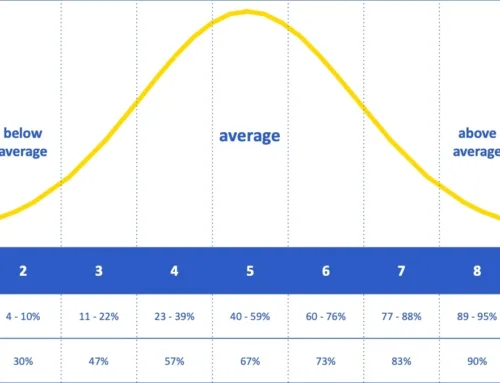
During the recent 2025–2026 fall testing cycle, around 400 Houston-area students prepared for their private school admissions tests with us. On average, our students improved their ISEE scores by 2.11 stanines, representing an impressive 31.5 percentile ranking jump. For college admissions, our targeted approach yields equally consistent, predictable improvements:
- SAT: Students generally expect about a 40-point improvement for every 7 hours of dedicated, high-quality preparation.
- ACT: Students generally expect about a 1-point improvement for every 7 hours of preparation.
Test anxiety is a very real hurdle, but it is deeply understood and highly solvable. By starting on an appropriate timeline, building true mastery, and fostering a supportive environment at home and in the classroom, your student can walk into test day feeling prepared, capable, and calm.
Key Takeaways to Reduce Student Test-Taking Anxiety
- Format Familiarity—take timed, full-length practice tests to remove the fear of the unknown and prevent test-day cognitive overload (register now).
- Structured Timeline—Begin prep early (e.g., the summer before junior year for the SAT, ACT, and ISEE) to avoid the severe panic caused by cramming.
- Deep Mastery Over Memorization—Work through problems step-by-step to build true academic self-efficacy and prevent “blanking.”
- Parental Boundaries—Parents should decouple their child’s self-worth from their scores and outsource the nagging to tutors to reduce emotional pressure.
- Ignore Peer Pressure—Measure progress against the student’s own initial diagnostic baseline rather than comparing scores to classmates.
- Prioritize Physiology—Enforce a strict “sleep taper” starting two nights before the exam, minimize caffeine to keep the body’s fight-or-flight response in check, and eat a nutritious breakfast.
- Consider Accommodations—If chronic timed testing issues persist despite adequate preparation, explore a formal evaluation for learning differences to level the playing field.
Read More About Test Prep from General Academic
- ISEE Tutoring and Test Prep Courses
- SAT Tutoring and Test Prep Courses
- ACT Tutoring and Test Prep Courses