For Houston students applying to highly competitive private schools—such as Awty, Kinkaid, and St. John’s—the ISEE admissions test is a high-stakes gatekeeper. We surveyed 134 rising 5th and 8th graders before and after they completed General Academic’s ISEE prep courses in summer of 2026. Approximately 81% of students understood the stakes of the assignment: they recognized they needed a top-tier stanine score (in the 7 to 9 range) to be competitive for their first-choice schools.
Yet, the survey results show high ambitions are often matched by high anxiety. Before beginning formal preparation, about 41% of our incoming students rated their confidence on the Quantitative Reasoning section (often considered the harder of the two math sections) as only a 1 0r 2 out of 5. This number was even greater for when it came to the Verbal Reasoning (or vocabulary) section of the test, where 47% of students reported feeling not confident in their abilites.
Preparing for this notoriously difficult exam is daunting, and relying on generic study habits is rarely enough to secure top percentile ranks.
At General Academic, we rely on targeted, data-driven instruction to turn that initial intimidation into measurable confidence, and the ISEE post course survey results validate our methodology. Following our recent prep courses, the post-course survey results revealed massive leaps in test readiness. Students rated their new mastery of crucial ISEE test-taking strategies an impressive 4.25 out of 5, and their understanding of the test’s strict timeline and structure a 4.43 out of 5.
Beyond test strategy, students reported tangible academic growth, rating their vocabulary and math skill improvements at 4.22 and 4.05 out of 5, respectively. Backed by expert instructors who earned a near-perfect 4.81 out of 5 for their knowledgeability, our courses systematically dismantle test anxiety and equip students with the exact tools they need to achieve their target scores.
These qualitative survey results are further backed up by our quantitative analysis of actual ISEE score improvement for the 2025-2026 cycle. In that analysis we found that our nearly 400 ISEE students improved by an average of 2.1 stanines.
Note that while we’re thrilled that students take their ISEE prep seriously, we also want to make sure they’re not overly stressed out about it. Click here to learn about the causes of and strategies for mitigating test anxiety.
Five Major Take-Aways from the Summer 2026 ISEE Course Survey Results
- Students understand the stakes and are motivated to succeed
Nearly 68% of students began the course highly motivated to do well, and more than 80% believed they needed a stanine score of 7, 8, or 9 to be competitive at their top-choice schools. - Verbal and Quantitative Reasoning create the biggest confidence gaps
Before the course, 47% of students reported low confidence in Verbal Reasoning and 41% reported low confidence in Quantitative Reasoning, making these the two sections where students felt least prepared. - Vocabulary and math show the strongest academic improvement
After the course, about 82% of students reported significant improvement in vocabulary and 75% reported significant improvement in math, the two strongest areas of reported academic growth. - Test strategy and timing matter just as much as content knowledge
About 90% of students reported major gains in understanding the ISEE’s timeline and structure, while more than 81% reported significant improvement in their test-taking strategies. - Students leave the course with a clearer plan for continued preparation
More than 86% of students reported that the course substantially improved their understanding of how to continue preparing for the ISEE, helping turn motivation into a more focused study plan.
Before ISEE Test Prep Begins: Students Start With Motivation—but Also Uncertainty
Unlike end-of-course standardized tests in public schools like the STAAR exam, which are used only as a metric for districts and schools to gauge student progress and have very little direct bearing on students, the results of the ISEE exam directly impact students’ lives. How they score plays a big part of where they go to school for the next three, four, or even seven years.
It’s unsurprising then that about 67% of students report being highly motivated to do well on the ISEE–most rated their motivation as a 4 or a 5 out of 5. An additional 25% of students rated their motivation as a 3 out of 5, or moderately motivated. These results tell us that students are aware of how important this test is. This is great for parents and tutors since it means that students are willing to study and put in the work, but how to channel this motivation is not always clear.
Overall, students report struggling with creating clear study plans, understanding the test format, and confidence in their ability to perform well. Motivation is great, but without structure and guidance it won’t result in higher scores.
What Sections of the ISEE Students Fear the Most
In order to actually raise students’ scores, it’s important to understand the areas where they have the least confidence. Regardless of actual skill in these areas, a perceived ineptitude will often cause students to score lower on certain sections. Raising a student’s confidence in their own ability and ensuring that they trust themselves to do well can have a big positive impact on scores.
Student Confidence in Sections of the ISEE Test
| Verbal Reasoning | Quantitative Reasoning | Reading Comprehension | Mathematics Achievement | Essay | |
| Average Student Confidence Score (1-5) | 2.68 | 2.84 | 3.39 | 3.19 | 3.41 |
Based on General Academic’s survey, the content areas that students are most concerned about before they begin preparation for the ISEE, in order, are:
- The Verbal Reasoning (vocabulary) – 47% of students cited this as an area of concern
- The Quantitative Reasoning – 41% of students cited this as an area of concern
- The Mathematics Achievement – 32% of students cited this as an area of concern
- Essay – 21% of students cited this as an area of concern
- Reading Comprehension – 18% of students cited this as an area of concern
Math Sections of the ISEE
Although the Verbal Reasoning section is the one that students are most concerned about individually, overall they’re more worried about the math sections than the English sections.
- Quantitative Reasoning – students tend to be concerned by the logical nature of these questions. They are not always formatted in ways that students are used to seeing in their school math classes.
- Mathematical Achievement – this section is more reminiscent of math that students might see in school, but asks students to perform some higher-level math operations that they might not be familiar with.
Students expressed concern about things as diverse as remembering formulas, missing easy questions, as well as running into math that they don’t recognize. Some of these fears are clearly based on confidence concerns–not remembering formulas that students know and missing easy questions are things that happen, but perhaps not as much as students believe. Confidence in their own abilities is vital to students performing well on the math sections.
The good news is that math skills are some of the easiest to improve through practice. After students took a course studying for the ISEE, about 75% of them reported a significant improvement in their math skills. This means that when they sit down on test day, they won’t be hamstrung by test anxiety and a lack of confidence in their own abilities.
Verbal Reasoning Section of the ISEE and Vocabulary
Overall, the section of the ISEE test that students are most concerned about is Verbal Reasoning, which is largely known as the vocabulary section.
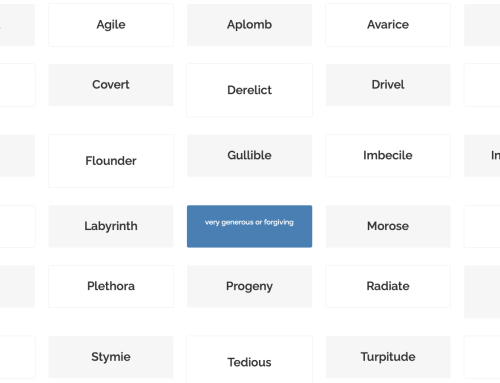
Traditionally, improving students’ vocabulary skills is a tall order and one that requires a lot of outside work on the students’ part. Unlike math, where the same skills are tested year after year, there is a nearly infinite number of vocabulary words that students might encounter. This means that even if a student memorized a thousand vocabulary words, there is no guarantee that one of those words will appear on their test.
That being said, there are things that can be taught to help students on the Verbal Reasoning section, especially in terms of coming up with plausible meanings of unfamiliar words. Students can learn about Greek and Latin root words, prefixes and suffixes, and word connotations.
Students with a strong understanding of these skills can help boost their confidence in this section of the test, even without them memorizing a million words that might, at the end of the day, be a wasted effort. 82% of students reported a significant improvement in their vocabulary skills–an even greater proportion than we saw in math!
Student Concerns about the ISEE Test Beyond Its Content
Students’ fears extend beyond the content of the test, however. Many students are also concerned about the test itself.
Earning Good ISEE Scores
By far, the concern most commonly mentioned by students is that they won’t score high enough on the ISEE to get into their first choice school. This fear is compounded by students’ understanding of what constitutes a “good” score on the ISEE.
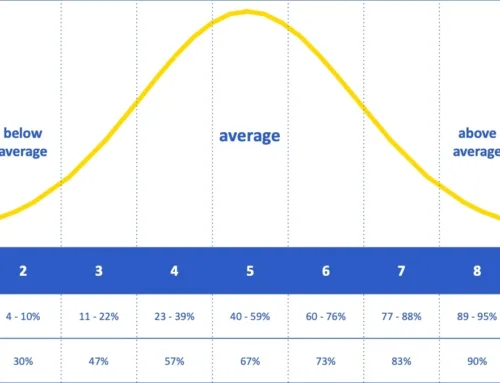
Our survey revealed that many students, about 56%, believe that they need to score within the 8th or 9th stanine on each section in order to be competitive for top schools. While higher scores are always better, General Academic recommends that students aim for an average of 7 across all their test sections.
When students understand that missing a few questions on each section is not the end of the world, they tend to be much more confident on test day. Mistakes happen–no one is perfect–but a fear of making mistakes is potentially even worse for test performance. It’s important for tutors and parents to stress this to students; a “top” score does not necessarily equate to a “perfect” score.
Time Management on the ISEE
Students also cite consistent concerns about time management on the ISEE exam. This is not an unfounded fear; the ISEE is intentionally designed to make it difficult to complete all the questions of each section in the time allotted. On the Upper Level ISEE, the time per question on each section is:
- Verbal Reasoning: 30 seconds/question
- Quantitative Reasoning: 57 seconds/question
- Reading Comprehension: 58 seconds/question (~6 minutes per passage)
- Mathematics Achievement: 51 seconds/question
Clearly, students are expected to move through questions quickly (compare this to tests like the ACT and SAT where students are typically given between 60-90 seconds per question).
Initially, these numbers might seem to indicate an almost impossibly fast pace to students. This is where strong test-taking strategies come in handy. In their preparation, students learned time management skills like banking time on easy questions, skipping ones that seem like too much of a time investment, and selecting answers for ALL questions, even ones that they don’t have time to complete. With these tools in their test-taking toolboxes, students can feel much more confident on test day.
Similarly, students will feel much more comfortable when they actually take the test if they have a strong understanding of how much time they have on each section, as well as a feeling for the kind of pace they must maintain in order to reach the end. This is the kind of confidence that only comes through practice. At General Academic, we prioritize real-test practice, that is, having students complete practice sections to time, as they would on their actual tests. This way, they can get a sense of how quickly they must work.
Remember, knowing the content is only half the battle; a student isn’t fully prepared for the ISEE test unless they’re familiar with the format and the timing.
The Role of Test Taking Strategy in ISEE Prep
One of the strongest post-course findings was improvement in test strategy knowledge. 90% of students reported significant improvement to their understanding of the timeline and structure of the ISEE. 81% of students reported that they felt much stronger in test taking strategies than before they began the course.
These students can now go into test day feeling far more prepared and confident in their ability to perform to the best of their ability. Having a strong framework in understanding the format of the test and test taking strategies will help minimize test anxiety and result in overall higher scores.
The Importance of Practice
Another clear finding from the survey results is that students fully understand the importance of consistent practice.
Sstudents were asked how much time per week they planned to dedicate to independent ISEE practice after the end of the course, and 79% of students reported that they planned to spend between 1-4 hours studying a week. While this number doesn’t account for how many actually followed through on this goal, the fact that so many are aware of the importance of practice is a good sign.
Final Take-Aways
Based on the survey results, several patterns emerge.
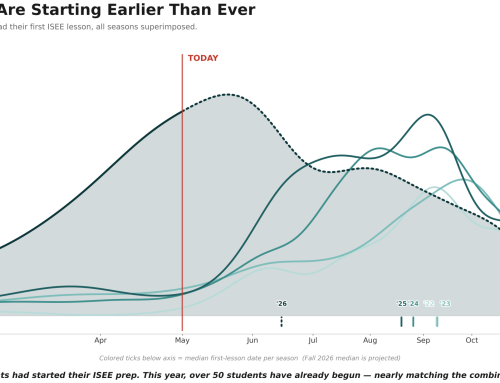
- Start preparation earlier than you think: Students need time to build: vocabulary, math foundations, and familiarity with the test.
- Build a consistent weekly study routine: Students who plan regular practice improve more efficiently.
- Address anxiety through clarity: Much of the stress comes from not knowing what to expect.