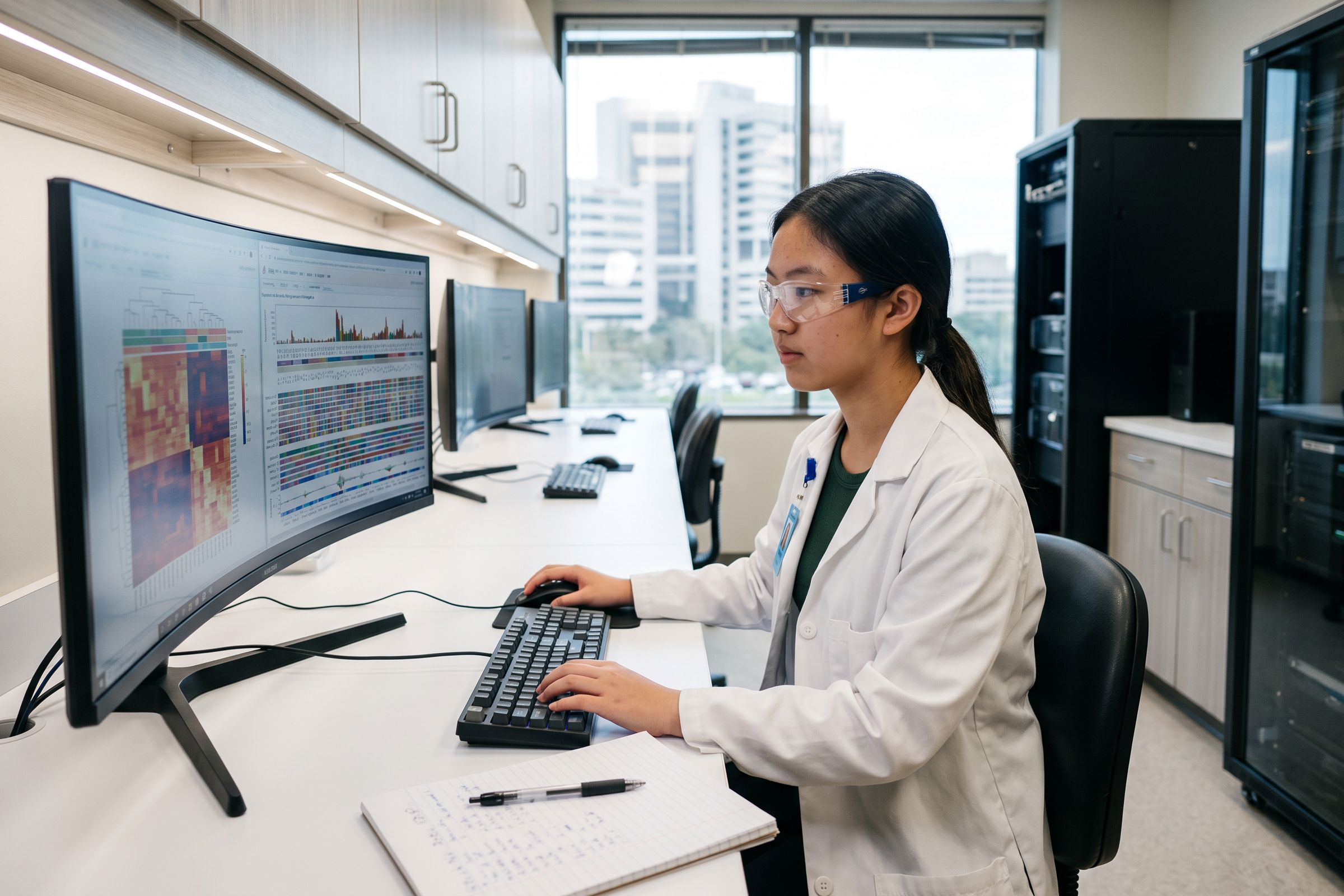
Many Houston-area high school students hope to find themselves amongst the ivy and gothic-adjacent architecture of an elite university. However, traditional formulae for college admissions are often no longer enough. A stratospheric GPA, near-perfect standardized test scores, and laundry list of general extracurriculars are necessary, but insufficient.
Admission decisions at top-tier institutions are increasingly rewarding “spikes.” In the words of Stanford’s undergraduate admissions, “an exceptional depth of experience in one or two activities may demonstrate your passion more than minimal participation in five or six clubs.”
For pre-med and biomedical aspirants, there is perhaps no greater spike than seriously dipping one’s toe in faculty-mentored clinical or laboratory research. Fortunately, Houston-area high schoolers have a distinct geographic leg-up: proximity to the largest medical complex in the world (Texas Medical Center (TMC)).
With 61 affiliated institutions and billions in annual research funding, Houston’s TMC is a world leader in biomedical innovation and scientific research. However, securing an internship in a prestigious lab is notoriously hazy, highly competitive, and strictly regulated. Understanding institutional compliance, traversing application cycles, and managing lab dynamics requires strategic planning.
This multi-part guide shows how Houston high schoolers can replace pay-to-play college summer camps with more prestigious TMC internships.
The “Spike” & The Importance of Longitudinal Commitment
Every year, highly competitive families spend thousands of dollars sending their children to university-based, pre-college summer enrichment programs. While these opportunities are flashy, many elite admissions committees increasingly view these “opportunities” as “pay-to-play” revenue generators that carry less resumé weight than their cost.
A summer lab assistantship at Houston Methodist or MD Anderson, for example, is different; these opportunities are merit-based. Nonetheless, a single isolated summer experience rarely moves the needle at top-tier universities. Admissions officers evaluate thousands of applications with impressive one-off summer camps or singular experiences.
Even the most oblivious admission counselor can spot the difference between a transactional “resume padder” and a curious student with authentic, longitudinal commitment. What differentiates a big envelope from a skinny letter is the ability to craft a narrative arc of interest and commitment. Stories are convincing; bullet points are easily missed. Here is an example narrative arc:
- Groundwork (Grades 9–10): Long before stepping into a lab, a student demonstrates interest through rigorous coursework, STEM clubs (e.g., Science Olympiad, HOSA), or learned technical skills like Python, R, or biostatistics.
- Heft (Summer after Grade 10 or 11): Student takes up a research post at the TMC, gathering raw data, learning specialized protocols, and building a rapport with a faculty mentor.
- Downstream (Grades 11–12): This is where elite candidates differentiate themselves. Instead of closing the door in August, the student extends their research throughout the academic year. They might enter their findings into major science competitions (such as the Regeneron Science Talent Search), submit for publication to student-focused peer-reviewed journals, continue working as a remote data analyst for the lab, or inquire about opportunities to remain with the lab.
When an admissions team sees a student who spent 10th grade learning computational tools, 11th grade wearing a lab coat, and 12th grade publishing findings, one single summer transforms into demonstrable proof of sustained intellectual commitment. It also shows a student who is curious and committed.
Timeline to Securing a Texas Medical Center (TMC) Internship
Securing a Texas Medical Center internship is a multi-year campaign. If a student is aiming to leverage medical research for college admissions, here is the timeline to follow:
- Grades 9–10: Focus on maximizing rigor in math and science. Crucially, this is the time to self-teach or take courses in coding (Python/R) and data analysis. These are the “friction reduction” skills that will get them hired by a lab later.
- October (Junior Year): Begin researching formal programs and curating a list of 15–20 independent Principal Investigators (PIs) at TMC institutions. Begin reading academic papers.
- November (Junior Year): Finalize resumes. Ensure all basic certifications (like basic CPR or online HIPAA modules, if accessible) are completed.
- December (Junior Year): Formal applications for Houston Methodist, UTHealth, and BCM open. Submit applications immediately. For the independent route, begin sending Cold Emails Batch 1 to PIs.
- January / February (Junior Year): Formal program deadlines close. Send Cold Emails Batch 2 to PIs who did not respond in December.
- March/April (Junior Year): Acceptance notifications are released. If accepted via the independent route, immediately begin the badging, background check, and HR compliance process with the hospital.
- June – August (Summer before Senior Year): Internship/program participation dates. The student must focus on making their supervising post-doc’s life easier.
- Senior Year (Downstream): Return to high school and leverage their summer experience to enter the regional Science & Engineering Fair, write a secondary research paper, or continue assisting the lab remotely.
Formal TMC High School Summer Programs 2027
The most straightforward way to secure a lab position is through formal, institution-sponsored summer programs. Because they are prestigious and structured, they are also incredibly competitive, often boasting acceptance rates lower than the Ivy League.
Here is a breakdown of some premier, formal programs available to high school students at the TMC:
1. Houston Methodist Hospital
Summer High School Research Internship
- Who: Current high school juniors and seniors. Students must be at least 16 years old by the start date and hold a minimum 3.5 GPA.
- When: Immersive, 8-week (June 7 – August 6, 2027), full-time (8:30AM–5:00PM) commitment. Internships are held at the main Houston Methodist Hospital in the Texas Medical Center (6565 Fannin St., Houston, TX 77030).
- What: Students are matched with faculty mentors across various departments, including oncology, cardiovascular sciences, and nanomedicine. Students conduct active experiments, analyze data, and present their findings at a symposium at the summer’s end.
- Pay: Participants are usually paid hourly depending on the matched program and student’s application.
- How: Applications open December 4, 2026 and close January 29, 2027.
General Academic Says: Probably the best-structured, formal program currently active.
2. UT Health Houston (McGovern Medical School)
Children’s Heart Institute (CiCHD) Summer Institute for 3d Bioprinting & Organ Biomanufacturing
- Who: Currently enrolled high school students in grades 9–12 with strong academic records and clear interests in science, engineering, or medicine. NOTE: Students under 16 are ONLY eligible to participate virtually.
- When: June 15–July 20, 2027
- What: Hybrid program structure – 2 weeks online (virtual lectures, journal clubs, and team-based projects), 2 weeks on site at UTHealth Houston (lab demos, 3D bioprinting and cardiovascular tissue engineering workshops, etc.).
- Cost/Pay: NA
- How: Applications are due January 22, 2027.
General Academic Says: With just 12 students admitted to the on-site Phase II program and no fee, this is an excellent program for highly qualified candidates.
Biochemistry & Molecular Biology (BMB) High School Summer Program
- Who: Current high school students at least 16 years old on/before June 7, 2027. Ideal candidates are students with a strong interest in biomedical science or medical careers.
- When: Immersive, 4-week (June 7–July 2, 2027).
- What: Participants will participate in research projects alongside faculty/student mentors in a range of labs, learn laboratory techniques, and cultivate scientific knowledge all the while networking with experts and participating in seminars.
- Cost: $4,000 out-of-pocket
- How: Applications are due January 15, 2027.
General Academic Says: Unfortunately, the hefty fee decreases the prestige of this program and places it in a similar category to college summer camps.
3. Baylor College of Medicine (BCM)
Saturday Morning Science (SMS) Career Development Program
- Who: Open to STEM-Interested 7–12th graders open to being matched with a faculty research mentor.
- When: The program lasts for 1-year with staggered start/end dates (Fall, Spring, Summer cohorts)
- What: Mentors/mentees will meet virtually at least four times per year. Program pairs participants with Baylor College of Medicine faculty, staff, and trainees in order to aid students with achieving their educational and career goals. Participation in this program is a prerequisite for other BCM high school research opportunities.
- Cost/Pay: NA
- How: There are 3 cohorts with corresponding application windows. Spring: applications accepted January 1–31st, mentors notified on February 28th; Summer: applications accepted May 1–31, matches notified June 30; Fall: applications accepted August 1–31, matches notified September 30.
General Academic Says: This is a virtual mentorship program that acts as a gatekeeper to the BCM’s in-person research program.
SMS In-person Summer Research Program
- Who: BCM requires students to be 18 by program start date and have previously participated in Saturday Morning Science. Participants must also have a US Social Security card or U.S. Permanent Resident Card.
- When: TBD
- What: An 8-week, full-time (~40 hours/week), Monday–Friday research placement. Daily clock-in/clock-out times are determined by faculty mentors.
- Cost/Pay: NA
- How: TBD (last year applications were due in mid-April)
General Academic Says: The program is in its infancy, and the 18 y/o age requirement is restrictive.
Informal, Independent PI Sponsorships at the TMC
Formal programs, like those in Houston’s TMC, are frequently managed by strict age cutoffs (ex. MD Anderson’s slate of opportunities). They also have near baseball score acceptance rates. However, this isn’t cause for despair. Many Houston-area students successfully leverage an entirely different strategy: Independent PI Sponsorship. High school students can legally work in many TMC labs outside of formal summer programs, with a caveat: if a Principal Investigator (PI) directly sponsors them as a volunteer or guest researcher.
To secure a volunteer opportunity, students and parents must understand an unspoken truth of medical and biomedical labs. Few to no one wants to nanny a high school student. There are many talented, hard-working individuals around Space City for that very job. Scientific researchers aren’t babysitters, at least not in their labs! PIs, post-docs, and lab managers are frequently under immense pressure to publish papers, secure increasingly scarce grant funding, and manage clinical loads. On paper, bringing a 16-year-old on board who requires safety clearances and basic orientations isn’t a boon to productivity. That said, many researchers are open to accepting high schoolers anyway. There are a few practical reasons for this:
- Grant Requirements (“Broader Impacts”): Major funding sources like the NIH and NSF frequently either require (or look fondly upon) PIs who demonstrate outreach (educational, community, etc.). Sponsoring high school students checks many of these boxes.
- CV Building (especially for post-docs and early career researchers): PIs rarely mentor high schoolers directly; they often delegate them down the chain of command to post-doctoral fellows and early career scholars. For a post-doc aiming for a tenure-track faculty position, supervising a student provides documented mentorship experience.
- Free Computational Labor: Labs are brimming with tedium. There are more than a grocery cart of tasks that full-time researchers hate doing—tidying messy spreadsheets, labeling medical images for machine learning, running literature searches, organizing inventory. A sharp high schooler who does this reliably for zero pay is a genuine asset.
How to pitch yourself for PI Sponsorship
A good pitch won’t necessarily land a research post. A bad one will, almost invariably, guarantee you won’t get the opportunity. A student sending a generic email saying, “I want to cure cancer, can I work in your lab to learn?” will be ignored. PIs hear that as, “I am going to frustratingly waste 5 hours of your week.” Additionally, practically everyone wants to cure cancer; merely having the desire doesn’t in any manner indicate dedication, discipline, or potential to do so.
To stand out, students must pitch what they can offer and how they can help, not just what they want to learn. Once again, there is good news! There is a process.
Step 1: Read the Literature: Identify 15–20 PIs whose research aligns with student’s specific interests. Students should read their recent abstracts and publications. NOTE: Given these are often technical and written for specialists students shouldn’t feel entitled to critique or offer ways to improve research. In other words, be careful to not get ahead of one’s skis.
Step 2: The Cold Email: The student (not the parent) must initiate contact, directly outlining their concrete skills.
The Cold Email Template:
Subject: High School Student Inquiry: Data Analysis / Assisting in Your [Specific Topic] Research
Dear Dr. [Last Name],
My name is [Name], and I am a [Junior/Senior] at [High School] in Houston. I have been following your lab’s recent work on [specific topic], and I was particularly fascinated by your findings regarding [insert one specific, intelligent takeaway from their research].
I am reaching out to inquire if you have any need for a high school research assistant in your lab for the upcoming [Spring/Summer] semester. I understand that running a lab is incredibly demanding, and my goal is to save your team time by assisting with data entry, literature reviews, statistical sorting, or routine computational tasks.
I currently maintain a [GPA] and have completed coursework in [AP Biology, AP Statistics]. Additionally, I am highly proficient in [Python / R / Advanced Excel / Specific Skill], which I believe could be useful for organizing your upcoming datasets.
I have attached my resume for your convenience. Would you or a member of your post-doc team have 10 minutes for a brief phone call next week to discuss any potential opportunities?
Sincerely,
[Student Name]
If a PI agrees, the student must then navigate the hospital’s HR department for a guest badge, which can take 4 to 8 weeks.
The “Wet Lab” vs. “Dry Lab” Reality – Compliance, Logistics, and Like
Students and parents must be realistic about what high school medical research entails. Due to strict age restrictions and biohazard compliance, many high schoolers will not be permitted to handle human tissue samples, blood, or dangerous chemicals (a “wet lab” environment). Nor should they be! Instead, students will be placed in “dry labs,” conducting computational biology, running statistical models, organizing clinical trial data, or conducting massive literature reviews.
Parents should not be disappointed by this. In the age of bioinformatics and AI, computational research is just as impressive to college admissions boards as wet lab experience.
Strict Medical Compliance: Before stepping foot in the TMC, a student must clear rigorous health checks, including up-to-date immunizations, TB tests, background checks, drug screenings, and extensive online HIPAA and laboratory safety training modules.
Professional Commitment: TMC labs expect near-professional-level commitment. While they shouldn’t expect someone to be more than a high school student, they will be expecting one to be their best and most available self. If a student attempts to balance a TMC internship with a two-week family jaunt to Europe alongside daily sports practices, they will quickly frustrate their PI. To earn a high-tier letter of recommendation, the research must be the primary priority of the summer. Remember, these opportunities are spikes!
Nothing Worth Doing Was Ever Easy
Securing a research internship at the TMC involves a dash of fortune; importantly, it involves more parts of early preparation, concrete skill-building, and professional execution. Students who succeed in these spaces are those who view the process not as just another high school extracurricular, but as their first step into the adult professional scientific community.
When executed correctly, a multi-year commitment to clinical research provides the makings of a compelling personal statement, secures elite letters of recommendation, and proves to top-tier universities that applicants are hedgehogs uniquely prepared for the rigors of world-class academia.
Need help navigating the process? At General Academic, we specialize in helping high-achieving Houston families build distinct, highly competitive academic profiles. From curating targeted PI outreach lists and polishing cold emails to framing the final research experience into an Ivy League-caliber longitudinal application strategy, our advisors provide the insider guidance necessary to stand out.
Contact our academic advisory team today to begin mapping your student’s timeline for the upcoming application cycles.
Learn More about College Admissions from General Academic
- Is Auto-Admission Good Enough? A closer look at UT-Austin and A&M Admissions
- College Application Timeline for Texas Students
- Automatic Admission at Texas Colleges for 2026–27
Frequently Asked Questions about TMC Internships
- Can 14- or 15-year-olds get research internships at the TMC?
Not generally. It is incredibly difficult for students under 16 to secure hospital-based positions due to strict liability, HIPAA, and biohazard regulations. If a student is 14 or 15, they are in “Phase 1: Groundwork” of their longitudinal commitment. They should spend their summers participating in programs like The Health Museum’s Global Teen Medical Summit, learning computational data languages (Python, R), lounging by the pool, mastering advanced Excel, or competing in regional science fairs. Starting to build concrete skills at 14 is exactly what will make a PI more likely hire them once they’re driving age. - Are TMC high school research internships paid?
Generally, no. Most high school research positions—especially those secured via independent PI sponsorship—are entirely volunteer. A few even require some out-of-pocket expense. High-achieving families should view the experience, mentorship, potential publication credits, and the eventual letter of recommendation as compensation. - Does a “dry lab” (computational) position look as impressive as a “wet lab” position to elite colleges?
Yes, in contemporary biomedical research, bioinformatics, data science, and computational modeling are the frontiers. If you spend a summer using machine learning to analyze thousands of MRI scans in a dry lab, elite university admissions committees (especially engineering and computer science departments) will view that just as highly—maybe even higher—than running routine gel electrophoresis. - What if I cold-email 20 Principal Investigators and no one responds?
Do not be discouraged; low response rates are the reality of cold outreach. First, double-check your pitch: Are you asking for a favor, or are you offering a concrete skill (like data cleaning or literature organization) that potentially reduces their workload? Second, expand your list. If TMC hospital labs are unresponsive, pivot to academic research labs at nearby universities like Rice or the UH; they often have slightly less restrictive age and badging requirements than clinical hospitals. - Can my student balance a TMC lab internship with sports or family vacation?
They could, but probably not well. Attempting to do everything usually results in doing nothing to the best of one’s ability. A lab position is effectively a full-time professional commitment (often 30–40 hours a week). If a student is constantly leaving the lab early for sports practice or missing weeks for family vacation, the supervising post-doc will not trust them with meaningful work, and resulting letters of recommendation will be mediocre. To build a genuine “spike,” families must be willing to prioritize the lab experience over generalist activities for that specific summer.
Did we leave out your Texas Medical Center summer program for high school students? Please let us know.