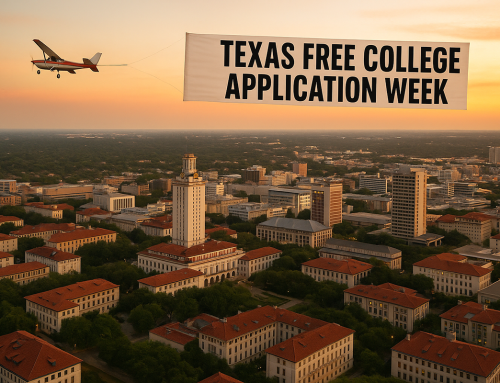
Applications for Fall 2027 entry open August 1, and UT Austin’s auto-admit cutoff for this cycle is top 5%.
If you’re the parent of a rising senior in Houston, the phrase “automatic admission” is probably doing a lot of comforting work right now. It sounds like a finish line. It isn’t, quite.
Texas Education Code (TEC) 51.803 requires every Texas public university to admit students who graduate in the top 10% of their class, and UT Austin runs a tighter cutoff of top 5% this cycle, per Texas Education Agency (TEA) correspondence dated December 18, 2025.
Here is what the statute doesn’t cover: automatic admission gets your student into the university, not necessarily into your student’s desired program. Majors like computer science, business, or engineering have lower admissions rates compared to the average university acceptance rate at schools like UT Austin or Texas A&M.
Since the end-of-junior-year rank that decides auto-admit status is already locked in for seniors applying to university, the question during application season isn’t “will they get in?” It’s “what should they prepare for?”
What does automatic admission actually guarantee?
A seat, by statute, is guaranteed under three conditions: (1) apply by the university’s deadline, (2) complete the Distinguished Level of Achievement (DLA) curriculum, and (3) graduate within the two school years before entry.
The catch sits in UT’s own catalog: automatic admission “does not guarantee admission to an applicant’s requested major”. Texas A&M is just as direct about engineering: every applicant, top-10% included, is reviewed for placement into General Engineering, not a specific discipline.
Even the percentage varies. State law lets UT cap auto-admits at 75% of its resident freshman seats, which is why its threshold floats lower while every other Texas public stays at 10%. Application volume keeps pushing it down: roughly 73,000 applications for fall 2024, up from 51,000 in 2017. Claiming the exemption takes paperwork, too. UT wants an explicit rank and class size on file by December 10. None of that paperwork touches the harder question of what happens after the seat is secured.
Why might an auto-admitted student still miss their major?
Because the major is a separate competition, and the two flagships hold it in different places.
UT decides at the front door. Every applicant goes through holistic review for major placement, which openly weighs how competitive the chosen major is, and UT’s reinstated SAT/ACT requirement feeds the same decision: scores help match applicants to majors. The first-choice box does heavy lifting; second-choice consideration exists only for auto-admits. McCombs reported a 9% acceptance rate for its Bachelor of Business Administration program in 2025. Nine percent, including the applicants that the state already promised a seat. Cockrell engineering adds a calculus-readiness requirement due with the December 1 application, and its backup plan is constrained: the second-choice major must come from outside engineering.
A&M decides after freshman year. All engineering admits start in General Engineering on a common curriculum and compete for a discipline through Entry to a Major (ETAM). The published requirements are exact: a 3.75 college GPA earns automatic entry to the first-choice major; below that, placement runs on capacity across three attempts, and students still unplaced after their fourth semester are dismissed from General Engineering.
Different mechanisms, same lesson: admission was never the real contest. The major is. Which naturally suggests a workaround every family thinks of next.
Can’t they just transfer into the major once they’re on campus?
Don’t build the plan on it. UT caps internal transfer attempts at two per limited-space college and cuts them off after 60 in-residence hours. McCombs posts a 3.25 minimum GPA that understates reality: fall 2025 admitted internal transfers averaged 3.89. Computer science runs through one space-available window a year, and meeting every minimum still doesn’t assure admission. At A&M, “transfer later” is the ETAM, with its 3.75 line and four-semester clock.
The back door is narrower than the front door. That moves the planning upstream, into senior year, where the picture at Houston’s most competitive campuses gets specific.
What does this look like at a competitive Houston high school?
Small. Run the headcount math on published class sizes:
| Campus (district) | Senior class | ~Top 5% seats |
|---|---|---|
| Seven Lakes (Katy ISD) | 868 | ~43 |
| Bellaire (Houston ISD) | 707 | ~35 |
| Memorial (Spring Branch ISD) | 648 | ~32 |
| DeBakey (Houston ISD) | 232 | ~12 |
| Carnegie Vanguard (Houston ISD) | 187 | ~9 |
Seat counts are arithmetic from class sizes, not school statements.
Rank-chasing is over; the junior-year snapshot decided it. What remains open is the record a major will read: senior-year coursework, test scores, and activities that match the first choice. One paperwork trap: several of these districts report exact rank only for the top 10%, and UT needs the explicit rank on file by December 10. Ask the counselor in early fall how the school will document it.
At these campuses, though, the auto-admit window fits roughly one senior in twenty. Most families are planning the other path.
What if my student isn’t in the auto-admit range?
Holistic review is genuinely open, but no single GPA, rank, or score ensures a UT admit, and a non-auto-admit gets exactly one shot at one major. Strong test scores work twice at UT, for admission and major matching; Texas A&M remains test optional.
Texas also builds structured fallbacks. Each reaches campus; none removes the major gate:
| Program | The deal | The caveat |
|---|---|---|
| UT CAP (Coordinated Admission Program) | Transfer to UT Liberal Arts after a year at a partner UT System campus: 30 hours, 3.2 GPA | Majors outside Liberal Arts require competitive transfer |
| A&M PSA (Program for System Admission) | Transfer to College Station after a year in the A&M System: 24 hours, 3.0 GPA (3.25 engineering) | Engineering PSA students still face ETAM |
| Blinn TEAM | Co-enrollment at Blinn College, then full A&M enrollment | Blinn itself steers computer science and engineering hopefuls away |
Front door or fallback, every route runs on the same calendar.
Which dates matter for the 2026-27 cycle?
Official dates for UT Austin Admissions and A&M Admissions are live for the 2026-2027 cycle.
- August 1: Applications open.
- October 15: UT Early Action deadline. It is non-binding and carries no review advantage; the payoff is a mid-January decision.
- December 1: UT regular and A&M deadlines; Cockrell calculus readiness due.
- December 10 and 15: documents due, including UT’s explicit rank and official scores (Dec 10) and A&M’s paperwork (Dec 15).
Two edge cases worth naming. Homeschool graduates now qualify through standardized-test benchmarks each university sets under House Bill 3041, beginning with fall 2026 admissions, not through class rank. And the statute’s freshness window allows one gap year; after two, the auto-admission claim lapses into holistic review.
The bottom line
- Auto-admit covers the university. The major is a separate contest at both flagships.
- UT’s cutoff is top 5% this cycle, TEA-confirmed. Every other Texas public stays at 10%.
- Internal transfer is a poor plan A: two capped attempts at UT, a 3.89 admitted average at McCombs, the 3.75 ETAM line at A&M.
- The rank is locked. The major choice isn’t, and that is where the family’s leverage lives now.
Next steps
- Summer: Confirm the end-of-junior-year rank and DLA status with the counselor.
- By August 1: Decide the first-choice major and check its added requirements, including Cockrell’s calculus rule
- By December 1-15: Submit applications and documents with buffer time on transcripts and scores.
Resources
- TEA correspondence, December 18, 2025: the official top-5% confirmation
- Texas A&M Engineering: Entry to a Major
- UT Austin: Coordinated Admission Program
The question parents keep refreshing tabs over, “will my student get in,” was mostly answered in June when the rank locked. The one still in the family’s control is what to ask for on the application. Answer that well, and the guarantee becomes worth what families think it is.
For a second set of eyes on the first-choice strategy across UT, A&M, and other Texas publics, General Academic offers a free college counseling consultation.