College Application Timeline for Texas Students

Our updated college applications timeline for the 2026–2027 cycle outlines the essential steps Texas high school students should take from junior fall through senior spring. For most students applying for Fall 2027 college entry, the process began in fall 2025, accelerates during spring and summer 2026, and culminates with major application, financial aid, and enrollment deadlines during senior year. This guide is tailored specifically for Texas high schoolers applying to both in-state and out-of-state institutions, with special attention to ApplyTexas, FAFSA/TASFA, Texas public university deadlines, and standardized testing.

College Applications Timeline 2026–2028

Junior Year (August to December 2026)

  1. Start junior year with strong academic habits. Grades from junior year are often the most important grades colleges see when students apply, so students should treat the fall semester as the beginning of the college admissions process, not merely as preparation for it.
  2. Take the most rigorous courses you can handle well. Colleges value challenge, but they also value performance. Students should aim for an appropriately demanding schedule in core academic subjects while avoiding unnecessary overload that could undermine grades, sleep, or sustained extracurricular commitment.
  3. Begin building a preliminary college list. At this stage, the list does not need to be final. Students should start researching colleges by academic interests, location, size, selectivity, cost, campus culture, student support, and major-specific admissions policies.
  4. Plan for standardized testing. Students should consider taking a mock SAT and mock ACT in the fall of junior year to determine which test is the better fit. The fall 2026 national SAT dates are August 22, September 12, October 3, November 7, and December 5; the fall 2026 ACT dates are September 19, October 17, and December 12.
  5. Take the PSAT/NMSQT if offered by your school. The PSAT/NMSQT is typically administered by schools in October, and for juniors it is the qualifying test for National Merit recognition. For 2026, schools may test on a school day between October 1 and 30 or choose the Saturday administration on October 17; students should ask their school counselor when their campus will offer the exam.
  6. Develop a testing timeline for the rest of junior year. Many students aim to take their first official SAT or ACT by winter or early spring, leaving enough time to review results, adjust preparation, and retest later in junior year if needed.
  7. Strengthen extracurricular focus. Rather than adding activities for the sake of appearing busy, students should look for ways to deepen leadership, service, work experience, research, creative projects, athletics, or other meaningful commitments.
  8. Begin documenting achievements. Students should keep a running list of activities, awards, service hours, leadership roles, jobs, summer programs, family responsibilities, and academic accomplishments. This makes the eventual activities list and resume much easier to write.
  9. Build relationships with teachers and counselors. Recommendation letters are usually requested later, but the strongest letters come from teachers who know the student’s work ethic, intellectual curiosity, character, and classroom contributions.
  10. Use winter break strategically. Students can review fall grades, refine their college list, plan spring testing, research summer opportunities, and identify academic or extracurricular gaps before the second semester begins.

Junior Year (January to April 2027)

  1. Hone your personal vision and craft a compelling pitch. Define what you aim to achieve in college and how it aligns with your long-term career goals. Reflect on the unique strengths and motivations that set you apart.
  2. Research and build your college list. Schedule campus visits and, if possible, sit in on classes to experience the academic atmosphere firsthand and evaluate the quality of instruction. Pay close attention to whether each college admits by major, school, or college.
  3. Prepare for standardized testing with the SAT or ACT. Complete your testing by the end of 11th grade so you can focus fully on your college applications next summer.
    • You can take the official ACT on February 27 and/or April 10, 2027, while the SAT is offered on March 6, 2027.
  4. Request your letters of recommendation. Ask two teachers—one from a STEM subject and one from English, history, or a foreign language—to provide balanced insights into your abilities, and follow your school counselor’s process for recommendation forms, brag sheets, and deadlines.
  5. Follow any additional guidelines provided by your school counselor, especially transcript, rank, recommendation, and college-list procedures.

Junior Year (May 2027)

  1. Focus on studying for your final exams and prepare diligently for your AP exams, as your GPA and performance in advanced courses are key components of your college applications.
  2. If needed, retake the SAT on May 1, 2027, and review your scores before deciding whether to test again on the June 5 SAT or June 12 ACT.
  3. Confirm which teachers and counselors will write your recommendations, and give them any requested materials before summer begins.

Summer before Senior Year (June & July 2027)

  1. Finalize your college list—including reach, target, and safety schools—and map out your fall application deadlines.
  2. Build a master deadline calendar covering applications, scholarships, financial aid, honors programs, housing, and special programs.
  3. Schedule your college visits to experience campus life firsthand if you haven’t done so already.
  4. Develop your activities list and polish your resume to showcase your extracurricular achievements—focusing on leadership, consistency, impact, work experience, family responsibilities, awards, and meaningful commitments.
  5. Begin completing your profile on the Common App. Although it refreshes for the new cycle on August 1, you can create an account and start entering general information in advance, and much of it rolls over.
  6. Draft your application essays—including the main Common App essay and any supplemental essays. Use our expert tips to create compelling narratives that resonate with admissions officers.
  7. Decide whether you need additional SAT or ACT testing. The June 5 SAT and the June 12 and July 10 ACT dates are the last chances before senior-fall testing begins in August.

A note for readers: the junior-year sections above follow the Class of 2028 through the 2026–2027 school year, while the senior-year sections below follow the Class of 2027, who are applying during the 2026–2027 cycle for Fall 2027 entry. Juniors, bookmark this page—your senior-year deadlines will follow a similar rhythm, and we update this article each July with the newest dates.

Senior Year (August & September 2026)

  1. Review application requirements after the Common App, ApplyTexas, and institutional applications open. UT Austin and Texas A&M Fall 2027 applications open August 1, 2026.
  2. Add colleges to Common App and ApplyTexas as needed, and confirm each college’s essay, testing, transcript, recommendation, fee-waiver, scholarship, and financial-aid requirements.
  3. Register for fall SAT or ACT dates if you still need scores. For many Early Action and Early Decision applicants, the August 22, September 12, and October 3 SAT dates and the September 19 and October 17 ACT dates are the most useful senior-year test dates.
  4. Finish your main essay and begin tailoring supplemental essays for each college.
  5. Ask your school counselor how transcripts, school reports, rank, recommendation letters, and school-specific forms are submitted.

Senior Year (October 2026)

  1. Keep your scheduled appointments with your school counselor to ensure that all required documents are submitted on time.
  2. Finalize your Common App essay: proofread it carefully, correct any grammatical errors, and read it aloud to ensure it flows naturally and powerfully.
  3. Complete your supplemental essays, and confirm that each supplement names the correct college and program.
  4. Ensure that your official SAT, ACT, and AP scores are sent directly from the testing agencies to each college on your list that requires them.
  5. Decide whether to apply via Early Action, Early Decision, Regular Decision, or rolling admission based on your college strategy and financial considerations.

Senior Year (October 2026) – Financial Aid & Early Deadlines

  1. Start entering your financial aid details when the FAFSA and the CSS Profile open—the 2027–2028 FAFSA is expected to be available by October 1, 2026. Texas students who are not eligible for the FAFSA should complete the TASFA instead.
  2. Remember that Texas high school students must complete the FAFSA, TASFA, or an official opt-out form to satisfy the state’s financial-aid graduation requirement. Many Texas institutions use January 15 as a financial-aid priority date, but always verify each institution’s requirements.
  3. Apply via Early Action or Early Decision if it aligns with your academic goals. For example, UT Austin‘s Early Action application deadline is October 15, 2026, with supplemental materials due October 22, 2026.
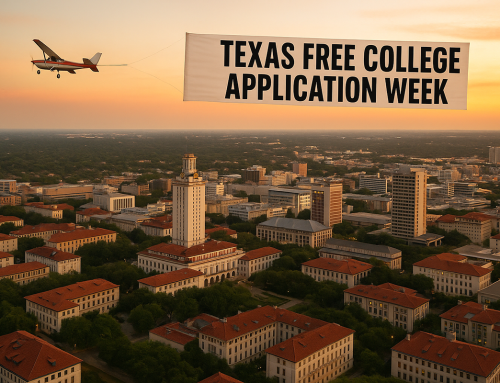
  4. Take advantage of Texas Free College Application Week: from October 12–18, 2026, Texas residents applying to undergraduate programs at Texas public institutions through ApplyTexas can apply for free.

Senior Year (November 2026)

  1. If you haven’t already, polish your Common App, ApplyTexas, and supplemental essays in preparation for Regular Decision and scholarship deadlines.
  2. For Early Decision applicants, note that Rice University’s Early Decision I deadline is November 1, 2026.
  3. Watch for November priority deadlines at Texas colleges and scholarship programs. For example, UH’s Fall 2027 scholarship priority application deadline is November 2, 2026, with supporting information due November 9, 2026.
  4. Continue monitoring your applicant portals after submission—many colleges require students to submit or verify materials through a portal after the application is received.

Senior Year (December 2026)

  1. Finalize and submit your Regular Decision applications. UT Austin‘s Regular Decision deadline is December 1, 2026, with supplemental materials due December 10, 2026.
  2. Texas A&M (College Station)’s Fall 2027 freshman application deadline is also December 1, 2026, with required documents due December 15, 2026.
  3. Review your Early Action or Early Decision results carefully, including financial-aid expectations, enrollment obligations, and next steps.
  4. Continue studying for your final exams and maintain strong grades; colleges can consider midyear grades, and your academic performance remains critical throughout senior year.

Senior Year (January & February 2027)

  1. Submit any remaining Regular Decision and Early Decision II applications—for example, Rice University’s Early Decision II and Regular Decision deadline is January 4, 2027.
  2. Track financial-aid priority deadlines. Many Texas institutions use January 15 as an important financial-aid priority date, but deadlines vary by college and program.
  3. UT Austin Early Action applicants receive either a decision or a deferral by January 15, 2027, and all UT Austin freshman applicants receive a decision by February 15, 2027.
  4. Search for and apply to college scholarships—institutional, local, employer, civic, and private—to help fund your education.

Senior Year (Spring 2027)

  1. Evaluate your Regular Decision acceptances, waitlist options, honors decisions, and scholarship offers, and compare the financial aid packages offered.
  2. Compare net cost, academic fit, major access, graduation outcomes, location, student support, housing, and campus environment. Revisit campuses in person if you can.
  3. Appeal your financial aid if your family’s circumstances have changed or if another college has made a substantially different offer.
  4. Make your final decision and submit your enrollment deposit by May 1, 2027!
  5. If you are applying later in the cycle, note that UH’s Fall 2027 application deadline is May 31, 2027, with supporting information due June 7, 2027.

Every student’s journey is unique. Adjust this timeline to fit your individual needs, school policies, testing plan, and college list—whether you need to accelerate your efforts or take advantage of extra time by starting early, this guide is designed to keep you on track. Always verify final deadlines on each college’s official admissions and financial-aid pages before submitting.

Key College Application Dates for Texas High Schoolers

Below is a comprehensive summary of important deadlines to help Texas students navigate the 2026–2027 college application cycle:

  • August 1, 2026: Common App refreshes for the new application cycle; UT Austin and Texas A&M Fall 2027 applications open.
  • August 22, 2026: SAT test date.
  • September 12, 2026: SAT test date.
  • September 19, 2026: ACT test date.
  • October 1, 2026: The 2027–2028 FAFSA is expected to be available by this date.
  • October 1–30, 2026: PSAT/NMSQT school-day testing window.
  • October 3, 2026: SAT test date.
  • October 12–18, 2026: Texas Free College Application Week for Texas residents applying to undergraduate programs at Texas public institutions through ApplyTexas.
  • October 15, 2026: UT Austin Early Action application deadline.
  • October 17, 2026: ACT test date and 2026 Saturday PSAT/NMSQT option.
  • October 22, 2026: UT Austin Early Action supplemental-materials deadline.
  • November 1, 2026: Rice University Early Decision I deadline.
  • November 2, 2026: UH Fall 2027 scholarship priority application deadline.
  • November 7, 2026: SAT test date.
  • November 9, 2026: UH Fall 2027 scholarship priority supporting-information deadline.
  • December 1, 2026: UT Austin Regular Decision application deadline and Texas A&M College Station Fall 2027 freshman application deadline.
  • December 5, 2026: SAT test date.
  • December 10, 2026: UT Austin Regular Decision supplemental-materials deadline.
  • December 12, 2026: ACT test date.
  • December 15, 2026: Texas A&M College Station Fall 2027 required-documents deadline.
  • January 4, 2027: Rice University Early Decision II and Regular Decision deadline.
  • January 15, 2027: UT Austin Early Action decisions released; many Texas institutions use January 15 as a financial-aid priority target, but students should verify each college’s deadline.
  • February 15, 2027: UT Austin all freshman decisions released.
  • February 27, 2027: ACT test date.
  • March 6, 2027: SAT test date.
  • April 1, 2027: Rice University Regular Decision decisions released by this date.
  • April 10, 2027: ACT test date.
  • May 1, 2027: National reply/enrollment deposit deadline for many colleges, including Rice Regular Decision admits.
  • May 1, 2027: SAT test date.
  • May 31, 2027: UH Fall 2027 freshman application deadline.
  • June 5, 2027: SAT test date.
  • June 7, 2027: UH Fall 2027 supporting-information deadline.
  • June 12, 2027: ACT test date.
  • July 10, 2027: ACT test date.

Texas-Specific Admissions Notes

Texas students should pay special attention to automatic admission, financial-aid completion, and ApplyTexas policies:

  • UT Austin automatic admission: For Summer/Fall 2027 and Spring 2028 enrollment, eligible Texas applicants must rank in the top 5% of their high school graduating class to qualify for UT Austin automatic admission. Current juniors should confirm the threshold for their cycle once it is announced, and read our guide on maximizing your GPA for automatic admission.
  • Other Texas public universities: Automatic admission rules, major placement, and program-specific review vary. For example, Texas A&M reviews all College of Engineering applicants for placement into General Engineering, including students who qualify for top-10% automatic admission.
  • Texas graduation requirement: Texas high school students must complete the FAFSA, TASFA, or an official opt-out form to satisfy the state financial-aid graduation requirement.
  • Free College Application Week: Texas residents applying through ApplyTexas to undergraduate programs at Texas public institutions can submit eligible applications for free during October 12–18, 2026.

College Applications & Test Prep FAQs

My child’s school already has a college counselor; isn’t that enough?2026-07-16T10:45:47-05:00

Although your child probably already has access to college counseling at their school, it may not be enough or the right kind of support. Counselors at Houston-area public schools routinely work with more than 500 students each.

Counselors at elite private schools have a significantly lower student to counselor ratio, but that closer-knit community comes with its own risks. The counselor might feel they know the student so well (including teacher break room gossip) that they steer them in a certain direction even if inadvertently.

Furthermore, private school counselors must also serve the school’s best interest, which can mean that they push students to go to the same 20 liberal arts colleges they sent all the similarly-bucketed students before yours.

However, seeking outside guidance is often less a judgement on your school’s counselors and more about the benefits of multiple, sage opinions.


Am I doing enough to ensure my high-achieving student succeeds?2026-07-09T15:24:58-05:00

That you are reading this FAQ speaks volumes to your commitment to your child’s success. Our decades of experience and published research identify at least five, top strategies to help parents ensure their child continues to succeed at the highest level:

  1. Champion “productive struggle” and cognitive endurance
  2. Cultivate your child’s holistic identity
  3. Match your goals with your child’s reality
  4. Outsource family friction to an external mentor
  5. Encourage self-advocacy and executive function

Click here to read our full article on “Parent Strategies for Empowering the High-Achieving Student.”

How will my child manage all of the moving parts of college admissions?2026-06-03T11:26:49-05:00

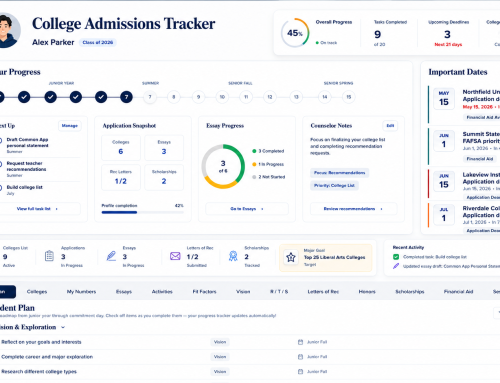
Given our decades of experience and proficiency with technology and publishing, General Academic has developed our own College Admissions Tracker.

The Tracker’s dashboard structure mirrors the counseling curriculum: vision and fit, the college list, essays, testing, activities and honors, recommendations, scholarships, financial aid, and applications. At the top of the front page, the student sees a few summary numbers (overall progress, tasks completed, deadlines in the next two weeks, colleges being tracked) above a horizontal timeline marked by year and season, so the full arc of the process stays visible from any other view on the dashboard.

Three panels do most of the day-to-day work.

  • Next Up is a short list of what the counselor wants the student focused on this week. A student who could be doing eighteen application-related things at any given moment benefits most from knowing which three matter.
  • Important Dates ranks upcoming application, financial aid, and scholarship deadlines by urgency, with enough context that a student can tell a CSS Profile deadline from a Regular Decision deadline without having to look it up.
  • Counselor Notes is where the substantive guidance from the most recent session lives: which priority is current, which recommendation needs review, which draft to come back to.

The rest of the dashboard is available when a student wants to drill into a specific area: the full college list, the essay tracker, recommendation status, the scholarship log, the application snapshot. The front page is built around the more practical question of what this particular student should be doing this week.

Learn more about our proprietary College Admissions Tracker

How will I know if my child is improving?2026-06-03T11:23:25-05:00

We strongly believe in practice and data at General Academic; therefore, we developed the Piqosity.com e-learning platform to measure student improvement in real time. On Piqosity, students will have access to General Academic’s own 50+ practice tests for the ISEE, ACT, PSAT, and SAT plus 50k+ practice questions. These questions are dynamically peer-normed for difficulty, and students see an estimated test-day score after every practice set. There are in-depth, step-by-step answer explanations and how-to lessons and videos.

In addition to daily progress tracking, we also encourage students to regularly take mock tests, including when we host them on most weekends.

Finally, parents will also receive regular tutor session notes available in their online portals.

What are the tutor’s qualifications?2026-04-13T14:17:10-05:00

We actively recruit, train, and coach the most brilliant and charismatic would-be tutors. Less than 10% of the top 1% of US college undergraduates and graduates meet our rigorous tutor qualifications.

  • We start by recruiting brilliant individuals with proven academic records—very high test scores and grades.
  • Then we train them on tutoring best practices and the specifics of standardized test prep
  • And we continuously monitor and coach them on how to improve with our AI-driven Tutor Buddy

All of our in-home and in-office private tutors are background checked and insured, W2 employees. Click here to learn more about our brilliant peer and pro tutors.

How do you help students with test anxiety?2026-04-06T13:08:08-05:00

To help students conquer their test anxiety, the first step we take is to validate their concerns—the ISEE, ACT, and SAT are high stakes test after all—but then we walk them through the science of why they feel the way they do and implement research-backed mitigation strategies.

Our more than 23 years of experience and a significant body of data show that there are generally 7 primary sources of test-taking anxiety:

  1. Fear of the unknown test format
  2. Inadequate preparation timelines
  3. Lack of deep content mastery
  4. Immense parental pressure
  5. Toxic peer comparisons
  6. Physiological exhaustion
  7. Undiagnosed learning differences

Our tutors are well-educated and trained to deal with these common issues. Our core strength is our ability to empathize with your child while leveraging a framework to help them work past their anxiety. Click here to learn more about test anxiety and our comprehensive mitigation efforts.

Which test should my child take? The ACT or the SAT?2025-09-25T14:45:18-05:00

Students should start their test prep by taking both a mock ACT and digital SAT. The student’s performance and comfort on that diagnostic exam will then guide their choice of which test to ultimately prepare for the most—but preparing for one test also prepares them for the other.

Whether your child should take the SAT or the ACT is purely a matter of preference. With about 1.3 million students taking either tests every year, both are equally accepted nationwide. The SAT is more popular in Houston just because of historical preference, and Houston ISD pays for every junior to take the SAT because College Board won the contract (conversely ACT won the contract in North Carolina for example). Click here to see which state governments sold out to College Board (SAT) and which ones got bought by ACT.

Both the Digital SAT (2024) and Enhanced ACT (2025) are relatively new and an hour shorter than the versions parents took. Furthermore:

  • Digital SAT passages are only a few sentences versus more than 700 words for the ACT.
  • The Enhanced ACT is offered both online and in paper
Why should students take a mock test?2025-09-17T17:03:50-05:00

Taking a full-length mock test under timed conditions is one of the best ways to predict how your child will perform on the actual exam; it also helps them build the mental toughness necessary to perform reliably on test day.

There’s a big difference between working 10, untimed questions at the kitchen table with the aid of a tutor versus slogging through 161 unassisted questions in a room with other kids all at the same time.

We offer complimentary diagnostic mock testing for ISEE, ACT, and SAT to both current and future clients. For current clients, we also offer ongoing mock testing when our guidelines for properly spacing out practice tests is followed.

How often should students take a mock test?2025-09-17T17:00:42-05:00

Ideally, students will complete at least 3 full-length practice tests before they take the ISEE, SAT, or ACT exam. However, parents should be careful not to force students to take mock tests in quick succession without sufficient studying.

We expect students to complete a minimum of 20 hours of tutoring and self-study between each mock test. Forgoing this recommendation risks demoralizing students and/or being disappointed by lack of perceived improvement.

Students working with us have access to more than 12 full-length practice tests.

Should I send test scores at test-optional schools?2025-06-25T13:00:12-05:00

Send test scores to test-optional schools when they enhance your application – typically at or above the school’s median. Otherwise, withhold and bolster essays, grades, and course rigor.

What if my finances change after I am admitted to college?2025-06-25T13:03:36-05:00

File an appeal with updated documentation such as job-loss notices or medical bills. Most colleges will re-evaluate need-based aid.

How can I demonstrate interest to college admissions?2025-06-25T13:03:42-05:00

Attend virtual sessions, visit campus, email regional reps, and reference specific programs in your supplements.

How do I choose between acceptances?2025-06-25T13:03:56-05:00

Revisit campuses (ideally, in-person), compare financial aid, talk with current/former students, and—above all—trust your gut.

What’s the biggest essay mistake?2025-06-25T13:04:03-05:00

The biggest essay mistake is having generic answers (e.g., “I’ve always loved science”) or listing achievements without reflection.

Can my parents help edit my essays? What about an AI editor?2025-06-25T13:04:17-05:00

There is nothing wrong with seeking help for essay editing, but the “voice” of the essay must be authentically yours. Avoid over-polishing—admissions officers spot inauthenticity.

Do alumni interviews matter?2025-06-25T13:04:28-05:00

They’re rarely decisive but can provide context. Treat them as conversations, not interrogations.

What makes a great personal essay?2025-06-25T13:04:34-05:00

Authenticity! Share a specific story that reveals your values, growth, or perspective.

Are small colleges better than large universities?2025-06-25T13:04:41-05:00

The optimal size of college depends on your goals: small = personalized attention; large = more resources/networks.

What if I don’t know my major?2025-06-25T13:04:51-05:00

Most colleges don’t require declaring until sophomore year, but your stated major on your application should fit your sales pitch.

Can I negotiate financial aid offers?2025-06-25T13:04:56-05:00

Yes! Politely appeal with competing offers or new financial circumstances.

How does financial aid work?2025-06-25T13:05:02-05:00

Submit the FAFSA and/or CSS Profile. Aid is based on need (grants, loans) and merit (scholarships).

Is senior year GPA important?2025-06-25T13:05:09-05:00

Yes! Colleges can rescind offers if grades drop significantly.

Are AP/IB classes required for admission?2025-06-25T13:05:18-05:00

No, but they show rigor. Focus on excelling in courses available to you.

Do colleges care about “demonstrated interest”?2025-06-25T13:05:25-05:00

Yes, most colleges and universities absolutely care about demonstrated interest. There are multiple ways to demonstrate interest: attend virtual tours (virtual or in-person), email admissions reps, or engage on social media to show enthusiasm. If you are deferred or waitlisted, consider sending a Letter of Continued Interest.

Can I reuse essays for multiple colleges?2025-06-25T13:05:31-05:00

Yes and no. You can reuse parts of essays or follow similar outlines, but you should always tailor them to each school’s prompts and values. Never mention the wrong college in an essay!

What’s the difference between Early Decision (ED), Early Action (EA), and Regular Decision (RD)?2025-06-25T13:05:39-05:00

– ED: Binding commitment if accepted (apply to 1 school).
– EA: Non-binding early application (multiple schools).
– RD: Standard deadline (no restrictions).

When should I start preparing for college applications?2025-06-25T13:05:58-05:00

Start exploring interests and building strong academic habits early (even in 9th grade), but formal application prep (essays, resumes, etc.) begins in junior year.

When do students start preparing for the SAT and ACT?2025-10-28T22:40:51-05:00

General Academic recommends that rising high school juniors start preparing for the ACT and/or SAT in the summer (June/July) in the lead up to the fall test dates (August/ November). This timeline allows the student to work around particularly stressful periods like mid-term and final exams. It provides ample time to prepare not only for the first, fall test date but also a second or third testing in the spring of their junior year.

Ultimately, the goal is to have the student finished with their testing by the May test date as a sanity check and to leave the summer period open for their college applications and essays. However, the student will still have plenty of opportunities for more testing in June, August, October (latest for early decision), and November (recommended latest for regular decision), but this would be on top of their applications and regular schoolwork in the fall of their senior year.

The most valuable resource in test preparation is time. The most difficult math topics tested on the SAT and ACT are Algebra II and some trigonometry, which most students will have already learned by the start of their junior year. Therefore, in order to avoid regretting not having started early enough, the summer before junior year is the best time to start.

With that said, “test prep burnout” is a very real phenomena. Parents should avoid cramming too much test prep into an especially tight or stressful period of time, and they should accept if students are already scoring at their peak ability.

Click here to read more about our analysis of when Houston students start preparing for the ACT and SAT.

What is the new, Enhanced ACT test?2025-09-17T17:09:37-05:00

In response to the new Digital SAT test rolled out in 2024, competitor ACT also announced that they would overhaul their exam beginning as early as spring 2025. The updated ACT test is shorter (2 hours) and makes the dreaded Science Test optional. Scoring remains on a scale of 1-36, and the test will differentiate itself from the Digital SAT in that it will be offered on both paper and computer.

When do students take the ACT or SAT?2024-02-15T10:45:25-06:00

Most General Academic high school juniors will take the ACT or SAT two or three times to ensure they earn the score they need. There is no penalty for taking the test multiple times, and colleges only care about the highest score.

Note that most juniors will also take the PSAT in October for National Merit Scholarship qualification.

The SAT is generally offered to Houston-area students eight times a year:

  1. August
  2. October
  3. November
  4. December
  5. March
  6. April (all Houston ISD juniors in-class, automatically registered and paid)
  7. May
  8. June

Students need to register online at CollegeBoard.org at least four weeks in advance to avoid late-registration penalties and ensure availability. Most General Academic students will take the SAT in November, March, and May of their junior year.

The ACT is generally offered nationally seven times a year:

  1. September
  2. October
  3. December
  4. February
  5. April
  6. June
  7. July

Students need to reegister online at ACT.org at least five weeks in advance to avoid late-registration penalties and ensure availability. Most General Academic students will take the ACT in October, February, and April of their junior year.

How much time does my child need to study for the SAT or ACT?2024-04-13T17:04:52-05:00

The genuinely not-waffling answer is that every student is different. How long your child needs to spend preparing depends primarily on:

  1. What score do they want to achieve?
  2. What score do they have right now?
  3. How big is the gap between their goal and current scores?

However, the overly simplified answer is:

  • For the SAT, students can expect about a 40-point improvement for every 7 hours of quality preparation
  • For the ACT, students can expect about a 1-point improvement for every 7 hours of quality preparation

The operative word in this basic response is “quality.” Students cannot spend those 7-hours just watching videos on Khan Academy while simultaneously posting to Tik Tok. They need to be actively engaged in the material, taking practice tests, and truly learning from their mistakes.

The majority of the time spent on test prep is remediating basic math and English skills. No amount of tips, tricks, or talking-head watching will make up for not being able to actually identify the main idea of a paragraph or manipulate fractions.

Aren’t the ACT and SAT optional for college applications now?2024-02-08T11:55:44-06:00

The shorter answer is that students who have the means and time to prepare and take the ACT or SAT should absolutely do so.

Colleges like standardized tests because they’re norm-referenced and their scores are comparable across the entire US population regardless of school and curriculum. However, the uncomfortable outcome of testing is results. And historically standardized testing shows enormous performance gaps between students from different socioeconomic backgrounds.

It’s this measured gap between students of different backgrounds that largely propels the test-optional movement. Furthermore, the COVID-19 pandemic led to additional challenges like simply not being able to get students in a room to test. As a result, colleges raced to go test-optional, and some university systems like the state of California even went test-blind in 2022.

While colleges are reluctant to publish their admissions data, since-redacted statistics from the pandemic and off-the-cuff remarks from admissions officers, demonstrated that students who submitted scores were often twice as likely to gain admission. The basic premise is that only students with something to hide didn’t submit scores.

But why did that happen even when it was the colleges’ policy to be “test-optional” and technically not penalize students who didn’t submit scores? There’s at least two reasons—submitting strong scores is another, positive data point, and admissions officers are still human. Would a car buyer rather choose the model that got “sufficient gas mileage” or the one that gets “50 miles per gallon” or “400 miles of range”?

Furthermore even less well-off students can reap huge rewards from submitting high test scores. For example, a low-income high school student is more able to ace the ACT or SAT than attend a rich, academically competitive school, participate in a bevy of after-school activities, and spend hundreds of hours on unpaid, volunteer work.

Click here to read more about our analysis of test-optional admissions.

How many colleges should I apply to?2025-06-25T13:06:16-05:00

Most students succeed with 8 – 12 well-researched schools: 2 – 3 safeties, 3 – 5 matches, and 2 – 3 reaches. Highly accomplished students might consider applying to a higher proportion of reach schools, but every student should balance out their list with colleges of varied selectivity.

What GPA does my student need to get into the college of their choice?2025-06-25T13:06:23-05:00

Every high school has a different way of calculating grades, which makes it difficult to use GPA as a metric for college admissions. Some colleges provide aggregate GPA data for recently admitted students, but this is nowhere near as widely available as test score data.

Some colleges standardize GPA themselves through a recalculation process, which can provide a clearer point of comparison for students. Others focus on holistic review of student transcripts, with an emphasis of rigor of curriculum – that is, they primarily care about which courses your student took, how challenging those courses are relative to what was available to them, and what grade is next to each course on the transcript.

How important is standardized testing now that many colleges are test-optional?2025-06-25T13:06:30-05:00

Many colleges switched to a test-optional policy with the onset of COVID-19. However, some colleges (including MIT) have switched back to a test-required policy, so we’d recommend checking the requirements of each university on your college list. On the opposite end of the spectrum, a handful of colleges have committed to a test-blind policy (including the University of California system), meaning that they are removing test scores from consideration entirely.

In general, we do recommend preparing for either the SAT or ACT, even if many of your student’s target colleges are test-optional. If a student can achieve a score that falls near or above the median for typical students admitted to any given college, then submitting scores will only serve to benefit them. Your student can also always choose to submit their score to some schools and withhold them from others.

Which extracurriculars should my student enroll in?2025-06-25T13:06:38-05:00

Generally speaking, colleges do not make value judgments about the extracurricular activities a student chooses to pursue. They do, however, value quality over quantity; they look for students who commit to particular activities for the long-term and rise to leadership roles within them.

Ideally, your student’s extracurriculars should reflect their genuine interests and passions. If they sincerely enjoy a particular activity, they’ll have a better time working hard to improve themselves, achieve awards, and maybe earn leadership positions. Extracurriculars are also a great way for students to explore new interests that may grow into passions – or even career paths.

What do colleges take into account when assessing an application?2025-06-25T13:06:53-05:00

College admissions officers assess applications holistically, meaning they evaluate the “whole” student. No factor (including grades, test scores, or extracurriculars) is considered in a vacuum; rather, these pieces are all assessed in the context of each student’s unique background.

With that being said, a student’s academic record (including their grades and course selections) tend to be the most important part of each application. College vary in terms of which factors they consider and how they weigh them; most colleges provide insight into these factors on their Common Data Set document (try searching the web for “[College Name] + Common Data Set”).

Choose General Academic for College Applications Support

We are here to help ensure your student’s applications are in the best shape they could possibly be. General Academic has more than 20 years of experience helping students achieve their college goals, and every member of our staff has lived a college success story of their own.

We can help your student with any element of the college application process, including the following:

  • Helping your student formulate their “vision” for college as well as their “pitch” for applications
  • Researching and building a college list
  • Writing, outlining, and refining their college essays
  • All other elements of the application process, including polishing their activities list, planning and executing letter of recommendation requests, and applying for scholarships

Learn more about our college counseling services or call us today to get started!

Learn More about the College Admissions Process

Author

  • Samuel Pearson

    Samuel Pearson is General Academic's Lead Manager and Director of College Counseling. He graduated from Rice University in 2017 with a B.A. in Cognitive Science & Visual and Dramatic Arts. Before joining General Academic's team in 2023, Samuel was a high school teacher and technical director at a premier independent school in Houston. He holds a Certificate of College Access Counseling from Rice University's Center for College Readiness.

    View all posts
2026-07-13T14:16:02-05:00July 10th, 2026|College|

Share This Story, Choose Your Platform!

Go to Top