Announcing General Academic’s custom-built college admissions tracking app: what it does for students, parents, and counselors.
In the run-up to college application deadlines, even families that started organized usually aren’t anymore. The Common App is in one browser tab, and the high school’s counseling portal in another. The personal statement is in a Google Doc, with each supplement draft as its own file. Recommendation requests are tucked inside email threads with the school counselor. Each college’s financial aid section has its own login. Scholarship deadlines are bookmarked somewhere (hopefully), FAFSA dates are screenshotted to a phone, and the running parent-and-student conversation tries to glue all of it together.
For high school students enrolled in our college counseling services, the General Academic College Admissions Tracker puts the working plan in one place. On the front page of the dashboard, a GA student can see what their counselor wants them working on this week, which deadlines are closest, where each essay stands, and what is still outstanding.
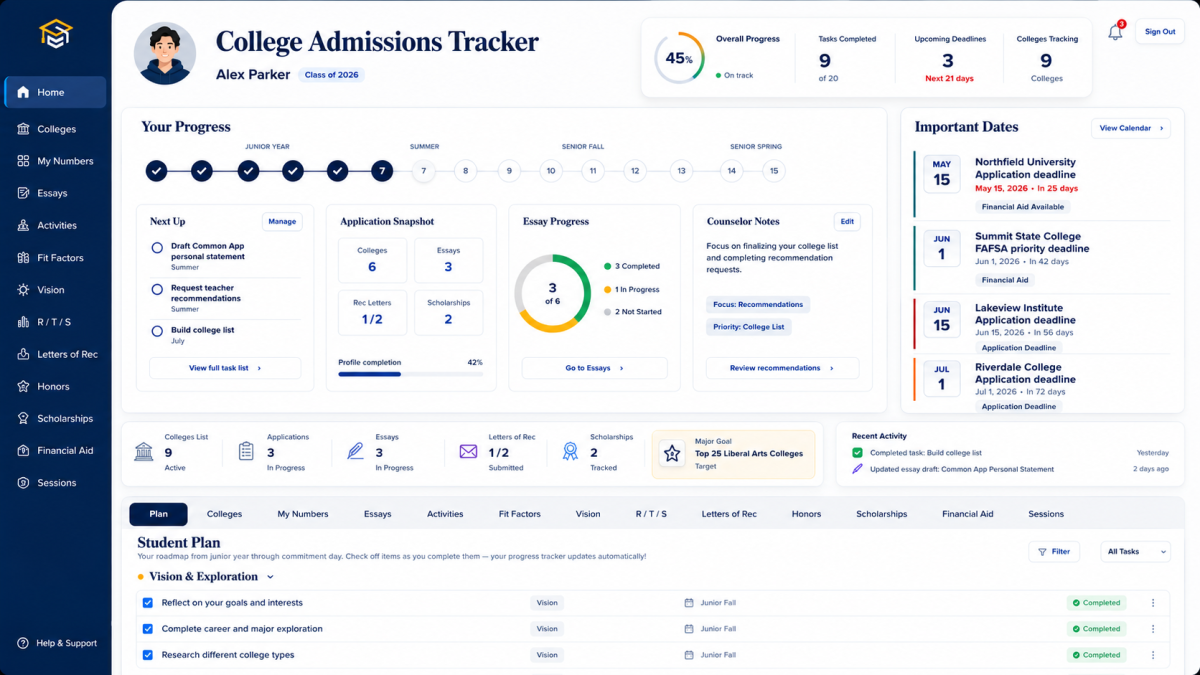
- Next Up This week’s priorities in one short list.
- Important Dates Deadlines ranked by urgency, with enough context to know what they mean.
- Counselor Notes Guidance from the last session attached to the current plan.
Why we built our own college applications tracker
After more than twenty years of college counseling in Houston, we have learned that the hardest part to preserve is continuity between sessions.
A counselor and student meet, talk through priorities, decide on next steps, and end the session. The student goes back into a life that is also full of Advanced Placement courses, varsity sports, part-time jobs, college visits, and everything else competing for their attention. By the next session, some of what was decided has faded, often most of it.
We built the tracker to keep the plan visible during the days between meetings. Every GA session produces decisions about what to draft, what to revise, who to email, and what to prioritize next. Those decisions become specific tasks in the dashboard, so that on a Tuesday night a week later, the student can open it and pick the work back up.
What the college tracker makes visible
The dashboard’s structure mirrors the counseling curriculum: vision and fit, the college list, essays, testing, activities and honors, recommendations, scholarships, financial aid, and applications. At the top of the front page, the student sees a few summary numbers (overall progress, tasks completed, deadlines in the next two weeks, colleges being tracked) above a horizontal timeline marked by year and season, so the full arc of the process stays visible from any other view on the dashboard.
Three panels do most of the day-to-day work.
- Next Up is a short list of what the counselor wants the student focused on this week. A student who could be doing eighteen application-related things at any given moment benefits most from knowing which three matter.
- Important Dates ranks upcoming application, financial aid, and scholarship deadlines by urgency, with enough context that a student can tell a CSS Profile deadline from a Regular Decision deadline without having to look it up.
- Counselor Notes is where the substantive guidance from the most recent session lives: which priority is current, which recommendation needs review, which draft to come back to.
The rest of the dashboard is available when a student wants to drill into a specific area: the full college list, the essay tracker, recommendation status, the scholarship log, the application snapshot. The front page is built around the more practical question of what this particular student should be doing this week.
Where our counselor’s judgment lives
Recording that a deadline exists is easy enough, and plenty of tools do it well. The harder work happens above that layer, in the judgment calls that take up most of the counseling hour: whether an essay needs another draft before submission, whether a recommendation request can wait until after Thanksgiving, which of two simultaneous deadlines to prioritize, whether to swap a school off the list. A calendar can’t help with any of that.
The GA tracker is built to carry that layer of judgment between sessions, so the hour a counselor spends with a student still has shape three days later. The tasks and priorities in the dashboard reflect how that counselor is advising that particular student: which work matters most this week, which essay is closest to ready, which decision can wait.
Built for students, parents, and counselors
Students, parents, and counselors each get something different out of the tracker, and the design has to work for all three.
For the student, it shifts ownership. They can log in and see what to do next without needing a parent or counselor to push them. The college application process is, for most students, the first long-running project they have ever owned end-to-end, and the planning, follow-through, and self-advocacy it teaches are skills they will need in college anyway.
For parents, the tracker offers transparency without surveillance. Instead of guessing whether things are on track, a parent can see where their student is in the process, what is coming up, and what the counselor is currently focused on. In practice, that tends to mean fewer dinner conversations that start with “Did you finish your essay yet?”
For our college counselors, the tracker gives continuity across meetings. Notes carry forward, priorities update in one place rather than scattered across emails and texts, and the student shows up to the next session with the plan still loaded.
Applications still require thought, writing, revision, judgment, and persistence. A shared plan doesn’t change that work, but it lowers the chaos around it, which is where most of a family’s stress actually lives.
From junior year to decision day
The tracker is designed to run from early junior year through final enrollment decisions. Most of the students who feel least overwhelmed in October of senior year started the upstream work twelve to eighteen months earlier: narrowing academic goals, figuring out which factors matter to them about a school, building a balanced college list, and getting a head start on testing and the personal statement. The dashboard gives those earlier phases the same visibility as the application deadlines that come later.
Technology that supports the counseling relationship
The tracker helps make each counseling session easier to use after the meeting ends. The conversation, feedback, and judgment from the session stay attached to the relevant tasks and deadlines, instead of depending on memory, scattered notes, or another email thread.
Eligible GA college counseling students receive access to the tracker as part of their counseling engagement.
Request college counseling with General Academic to learn more about working with our team.
Learn more about General Academic’s Proprietary Technology and Curriculum
- Take our College Readiness Self-Assessment
- Take our Executive Function Self-Assessment
- How we’re Using AI to Develop Better Tutors