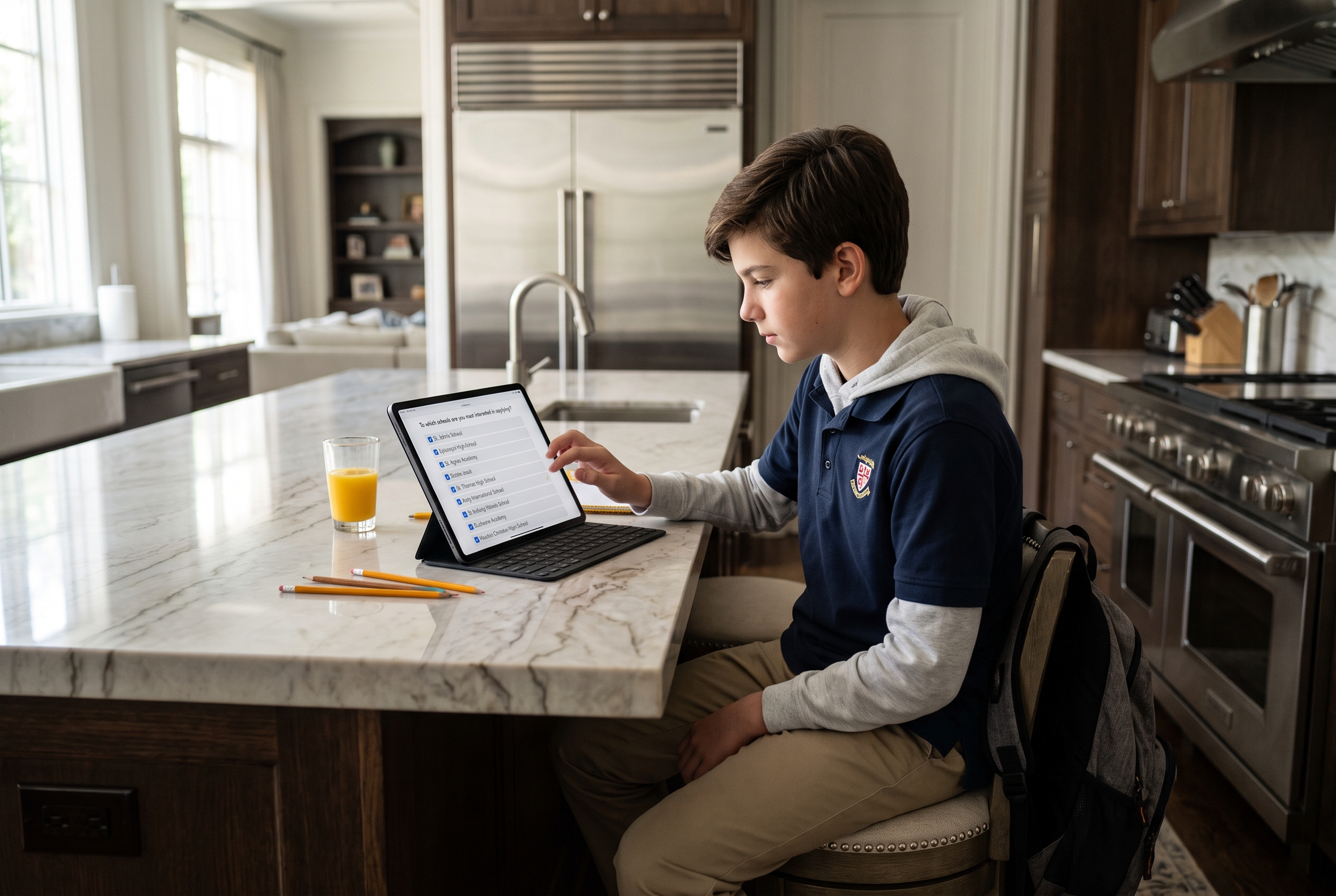
What are the most popular, elite private schools in Houston? It seems like a simple question, but unlike the voluminous data available about Houston’s magnet schools, Houston private schools generally do not publish the number of applications they receive, and even when acceptance rates are available, they do not necessarily tell us which schools families are considering alongside one another.
However, as the largest academic consulting firm in Houston, General Academic has another window into the Houston private-school admissions market: our own students.
During the beginning of the 2026-2027 admissions cycle, 184 students told us their first, second, and third-choice schools. Most were students enrolled in our ISEE preparation courses (“ISEE” stands for the Independent School Entrance Exam), meaning they were actively preparing for admission to private schools. During the same cycle, General Academic served approximately 600 ISEE students, so these responses represent about one-third of that population.
The results show a remarkably concentrated market. St. John’s School was the clear leader, but the data also reveals important differences between schools that are not only widely considered but also inspire particularly strong, first-choice preference. It also shows which schools tend to compete for the same students—and even how Houston’s strongest public schools fit into families’ plans.
The Survey Results, Indicating Most Popular Houston Private Schools
| wdt_ID | wdt_created_by | wdt_created_at | wdt_last_edited_by | wdt_last_edited_at | School | First Choice | Second Choice | Third Choice | Total | School Type |
|---|---|---|---|---|---|---|---|---|---|---|
| 1 | hannahkelly | 09/29/2026 12:51 PM | hannahkelly | 09/29/2026 12:51 PM | St. John's School | 38 | 27 | 24 | 89 | Private |
| 2 | hannahkelly | 09/29/2026 12:51 PM | hannahkelly | 09/29/2026 12:51 PM | The Kinkaid School | 15 | 16 | 29 | 60 | Private |
| 3 | hannahkelly | 09/29/2026 12:51 PM | hannahkelly | 09/29/2026 12:51 PM | Episcopal High School | 23 | 23 | 13 | 59 | Private |
| 4 | hannahkelly | 09/29/2026 12:51 PM | hannahkelly | 09/29/2026 12:51 PM | St. Agnes Academy | 30 | 13 | 8 | 51 | Private |
| 5 | hannahkelly | 09/29/2026 12:51 PM | hannahkelly | 09/29/2026 12:51 PM | Strake Jesuit College Preparatory | 31 | 13 | 5 | 49 | Private |
| 6 | hannahkelly | 09/29/2026 12:51 PM | hannahkelly | 09/29/2026 12:51 PM | St. Thomas High School | 4 | 15 | 11 | 30 | Private |
| 7 | hannahkelly | 09/29/2026 12:51 PM | hannahkelly | 09/29/2026 12:51 PM | The Awty International School | 6 | 8 | 6 | 20 | Private |
| 8 | hannahkelly | 09/29/2026 12:51 PM | hannahkelly | 09/29/2026 12:51 PM | Duchesne Academy of the Sacred Heart | 1 | 8 | 3 | 12 | Private |
| 9 | hannahkelly | 09/29/2026 12:51 PM | hannahkelly | 09/29/2026 12:51 PM | The Emery/Weiner School | 4 | 6 | 2 | 12 | Private |
| 10 | hannahkelly | 09/29/2026 12:51 PM | hannahkelly | 09/29/2026 12:51 PM | Houston Christian High School | 4 | 4 | 3 | 11 | Private |
| School | First Choice | Second Choice | Third Choice | Total | School Type |
To collect this data, we asked students to rank their top three schools. The 184 students in our survey generated 508 total school selections:
- 184 first choices
- 172 second choices
- 152 third choices
This data includes both Lower and Upper Level ISEE students, meaning that middle and high schools are both mixed in, though the data skews toward Upper Level, meaning high schools are the best represented.
The Most Frequently Named Houston Private Schools
The concentration at the top of the data is striking. The five most frequently named schools—St. John’s, Kinkaid, Episcopal High School, St. Agnes, and Strake Jesuit—accounted for 308 of the 508 selections, or more than 60% of every school choice recorded. Their dominance was even greater among first choices. Those five schools received 137 of 184 first-place selections, or approximately 74%.
How Students Ranked Houston’s Most Popular Private Schools
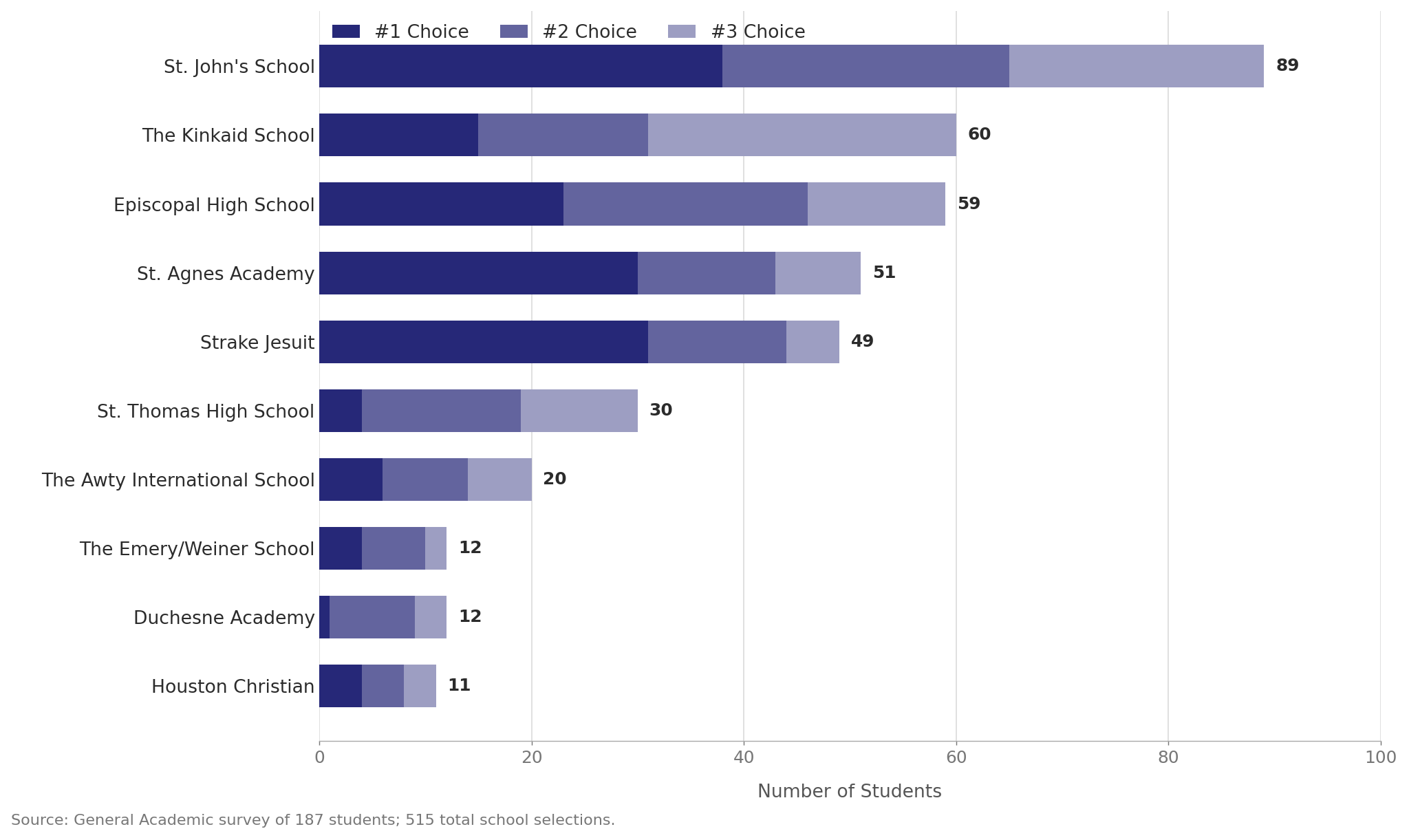
Houston has hundreds of private-school options, but among our admissions-focused families, student interest is concentrated heavily around a small group.
St. John’s School Stands Apart
No school came particularly close to St. John’s in overall mentions. Eighty-nine of the 184 respondents—more than 48% of the entire sample—put St. John’s somewhere in their top three. It also led in first-place selections with 38, while remaining extremely strong as a second and third choice.
That consistency matters. St. John’s is not simply receiving a large number of mentions because many students treat it as an additional option. It performs strongly at every ranking position. Within this sample, St. John’s has the strongest combination of both breadth of interest and intensity of preference.
One qualification is that St. John’s has Lower, Middle, and Upper Schools, so students considering entry at several grade levels may have listed it. Our survey did not record intended entry grades, so we cannot tell how much this contributed to its lead over high-school-only schools. Additionally, our sample was collected relatively early in the ISEE prep cycle, meaning that it likely captured a more “eager” audience. Even with these caveats, St. John’s remains the clear standout in our sample.
Kinkaid Shows Why “Most Popular” Is More Complicated Than a Ranking
The Kinkaid School finished second in overall mentions, appearing on 60 students’ lists—just ahead of Episcopal’s 59. But its ranking distribution looks very different from St. John’s. Only 15 students ranked Kinkaid first, compared with 29 who placed it third. In other words, almost half of Kinkaid’s appearances came in the third-choice position.
These rankings do not make Kinkaid a “safety school.” A student’s personal third choice may still be extremely selective and highly desirable. Instead, the data suggests a distinction between two kinds of popularity. Some schools attract a large number of students who are strongly committed to making them their first choice. Others have enormous breadth of consideration, appearing on many families’ application lists even when another school ranks slightly higher. Kinkaid appears particularly strong by that second measure.
Strake Jesuit and St. Agnes Inspire Strong, First-Choice Preference
Strake Jesuit and St. Agnes show almost the opposite pattern. Strake received 49 total mentions, fewer than St. John’s, Kinkaid, Episcopal, or St. Agnes. Yet 31 of its 49 mentions were first choices—about 63%. St. Agnes showed a similar pattern: 30 of its 51 mentions, or about 59%, were first choices. For comparison, first choices represented approximately 43% of St. John’s mentions, 39% of Episcopal’s, and just 25% of Kinkaid’s. This suggests that Strake and St. Agnes have particularly strong appeal among the students considering them.
There is an important caveat: both Houston private schools are single-sex, Catholic, high schools, so their potential applicant populations are narrower than those of coeducational schools serving multiple grade levels. Raw totals are therefore not perfectly comparable. Still, their first-choice numbers are difficult to ignore. Among eligible students interested in these schools, preference appears unusually strong.
Episcopal Combines Broad Interest With Strong, First-Choice Demand
Episcopal High School has perhaps the most balanced profile in the data. It received:
- 23 first choices
- 23 second choices
- 13 third choices
Those responses gave Episcopal 59 total mentions, coming in just behind Kinkaid for third place overall. Unlike Kinkaid, however, Episcopal’s appearances were much more evenly distributed between first and second choices. It therefore combines substantial breadth of consideration with comparatively strong first-choice demand. That distinction is one reason we would hesitate to publish a simple numbered ranking and call the question settled. Different measures of “popularity” tell us different things.
Beyond the Top Five
After the five dominant schools, there is a noticeable drop in total mentions. St. Thomas High School is the clearest member of the next group with 30 appearances, followed by Awty International School with 20. Emery/Weiner and Duchesne each received 12, while Houston Christian High School and St. Francis Episcopal each received 11. Awty’s profile is especially balanced: six students ranked it first, eight second, and six third.
Other schools may serve more specialized applicant populations. Some cover different grade ranges, some are single-sex or religious, and others offer distinctive educational approaches. For that reason, lower raw totals should not automatically be interpreted as lower selectivity or lower quality.
For example, take Awty International, which appears seventh on our list and offers both a French and International Baccalaureate (or IB) curriculum. It has one of the most impressive academic track records of any private school in Houston. For the 2026-2027 school year, Awty had the second highest percentage of National Merit Semifinalists of any Houston-area private school behind only St John’s. It beat out Kinkaid, Episcopal, St. Agnes, and Strake Jesuit, all of which appear ahead of it in popularity in our list.
Houston Families Consider Schools in Recognizable Clusters
Looking at which schools students listed together provides another useful view of the admissions market.
Private Schools Families Consider Together:
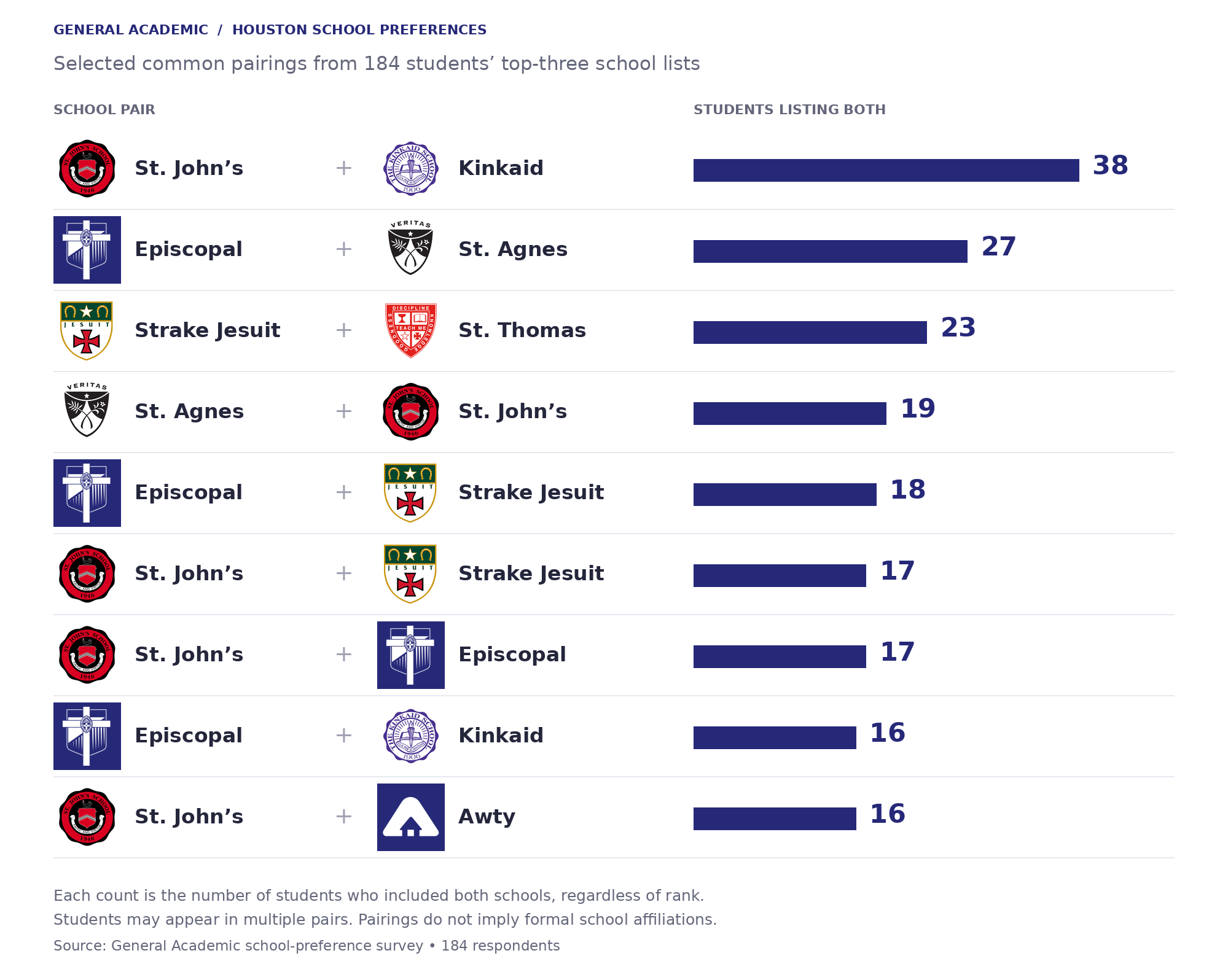
- St. John’s and Kinkaid: 38 students
- Episcopal and St. Agnes: 27
- Strake Jesuit and St. Thomas: 23
- St. Agnes and St. John’s: 19
- Episcopal and Strake Jesuit: 18
- St. John’s and Strake Jesuit: 17
- St. John’s and Episcopal: 17
- Episcopal and Kinkaid: 16
- St. John’s and Awty: 16
These clusters show that families do not evaluate schools in isolation. St. John’s and Kinkaid compete for many of the same students. Strake and St. Thomas form a particularly strong pair among boys. St. Agnes frequently overlaps with other religiously-affiliated and/or girls’ schools.
For parents beginning the process, these patterns may be more useful than a simple ranking. They show which schools other applicants tend to compare while building their lists.
Catholic Schools Play an Important Role
Another notable pattern is the strength of Houston’s Catholic schools. St. Agnes and Strake Jesuit ranked fourth and fifth in total mentions, while St. Thomas High School ranked sixth. Duchesne, St. Pius X, Incarnate Word, and several other Catholic schools also appeared in students’ lists. Students frequently grouped these schools together. Twenty-three respondents, for example, listed both Strake Jesuit and St. Thomas, while seven listed both St. Agnes and Duchesne.
There are a number of potential explanations for this, including religious identity and a desire for a same-sex educational model, but finances may matter too. According to our 2026–2027 Houston private-school tuition analysis, the average Houston private-school tuition is $29,087 per year, while the average among Catholic schools is $22,673—about 22% less. That difference amounts to more than $6,000 per child per year on average.
Cost therefore provides another possible explanation for the strong showing of Catholic schools. We should be careful not to over-interpret this point. Our survey asked students which schools they preferred; it did not ask why. Religion, cost, academics, athletics, tradition, location, single-sex education, and family history could all contribute.
Public Schools Are Competing With Private Schools Too
One of the most interesting findings from our survey of ISEE prep students is that public schools appear at all. Our students named Kinder HSPVA (High School for the Performing and Visual Arts) nine times, Pin Oak Middle School seven times, Bellaire High School six times, Carnegie Vanguard twice, and Memorial and Lamar High Schools once each. Other public schools, including DeBakey, Energy Institute, Heights, Elkins, Clements, and Seven Lakes, also appeared.
The numbers are small compared with the private schools, but that is exactly why they are interesting. Remember that this survey consists entirely of ISEE students. A family whose only goal is to attend a public school would have little reason to pay for private-school entrance-exam preparation. Our sample is therefore inherently biased toward private education.
Yet some of these families were still placing public schools directly alongside Houston’s best-known private schools. That means schools such as HSPVA, Carnegie Vanguard, Pin Oak, Bellaire, and others are competing for at least some of the same students—even when their parents have already invested significant money and effort in the private-school admissions process.
For some Houston families, the decision is not simply “public versus private.” It may be a choice among several specific opportunities: perhaps St. John’s, Kinkaid, and a strong public option.
Data Considerations
This data was self-reported by students, so some editorial liberties had to be taken when analyzing it—for example, consolidation of obvious variations in school names (“St. Agnes Academy” and “Saint Agnes Academy”). It should be noted, however, that some were hard to interpret. For example “St. Thomas” could refer to St. Thomas High School, a Catholic all-boys school, or St. Thomas’ Episcopal School, a co-ed Episcopal high school. We did our best to decipher which schools students were referring to when cleaning up the data, though it likely remains slightly imperfect.
It is also important to understand that these are student preferences, not application totals. We cannot say that every student ultimately applied to every school listed. However, putting a school in one’s top three is a strong indication that the school was under serious consideration.
There is also significant selection bias in this sample. The ISEE test is specifically an admissions assessment used by independent schools. Families focused exclusively on public school therefore have little reason to enroll in an ISEE course. That makes this dataset especially useful for understanding families actively navigating Houston private-school admissions, but it should not be treated as a scientific survey of every family in Greater Houston.
Geography Also Shapes Our Results
When considering these results, it’s important to note that our students are not evenly distributed across the Houston metropolitan area. General Academic’s flagship tutoring center is just north of Rice Village, while our newer, smaller west Houston office is in Hedwig Village in the Memorial area. We also provide in-home tutoring primarily around those locations. As a result, our students naturally show more interest in schools convenient to central, southwest, and west Houston.
That matters when interpreting schools that appear only occasionally in the data. The John Cooper School, for example, received four mentions. That should not be read as evidence that Cooper is unpopular. Its campus is in The Woodlands, approximately 40 miles north of Houston, placing it well outside the geographic center of our student population.
General Academic’s Geographic Reach in Houston
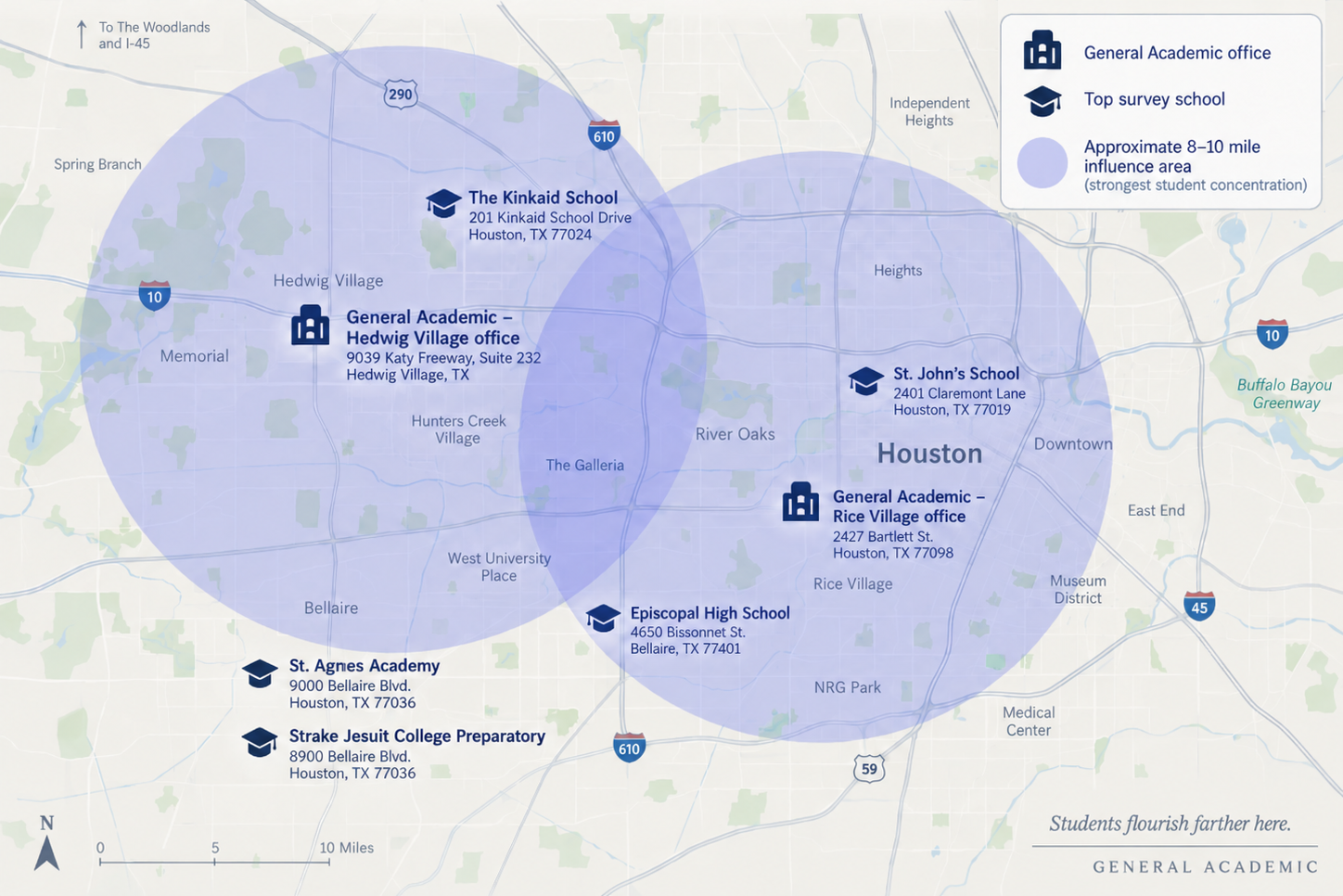
The same principle applies throughout this analysis: these rankings are best understood as a snapshot of the admissions market among General Academic families, not a definitive census of every private-school applicant in Greater Houston.
What Parents Can Learn From These Rankings
The clearest lesson is that Houston’s competitive, private-school admissions market is highly concentrated. A large share of applicants are targeting many of the same schools, especially St. John’s, Kinkaid, Episcopal, St. Agnes, and Strake Jesuit. But parents should avoid interpreting popularity as an exact proxy for admissions difficulty. A school receiving fewer mentions is not necessarily easier to enter. Similarly, a school frequently listed third is not necessarily a “backup.” These rankings describe student preferences, not school acceptance rates.
The data also reinforces the importance of building a thoughtful school list. Families tend to apply to recognizable groups of schools, but each school can differ substantially in curriculum, culture, size, location, religious affiliation, cost, and admissions expectations.
The most popular school is not automatically the best school for a particular student. For parents, that makes “Which school is most popular?” a useful starting question—but not the final one.
A better question is: Which schools are families like ours considering, why are they considering them together, and which environment will ultimately be the best fit for our student?
Learn More about Private School Admissions from General Academic
- Is Private School Worth the Cost in Houston?
- Texas School Vouchers (TEFA): What Houston Families Need to Know
- ISEE Test Dates in Houston for 2026-2027
- ISEE Course Survey Results: Students Understand the Stakes
- When Should Houston Students Start Preparing for the ISEE Test
- ISEE Test Score Improvement, What to Expect