
Houston Private School Admissions Interviews

Applying to Houston’s most competitive private schools involves more than submitting good grades and standardized test scores. Students may also need to write essays, obtain teacher recommendations, demonstrate extracurricular interests, and participate in an admissions interview. For many applicants, the private school admissions interview is one of the most unfamiliar—and intimidating—parts of the process.
Unlike the Independent School Entrance Exam (ISEE), which measures academic abilities, an admissions interview allows schools to learn about the person behind the application. What interests the student? How do they approach challenges? What might they contribute to the school community? And is the school a good fit for the student?
Many of Houston’s most popular private schools, including St. John’s School, The Kinkaid School, and Episcopal High School, require interviews for ninth-grade applicants. Others, such as Houston Christian High School, include parents in the interview process.
This guide explains what to expect from Houston private school admissions interviews, how interviews influence admissions decisions, and how students can prepare. Our advice focuses primarily on ninth-grade applicants, with a separate section for students entering sixth grade.
Do Houston Private Schools Require Admissions Interviews?
Many do, but requirements vary by school and grade level.
| Houston Private School | Admissions Interview Requirements |
| St. John's School | Student interview required for all grades; parent/guardian meetings available and encouraged for families new to SJS |
| The Kinkaid School | Student interview required for sixth and ninth grade applicants |
| Episcopal High School | Student interview required for all grades |
| The Awty International School | Student interview required for sixth-grade and Upper School applicants |
| Houston Christian High School | Combined student-family interview required for all grades |
| The Emery/Weiner School | Student interview required for all grades; parent interview required for families new to EWS |
| Duchesne Academy | Student interview required for Middle School applicants; family interview required for Upper School applicants |
Other prominent Houston schools, including Strake Jesuit College Preparatory and St. Agnes Academy, do not feature an interview as part of their admissions process. The important takeaway is that Houston private school admissions procedures are not uniform. Families applying to multiple schools should understand each institution’s requirements before beginning the process.
When Do Admissions Interviews Take Place?
Most Houston private school admissions interviews occur during the fall and winter before enrollment. For students entering ninth grade, the admissions process typically begins during eighth grade. Families attend open houses in the fall, submit applications toward the end of the calendar year, and complete interviews and other requirements before spring admissions decisions.
However, scheduling procedures differ. At Episcopal High School, applicants must submit an application before scheduling an interview. The school encourages families to reserve appointments early because availability becomes more limited throughout the admissions season. Kinkaid also requires students to submit applications before interviews are scheduled.
Families should not wait until application deadlines to begin planning interviews. Review each school’s admissions calendar early, particularly when applying to several Houston schools simultaneously.
How Important Is the Private School Admissions Interview?
The interview is an important component of the admissions package, but it is rarely the deciding factor on its own.
Houston private schools generally use a holistic admissions process, evaluating students’ academic performance, personal characteristics, extracurricular involvement, and potential contributions to the school community.
At St. John’s School, for example, admissions criteria include academic records, ISEE scores, teacher recommendations, student writing, extracurricular recommendations, and the admissions interview. These materials provide different perspectives on the applicant. Grades and test scores help establish academic readiness, while recommendations offer insight into classroom performance and character.
What’s Considered in Private School Admissions?
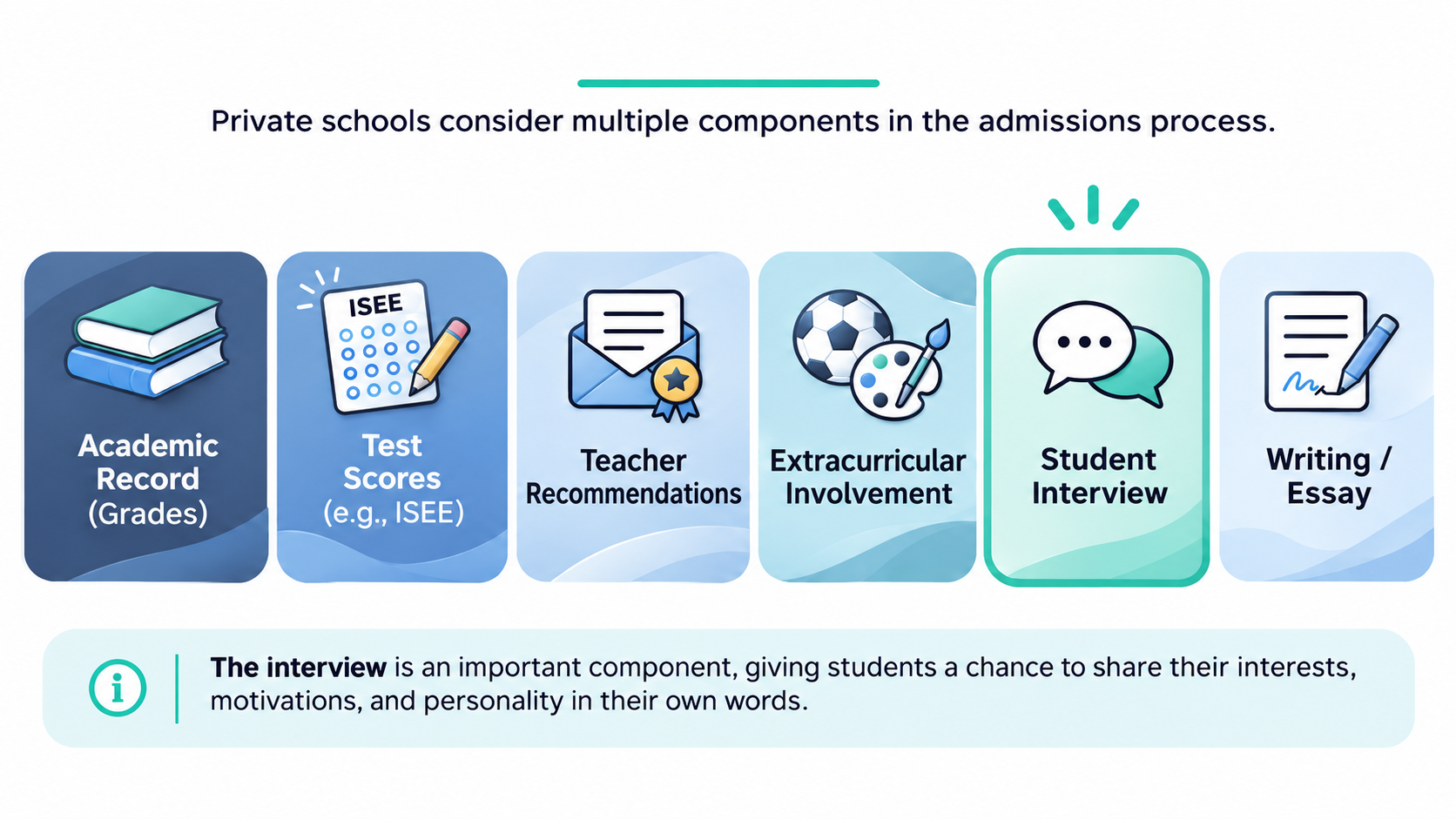
Importantly, the interview allows students to communicate their interests, motivations, and personalities directly. A student with excellent grades might struggle to articulate what excites them about learning. Conversely, a student with somewhat less impressive academic credentials might demonstrate unusual curiosity, maturity, or enthusiasm.That does not mean a strong interview can erase academic weaknesses, but the interview gives students an opportunity to represent themselves in their own words.
What Are Admissions Officers Looking For?
Although individual schools have different educational philosophies, interviewers generally want to understand several characteristics:
- Academic curiosity: Does the student enjoy learning and demonstrate interests beyond earning good grades?
- Communication skills: Can the student listen carefully, answer thoughtfully, and participate in a conversation?
- Maturity and self-awareness: Can the student recognize strengths, acknowledge weaknesses, and discuss challenges constructively?
- Extracurricular interests: Does the student participate meaningfully in activities outside the classroom?
- Character: How does the student treat classmates, teachers, teammates, and others?
- School fit: Does the student understand the school’s distinctive characteristics and have genuine reasons for applying?
- Community engagement: Does the student demonstrate an interest in helping others, participating in community activities, and making a positive contribution to the school and broader community?
These are general qualities that interviews can reveal, not necessarily formal scoring categories used by every Houston school.
The strongest applicants are not necessarily exceptional in every category. Instead, they demonstrate authentic interests, recognizable strengths, and the potential to contribute positively to their school community.
What Happens During a Houston Private School Admissions Interview?
Most student interviews are conversational rather than academic examinations. Applicants typically meet with an admissions representative who asks about their academic interests, extracurricular activities, personal experiences, and reasons for applying. Some interviews may last approximately 20–30 minutes, although duration and format vary by school. Conversations often begin with accessible questions about the student’s current school, favorite classes, or hobbies. Interviewers may then ask more reflective questions about challenges, relationships, or future goals.
Although in many cases students will be meeting with admissions officers or other administration personnel, it is also possible that a teacher or coach might be conducting the interview. If a student expresses specific interests in their application materials, then they might meet with a teacher or coach who aligns with those interests. For example, a student that seems particularly STEM-aligned in their application might meet with a math or science teacher for their interview. Regardless, students should be prepared for whoever ends up interviewing them.
This is also true of different interviewer personalities. Sometimes an interviewer will be casual and the interview will feel very conversational, but other times the interviewer might be more formal as they work their way through a list of set questions. One style is not necessarily better than the other, nor is it indicative of how the student is performing. Being prepared for different scenarios is essential when it comes to private school interviews; no matter what kind of interviewer they encounter it is important for students to remain polite, focused, and have conscious presence and composure (maintain eye contact, minimize fidgeting, etc.).
Students should also expect opportunities to ask questions themselves. The objective is not to determine whether an eighth grader can deliver sophisticated, adult-level questions and answers. Rather, schools want to understand how students think, communicate, and engage with others.
Student Interviews Versus Family Interviews
An important distinction among Houston private schools is whether interviews involve students alone or include parents. For instance, Kinkaid and Episcopal emphasize student interviews, While Houston Christian requires an interview with both the student and their family present. St. John’s also offers parent/guardian meetings for eligible families new to the SJS community and the school’s admissions process.
During family interviews, parents may discuss their educational priorities, reasons for applying, and expectations for their child’s development. Parents should answer candidly while allowing their children to speak independently when questions are directed toward them.
Common Private School Admissions Interview Questions
Interview questions are not generally made public, and will vary from school to school. However, students can prepare for common themes without memorizing responses. The following are representative practice questions, not confirmed questions from any particular school.
1. Tell Me About Yourself.
This open-ended question can be surprisingly challenging. Students should prepare a brief introduction that includes their interests, activities, and something distinctive about their personality. For example, an eighth grader might explain that they enjoy mathematics, play club soccer, and recently developed an interest in photography. The objective is not to recite a résumé but to provide natural starting points for conversation.
Why are they asking this question? Admissions officers want to learn about the student’s personality, interests, hobbies, and communication skills and where these aspects could take you within the school and its programs.
2. Why Do You Want to Attend Our School?
This is among the most important questions because it directly addresses school fit. Generic answers such as “It’s a great school” or “It has excellent academics” reveal little about the applicant, and instead, students should identify specific aspects of the school that appeal to them. Students here should make it clear that they have researched the school enough to be able to answer this question in a non-generic way.
An applicant to St. John’s might discuss its academic environment and extracurricular opportunities. An Episcopal applicant might mention a particular arts or athletics program. An Awty applicant might explain their interest in an international educational environment.
Students applying to multiple Houston private schools should prepare distinct, genuine answers for each institution. This can also be a great time to highlight any personal connections the student might have to the school. Do they have friends or family who attend or teach there? Are they in clubs with students who currently attend? This is also a great opportunity for students to highlight their personal connections to the school. Remember that admissions officers are looking not just for good students but also good additions to the school’s community!
Why are they asking this question? Admissions officers want to understand how the student’s academic interests align with the school’s offerings and what subjects or opportunities they might pursue there, including how the student could challenge themselves.
3. What Is Your Favorite Subject, and Why?
Interviewers are often more interested in the explanation than the subject itself. A student who enjoys mathematics might describe the satisfaction of solving challenging problems. Someone interested in English could discuss a memorable novel or creative writing assignment. Specific experiences demonstrate intellectual curiosity more effectively than simply reporting good grades.
An interesting potential follow-up to this question is “what is your least favorite subject?” This one might be harder for students to answer. If they are asked, it’s important for students to be honest, but not to be overly negative. Instead, students should let this answer be another way for the interviewer to know what they do like. For example. If a student doesn’t love English, they could frame it like “I prefer subject where I can solve something.”
Why are they asking this question? Admissions officers want to understand how the student’s academic interests align with the school’s offerings and what subjects or opportunities they might pursue there.
4. Tell Me About a Challenge or Failure.
Students sometimes worry that acknowledging mistakes will make them appear less qualified. However, discussing setbacks constructively can demonstrate maturity. A student might describe struggling in a class, losing an important competition, or navigating a disagreement with a friend.
The important question is what happened afterward. Did the student seek help, change their approach, or learn something meaningful? Admissions officers do not necessarily expect every challenge to end in extraordinary success. They want to understand how students respond to difficulties.
Why are they asking this question? Admissions officers want to assess the student’s resilience, maturity, and ability to learn from setbacks.
5. What Do You Enjoy Outside School?
Houston private schools offer extensive extracurricular opportunities, but students should not assume that only prestigious activities matter. Competitive athletics, music, theater, volunteering, coding, reading, and personal hobbies can all provide meaningful conversation topics. What matters is genuine engagement. A student who enthusiastically explains an unusual hobby may leave a stronger impression than someone who recites a long but superficial list of activities.
Why are they asking this question? Admissions officers want to understand the student’s interests beyond academics and how they choose to spend their free time.
6. What Would You Contribute to Our School?
This question encourages students to think about community participation. Students might discuss athletics, performing arts, academic clubs, student organizations, or community service. However, contributions are not limited to formal achievements. Helping classmates, welcoming new students, and supporting teammates can also demonstrate valuable qualities. Students should connect their strengths to realistic ways of participating in school life.
In many ways, all the questions an interviewer asks will be pushing toward this point, though perhaps less directly. Because of that, this is often a good place in the interview for a student to bring up something that they haven’t yet gotten to talk about, rather than repeat something that has already been discussed extensively.
Why are they asking this question? Admissions officers want to understand how the student might contribute positively to the school’s extracurricular programs, culture, and community.
7. Tell Me About Your Family.
Admissions officers may ask students to describe their families, including their relationships with parents, siblings, and other family members. Students should focus on the positive aspects of their family relationships, such as activities they enjoy doing together, family traditions, or experiences that have shaped their personalities. For example, a student might discuss a shared family hobby, a favorite holiday tradition, or something they enjoy doing with their siblings.
Why are they asking this question? Admissions officers want to understand the student’s family relationships and how their family might fit into the broader school community.
8. Do You Have Any Questions for Me?
Students should arrive with several thoughtful questions. Good examples include:
- What helps new ninth graders adjust to the Upper School?
- How can students explore extracurricular activities they have never tried?
- What opportunities exist for students interested in a particular subject?
- What school traditions do students especially enjoy?
Students should avoid asking questions easily answered on the school’s website. More importantly, they should ask about subjects they genuinely care about. Preparing a few strong questions before an interview is good idea; it shows engagement and excitement on the part of the student.
To prepare thoughtful questions, students should explore the school’s website and look for programs, activities, or traditions that interest or surprise them. For example, they might ask about a particular club, an unusual elective, or an extracurricular opportunity they would like to pursue. Students can also draw on their experiences during campus tours or open houses to ask about things they want to learn more about. Remember that the interviewer might not know the answer to every question, particularly if it concerns a specific academic program or club. That’s perfectly fine! The goal is not necessarily to get an answer, but to demonstrate genuine curiosity, enthusiasm, and interest in the school.
Why are they asking this question? Admissions officers want to gauge the student’s preparation, curiosity, and genuine enthusiasm for attending the school.
How to Prepare for a Private School Admissions Interview
Effective interview preparation should build confidence and self-awareness rather than produce memorized responses.
1. Research Each Houston Private School
Students should understand each school’s academic offerings, extracurricular programs, educational philosophy, and distinguishing characteristics. A good place to start is the school’s website, particularly the following sections:
- About Us / Mission and Values: Learn about the school’s educational philosophy, core values, and what it considers important in its students and community.
- Academics: Explore the school’s curriculum, distinctive courses, academic programs, and electives. Look for subjects or opportunities that align with your interests.
- Athletics: Review the sports and teams offered, particularly if you hope to participate in athletics at the school.
- Arts and Extracurricular Activities: Explore opportunities in music, theater, visual arts, student clubs, and other activities. Identify programs you might want to join or try for the first time.
- Student Life / Community: Learn about school traditions, community service opportunities, student organizations, and events that contribute to the school’s culture.
- News and Events: Browse recent school news to see what students have accomplished, what activities are taking place, and what the school chooses to celebrate.
For example, students considering Awty should explore its international approach, while Houston Christian applicants should familiarize themselves with the school’s Christian mission. Students should identify at least two or three specific aspects of each school that genuinely interest them, rather than simply memorizing facts from its website.
Campus tours and open houses provide particularly useful opportunities to learn about schools firsthand. After visiting, students should write down three things they liked, something that surprised them, and one question they still have. These observations can help students explain their interest during the interview and develop thoughtful questions to ask the interviewer.
2. Review Your Application
Students should be familiar with everything they have submitted. If an essay describes a meaningful extracurricular experience, the interviewer may ask about it. If the application mentions a particular academic interest, students should be ready to elaborate. Applicants should also be prepared to discuss unusual circumstances, such as a semester with lower grades, if asked. The goal is not to memorize application materials but to reflect on the experiences behind them.
3. Practice Answering Questions Out Loud
One of the best ways to prepare for a private school admissions interview is to practice speaking with an unfamiliar adult. A parent, teacher, tutor, or trusted mentor can conduct a mock interview using representative questions. The interviewer should ask follow-up questions rather than simply reading from a list.
For example, if a student mentions enjoying science, the interviewer might ask which scientific topic interests them most or what they have studied recently. Two or three focused practice sessions can help students become more comfortable answering unexpected questions without encouraging excessive rehearsal.
4. Prepare Specific Examples
Students often describe themselves as hardworking, creative, responsible, or determined. These qualities become more convincing when supported by examples. Instead of saying, “I’m a good leader,” a student might explain how they organized a group project or supported teammates during a difficult season.
Students should identify four or five experiences illustrating different aspects of their personalities, such as an academic accomplishment, a challenge, an extracurricular commitment, or an experience helping someone else. These examples can be incorporated naturally when relevant questions arise.
5. Practice Conversational Skills
An interview is a conversation, not a speech. Students should practice listening carefully, allowing interviewers to finish questions, and providing complete but reasonably concise answers. They should also become comfortable with brief pauses. Saying, “That’s a good question. Let me think about it,” is preferable to rushing into an answer. Students should avoid both one-word responses and excessively long explanations that lose sight of the original question. Students should be generally positive; they shouldn’t spend the interview complaining or talking about dislikes. Instead, focus on likes and positives!
Similarly, it’s important for students to practice their general presence in the interview as well. They should get comfortable maintaining eye contact with the interviewer and minimizing fidgeting. Even if fidgeting is just a way of dealing with anxiety, it can make the student seem uninterested or unfocused. Students should sit up straight, if they’re in a swivel chair, they shouldn’t spin back and forth, and they should make sure not to excessively cross their arms or shrink in on themselves. Body language is important; it can communicate confidence and interest to the interviewer!
6. Plan the Logistics
Families should confirm the interview location, arrival time, parking arrangements, and dress expectations. Houston traffic can be unpredictable, particularly during morning and afternoon commutes. Families traveling to schools in River Oaks, Memorial, Bellaire, or other busy areas should allow additional time. Students should wear clean, neat clothing appropriate to the school’s guidance. For virtual interviews, test the camera, microphone, internet connection, and meeting software beforehand.
Common Private School Interview Mistakes
Even well-qualified applicants can make avoidable mistakes during admissions interviews.
- Memorizing answers: Over-rehearsed responses may sound unnatural and make unexpected follow-up questions more difficult.
- Giving generic reasons for applying: Students should explain what specifically attracts them to each Houston private school.
- Exaggerating accomplishments: Genuine enthusiasm and thoughtful reflection are more persuasive than inflated claims.
- Criticizing their current school: Especially if students are applying in non-gateway years, they should explain why they want a different environment without disparaging current teachers or classmates.
- Letting parents dominate: Even during family interviews, students should answer questions directed toward them.
- Providing extremely short answers: One-word responses make it difficult for interviewers to learn about the applicant.
- Trying to appear perfect: Admissions officers understand that adolescents are still developing. Authenticity is generally more compelling than flawless self-presentation.
- Being excessively negative: Students should avoid complaining about teachers, classmates, or personal experiences, instead demonstrating a positive attitude and an ability to discuss challenges constructively.
Students should remember that interviewers routinely meet nervous teenagers. An awkward moment or imperfect answer is unlikely to determine the outcome of an otherwise strong application.
Private School Interview Tips for 4th and 5th Graders
Although this guide focuses on ninth-grade admissions, many Houston families also apply to private schools for sixth grade. Sixth grade is an important entry point at schools such as St. John’s, Kinkaid, and Awty. Kinkaid explicitly requires interviews for sixth- and ninth-grade applicants, while Awty also specifies interviews for sixth-grade students. The underlying objectives are similar at both levels, but expectations should be age-appropriate for fifth grade students interviewing for sixth grade.
Focus on Basic Communication
Students entering sixth grade are generally ten or eleven years old. Admissions officers should not expect the same level of reflection or conversational sophistication they might expect from high school applicants. Younger students should practice introducing themselves, discussing favorite subjects, explaining hobbies, and answering simple follow-up questions. They should also practice listening carefully, responding politely, and speaking clearly.
Avoid Over-Coaching
Sixth graders may be especially tempted to memorize answers provided by their parents. However, a child who recites an elaborate explanation of a school’s educational philosophy may sound less convincing than one who simply explains that they enjoyed visiting the science classrooms. Parents should help children identify genuine interests rather than supplying language they would never use independently.
Practice Age-Appropriate Questions
Useful questions include:
- What is your favorite thing about your current school?
- What do you enjoy doing after school?
- Tell me about something interesting you learned recently.
- What do you do when schoolwork becomes difficult?
- How would your friends describe you?
- What excites you about middle school?
- What is something you enjoy doing with your family?
Sixth-grade applicants should also consider how they handle friendships, group projects, and increasing academic responsibilities. The objective is to help students communicate comfortably, not to transform them into miniature adults.
How Should Parents Prepare for Admissions Interviews?
Parents play an important role in Houston private school admissions, even when they are not formally interviewed. Their primary responsibility is to help students arrive prepared, confident, and informed. Parents should encourage children to research schools, reflect on their experiences, and practice speaking with adults. However, excessive coaching can make students more anxious and less conversational.
Preparing for Family Interviews
When schools require parent or family interviews, parents should be prepared to discuss their educational priorities, reasons for applying, and expectations for their child’s development.
They should also understand the school’s mission and values. For example, families interviewing at Houston Christian should be familiar with its Christian educational environment.
Parents should discuss their children’s strengths candidly while acknowledging reasonable areas for growth. The objective is not to convince admissions officers that a student has no weaknesses. It is to help determine whether the school and student are a good match.
Should Students Send Thank-You Notes?
A brief thank-you email after an interview can be courteous, particularly when the student had a meaningful conversation with the interviewer. However, families should not assume that sending a note improves admissions chances. If students choose to write one, it should be short, sincere, and specific. Do not use elaborate language, send gifts, or send repeated follow-up messages, as this can seem excessive rather than grateful.
Can a Strong Interview Make Up for Lower ISEE Scores?
A strong interview can provide valuable context for a student’s application, but it cannot automatically compensate for academic weaknesses. Schools such as St. John’s and Kinkaid evaluate interviews alongside transcripts, teacher recommendations, standardized testing, and other application materials. An engaging interview may help admissions officers recognize intellectual curiosity, extracurricular commitment, or personal maturity that is not apparent from test scores alone.
However, admissions committees must also determine whether students are academically prepared for their curricula. A student whose grades and test scores fall substantially below a school’s expectations may face challenges that an interview cannot resolve. Families should therefore approach admissions preparation comprehensively.
Maintaining strong grades, preparing for the ISEE, obtaining thoughtful recommendations, and developing compelling essays remain important. The interview should strengthen the overall admissions package, not substitute for its other components.
Final Advice: Be Prepared, but Be Yourself
Houston private school admissions can be competitive, particularly at institutions attracting large numbers of academically accomplished applicants. In General Academic’s 2026 survey of Houston’s most popular private schools, St. John’s, Kinkaid, Episcopal, St. Agnes, and Strake Jesuit accounted for more than 60% of the school preferences recorded among surveyed students.
However, a private school admissions interview should not become an exercise in manufacturing the perfect applicant. Schools want to understand the students who may eventually join their classrooms, teams, clubs, and communities. For students preparing for Houston private school admissions interviews, the most effective approach is to research each school carefully, reflect on meaningful experiences, practice conversational skills, and prepare thoughtful questions. Parents can support this process through encouragement and practice without taking ownership of their children’s answers.
Ultimately, a successful interview should leave the school with a clearer understanding of the student—and leave the student with a better understanding of whether the school is somewhere they would genuinely like to spend the next several years. For additional information about applications, testing, recommendations, and deadlines, consult General Academic’s Houston Private School Admissions Guide.