
Many parents find themselves in a familiar situation: they have a smart, curious child, whose grades are not reflective of their intelligence or academic ability. Often, this disconnect can be explained by weaknesses in their student’s executive function–the mental control system that helps people manage attention, behavior, memory, and time.
Your child might be bright and inquisitive, but still melt down over multi-step assignments, forget materials, procrastinate until midnight, or rush through tests with careless mistakes. This results in smart kids receiving lower grades that are lower than what they’re capable of.
What can be done to address this issue? General Academic has created an executive function self-assessment that students can take online and receive instant feedback. The goal of this assessment is to identify areas under the executive function umbrella where students have difficulty. Identifying where students are struggling is the first step to helping them develop the skills they need in order to succeed.
Executive Function Self-Assessment Specifications
- Testing Areas: the assessment tests up to eight discrete skill areas that relate to executive function, though five of these categories are optional.
- Questions: if students choose to get assessed in all eight areas, the student will complete 88 questions, or 11 for each category that they choose to be assessed in.
- Time Estimate: if students choose to get assessed in all eight areas, they should spent approximately 20-30 minutes completing the assessment. Overall, it should take students fewer than 5 minutes to complete all the questions associated with each testing area.
Scientific Research on Executive Function
Executive function (EF) refers to a set of higher-order cognitive skills—such as working memory, self-control, and cognitive flexibility—that are primarily governed by the brain’s prefrontal cortex and enable goal-directed behavior. These skills begin developing in early childhood but continue maturing through preadolescence and into the late teenage years, with measurable improvements occurring into at least the mid-to-late teens.
During adolescence, brain specialization and increased efficiency support more advanced planning, problem-solving, and emotional regulation. EF is critical because it underpins students’ ability to focus, follow instructions, manage time, and regulate behavior, all of which directly influence academic performance and social functioning.
Research consistently shows that stronger EF skills are associated with better school achievement and long-term outcomes, including successful transitions through school and overall well-being, making EF a foundational predictor of future success in both academic and real-world settings.
How to Improve Executive Function
The most effective way to develop executive functioning in preteens and teenagers is through explicit, structured practice embedded in real tasks rather than abstract instruction alone. EF skills improve when students are required to plan, organize, and complete meaningful, multi-step activities—especially when guided by adults who model strategies like goal-setting, breaking tasks into steps, and self-monitoring progress.
Classroom-based interventions and teacher-led training programs have been shown to produce measurable improvements in higher-order EF skills, particularly when they emphasize reasoning, reflection, and iterative problem-solving. In practice, this means giving students increasing autonomy with appropriate scaffolding: structured routines, checklists, and feedback early on, followed by gradual release of responsibility.
Consistent opportunities to practice time management, decision-making, and emotional regulation—combined with feedback and reflection—are what actually build these skills over time.
What’s tested on General Academic’s Executive Function Self-Assessment?
General Academic’s executive function self-assessment tests students’ ability in up to eight different skillsets, all of which work together to form a student’s general executive functioning ability. The assessment can be tailored to what exactly a student needs, testing three core skillsets with the ability to also test in five additional areas.
Let’s go through them one-by-one, beginning with the three required core areas of assessment:
- Working Memory: the ability to hold and use information in the moment, such as remembering directions, steps in a process, or details from a lesson. It is essential for learning, problem-solving, and following multi-step instructions. Strong working memory allows students to connect new information with what they already know and stay on track during tasks.
- Warning signs: Frequently forgets instructions, loses track of steps in tasks, struggles to follow multi-step directions, needs constant reminders
- Inhibitory Control: the ability to pause before acting and resist distractions, impulses, or inappropriate behaviors. It helps students stay focused, think before responding, and make thoughtful decisions rather than reacting automatically. This skill is critical for classroom behavior, attention, and self-discipline.
- Warning signs: Interrupts often, acts without thinking, struggles to wait their turn, easily distracted by surroundings
- Cognitive Flexibility: the ability to shift thinking, adapt to new situations, and consider different perspectives. It allows students to adjust when plans change, try new strategies, and recover from mistakes. This skill supports problem-solving and resilience.
- Warning signs: Becomes upset with changes in routine, struggles to switch tasks, gets stuck on one way of thinking, has difficulty handling mistakes
In addition to these three core areas of assessment, students can also choose to take assessments on five additional skillsets:
- Planning and Organization: the ability to set goals, break tasks into steps, and manage materials and information effectively. These skills help students approach complex assignments in a structured way and keep track of what they need to do.
- Warning signs: Disorganized backpack or workspace, forgets assignments, has trouble starting long-term projects, does work without a clear plan
- Self-Monitoring: the ability to evaluate one’s own performance and recognize mistakes or areas for improvement. It allows students to check their work, reflect on their behavior, and make adjustments as needed. This skill is key for independent learning and growth.
- Warning signs: Turns in careless work, does not notice mistakes, repeats the same errors, lacks awareness of performance or behavior
- Emotional Regulation: the ability to manage emotions in a productive way, especially during frustration, stress, or disappointment. It helps students stay calm, recover from setbacks, and remain engaged in learning even when tasks are challenging.
- Warning signs: Overreacts to small problems, has difficulty calming down, gives up easily, experiences frequent frustration or emotional outbursts
- Task Initiation: the ability to begin tasks promptly and independently without excessive procrastination. It enables students to overcome avoidance and get started, even when tasks feel difficult or uninteresting.
- Warning signs: Delays starting work, needs repeated prompts to begin, avoids challenging tasks, spends excessive time preparing instead of starting
- Time Management: the ability to estimate, allocate, and use time effectively. It allows students to complete tasks within deadlines, pace their work, and balance multiple responsibilities. Strong time management supports productivity and reduces stress.
- Warning signs: Frequently runs out of time, underestimates how long tasks take, misses deadlines, rushes through work at the last minute
If your child struggles with any of the warning signs listed for a particular skillset, adding this skillset to their assessment is a good idea.
Types of Questions on the Executive Function Self-Assessment
Our full executive function self-assessment is made up of 88 questions, 11 in each of the eight skillset categories. Each question presents students with a scenario, and they have to choose the frequency with which they feel the scenario applies to them.
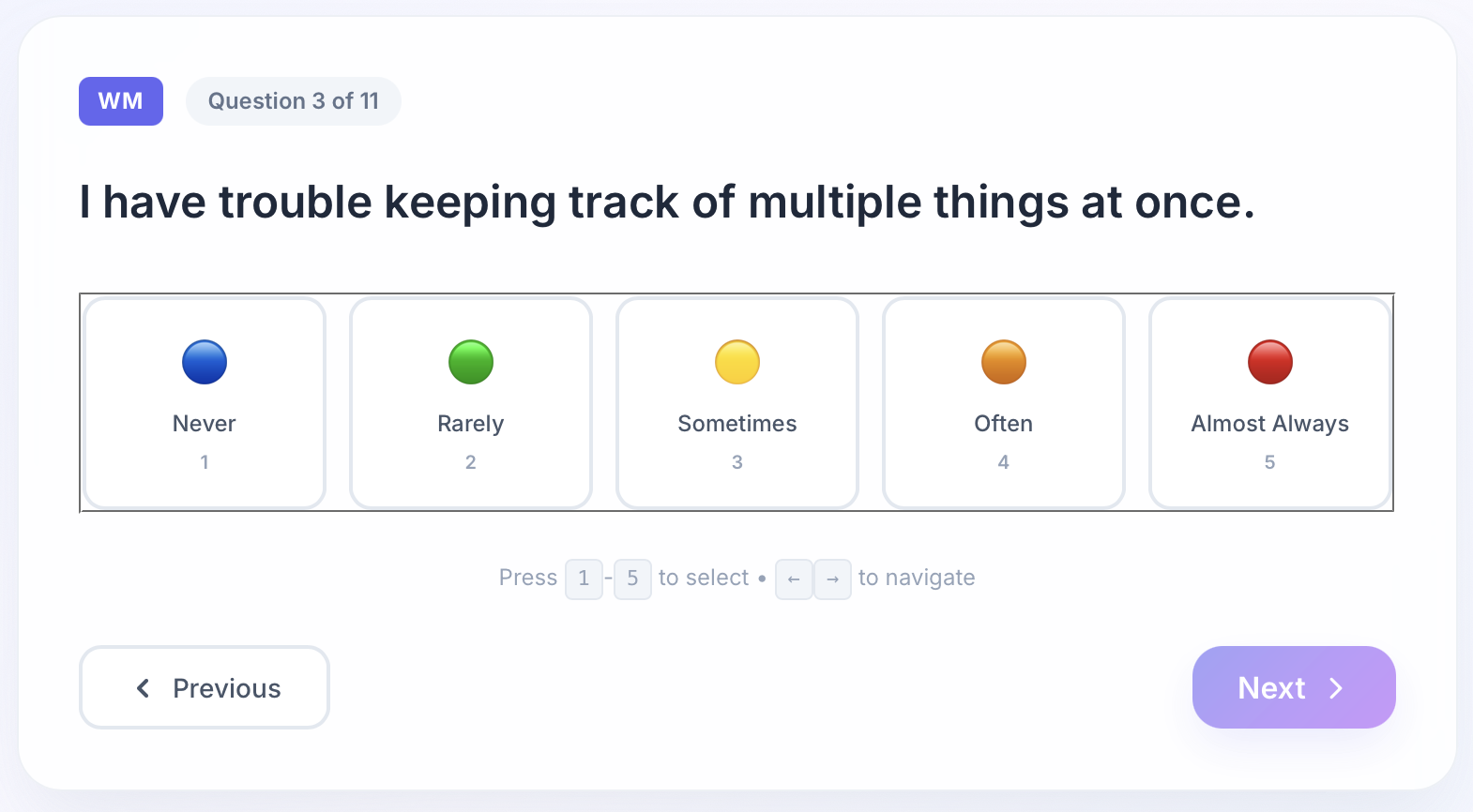
Students shouldn’t agonize over these answers, but instead should choose whichever feels the most natural. These questions should not take an excessive amount of time–even students who decide to test in each skillset should not be spending more than half an hour on the entire assessment.
Scientific Foundations for General Academic’s Executive Function Self-Assessment
Our executive function self-assessment is grounded in the Miyake unity/diversity model of executive functions, for the three core domains tested. Additional domains are designed to provide further context and to provide a more comprehensive profile of a student’s EF skillsets.
How to Read the Results of General Academic’s Executive Function Self-Assessment
Once students have completed the self-assessment, they’ll get a PDF document that shows their results in each category they took an assessment for. They’ll also have a general summary that shows their overall strengths and their overall weaknesses, or “Growth Areas.”
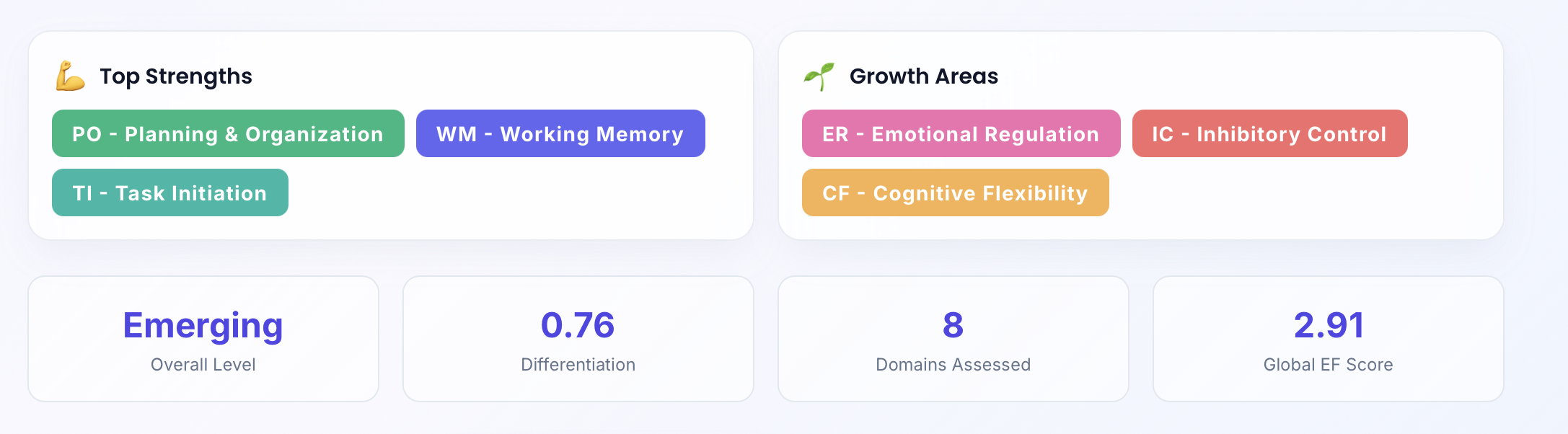
Students will additionally receive a score of 1-5 (called their “Global EF Score”) as well as a designation of “emerging,” “developing,” or “strong.” If a student is emerging (1.0-2.9), it means that they have not yet developed a strong executive function skill set. Developing (3.0-3.9) is a step up, though there is still room for students to hone their skills and improve in certain categories. Strong (4.0-5.0) means that the student is performing well overall in executive function for their age range.
Generally, students who receive an overall level of “Strong” do not need any additional help in executive function. These students are usually already utilizing EF skills in their schoolwork and extracurriculars to good effect, though additional reinforcement can never hurt.
Individual Executive Function Skillset Scores
The results are also broken down by category, so students can get a better idea of where they’re struggling the most, as well as where they’re the strongest. Like their overall score, these categories are scored out of 5, and are each assigned the same designation of emerging, developing, or strong.
In addition to these two measures, each skillset is also accompanied by a percentile ranking to show students how their abilities in that category compare to their peers’.
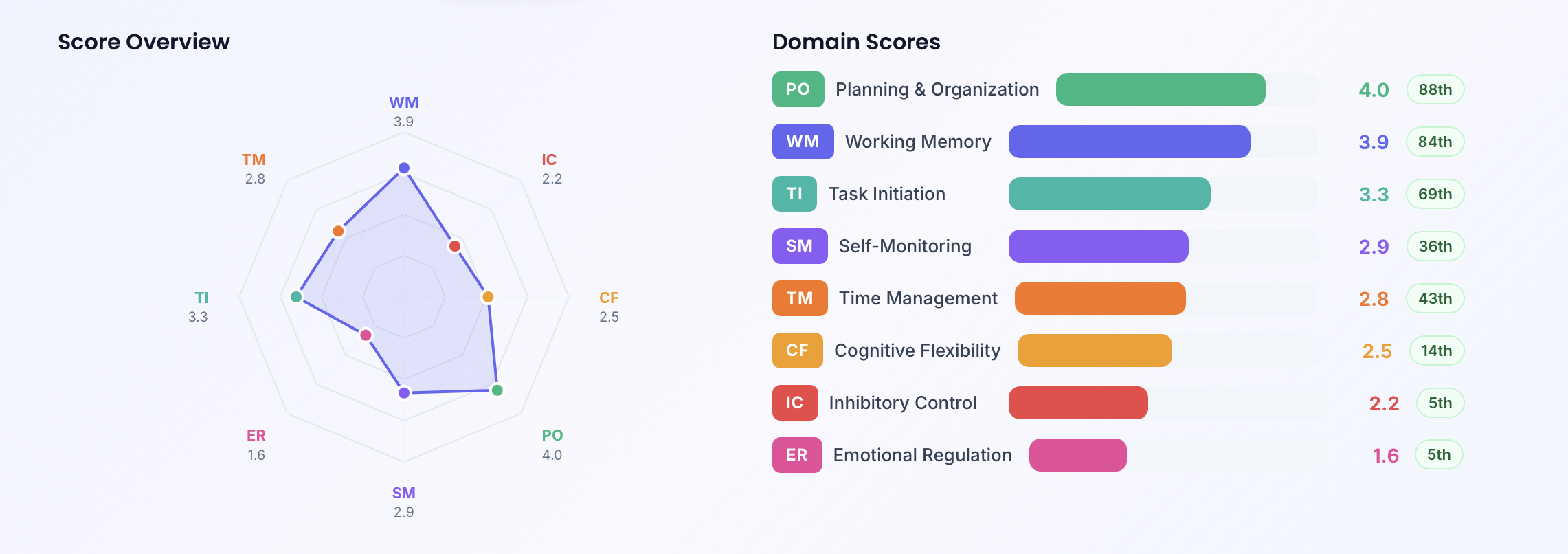
These results will tell students where they should focus their attention as they go about improving their executive function skills.
Composite Executive Function Indices
Finally, students can see how their scores in different skillsets work together to help them in different areas of the core tenets or indices of executive functioning. They also receive a numerical (1-5) score on each index.
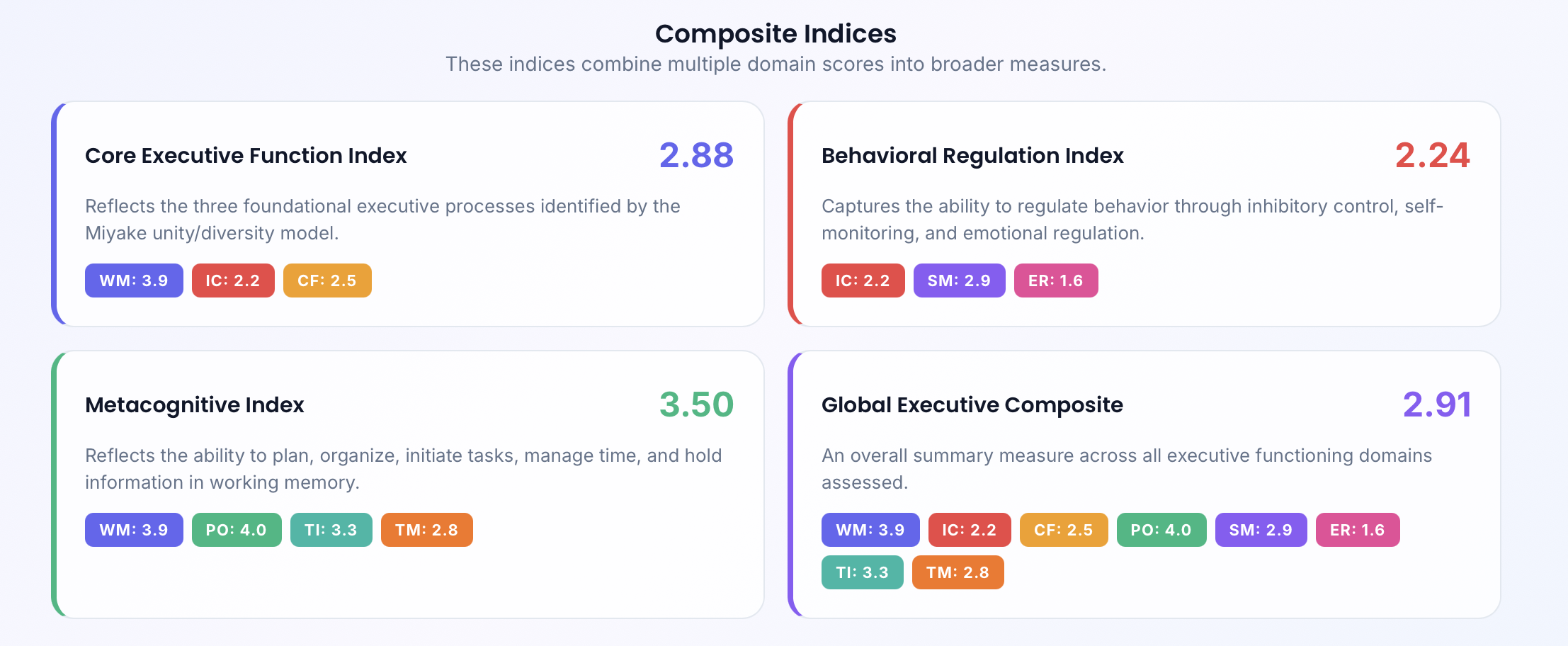
- Core Executive Function Index: this index combines the three required core skillsets of executive functioning; Working Memory, Inhibitory Control, and Cognitive Flexibility.
- Behavioral Regulation Index: this index focuses on outward behavioral skillsets like self-monitoring, emotional regulation, and inhibitory control.
- Metacognitive Index: this index highlights the more technical skillsets students need in order to accomplish big tasks; Working Memory, Planning and Organization, Task Initiation, and Time Management.
- Global Executive Index: this index includes all tested skillsets, and is the same as the overall composite score that students received
In order for students to get the most full and effective understanding of their performance in these various indices, they should take all 8 skillset assessments.
Next Steps to Improve Executive Functioning
Once you have an understanding of where your student is struggling when it comes to executive function, you can begin to develop a plan to help them improve these skills and become a stronger overall student and be set up for success in their post-school careers.
- Independent Tutoring: General Academic is happy to offer one-on-one executive function support to students, either as an add-on to subject tutoring, or as its own discrete hour-long session. In these sessions, tutors work with students to develop EF skills tailored to their specific needs. Tutors will help students organize their schedules, plan their weeks, and break up long projects and tasks into workable plans of action.
- Executive Functioning Course: General Academic is also offering an eight-week summer course that is focused on developing students’ executive function skillset, through the medium of working on a capstone volunteer project that they will be able to include on resumes and college applications.