Over General Academic’s 23+ years of supporting Houston students, we have seen academic expectations increase exponentially. Whether students are navigating the rigorous transition into an HISD Vanguard program or juggling advanced classes with intense extracurriculars at competitive schools like St. John’s, Kinkaid, or Awty, the sheer volume of work can quickly feel like a full-time job.
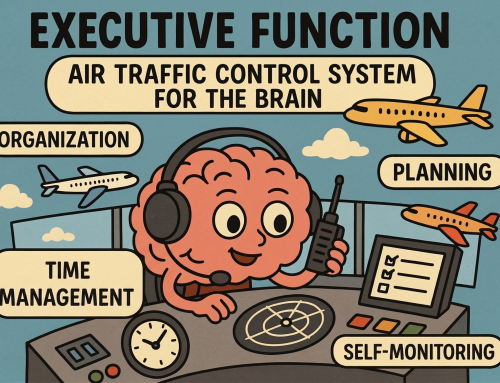
To thrive in these environments, intelligence and motivation are rarely the bottlenecks. Instead, the invisible foundation behind a successful, independent student is a strong set of executive function skills—the mental tools that help them regulate behavior, remember information, make plans, manage time, and adapt to changing circumstances.
We analyzed the self-reported results from students who completed our proprietary Executive Function Self-Assessment during our 2026 summer courses. While it is natural to question the accuracy of self-reported data among adolescents, peer-reviewed educational research demonstrates that teenagers are highly capable of identifying their own metacognitive limits. By asking the students directly, we gained a clear, unfiltered window into the specific friction points they experience daily.
The results reveal a fascinating pattern: these students assert that they are in control of their emotions and behavior but struggle to manage the logistical demands of their coursework, with working memory and time management standing out as the primary challenges.
Validated K-12 clinical tools establish a strict divide between behavioral regulation (impulse and emotional control) and metacognition (working memory, planning, and time management). Just as the broader clinical literature indicates, our data shows that a student can possess excellent behavioral control while simultaneously facing significant deficits in working memory as their academic environment demands more than their current developmental stage can support.
Of course middle and high school students are aware of social expectations, which can lead to some “social desirability bias” in these results. They know that society expects them to be impulsive, disruptive, or lack emotional control; therefore, they self-report to be better in these areas. Conversely, they also know that it’s socially acceptable to admit to being procrastinators or having trouble with time management.
The Eight Executive Function Skills We Measured
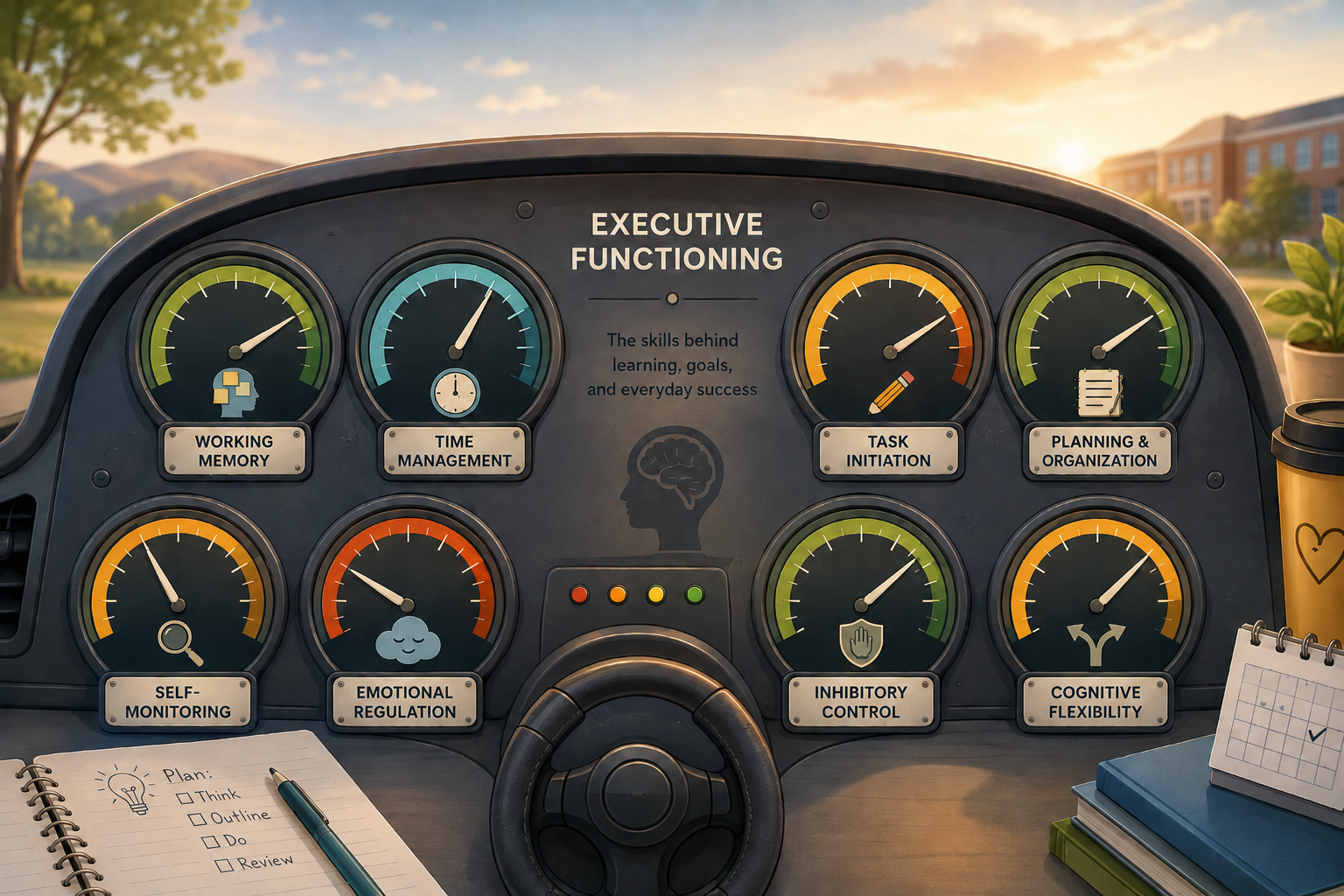
The assessment evaluates students in eight areas:
- Working Memory: Holding information in mind long enough to use it
- Time Management: Estimating, allocating, and using time effectively
- Inhibitory Control: Resisting impulses and distractions
- Cognitive Flexibility: Adjusting when plans, expectations, or circumstances change
- Planning & Organization: Developing a plan and keeping materials and information organized
- Self-Monitoring: Recognizing mistakes and evaluating one’s own performance
- Emotional Regulation: Managing emotional reactions appropriately
- Task Initiation: Beginning work without excessive delay or prompting
Students answer questions in each category from a scale of 1 to 5, with 5 being best. The assessment describes scores from
- 1.0–2.9 as Emerging
- 3.0–3.9 as Developing, and
- 4.0–5.0 as Strong.
Those categories can help parents understand a child’s individual results. But they do not necessarily tell us what scores are common among other students.
For that, we can look at the actual distribution of scores in our student sample.
What Is a “Typical” Executive Function Score?
It is important not to describe this dataset as a set of national or clinical norms. These students were not randomly selected from the entire student population, and our summer course sample is not large enough to establish formal normative standards.
However, the data can still provide a useful point of comparison.
For this analysis, we looked at the middle 50% of student scores in each category. In other words, we identified the range in which the middle half of students in our sample scored.
| wdt_ID | wdt_created_by | wdt_created_at | wdt_last_edited_by | wdt_last_edited_at | Executive Function Skill | Average | Median | Middle 50% | Flagged as Growth Area |
|---|---|---|---|---|---|---|---|---|---|
| 1 | hannahkelly | 08/17/2026 11:43 AM | hannahkelly | 08/17/2026 11:43 AM | Working Memory | 3.28 | 3.31 | 2.91–3.73 | 61% |
| 2 | hannahkelly | 08/17/2026 11:43 AM | hannahkelly | 08/17/2026 11:43 AM | Inhibitory Control | 3.64 | 3.87 | 3.27–4.27 | 37% |
| 3 | hannahkelly | 08/17/2026 11:43 AM | hannahkelly | 08/17/2026 11:43 AM | Cognitive Flexibility | 3.61 | 3.64 | 3.27–3.98 | 26% |
| 4 | hannahkelly | 08/17/2026 11:43 AM | hannahkelly | 08/17/2026 11:43 AM | Planning & Organization | 3.58 | 3.87 | 3.13–4.09 | 29% |
| 5 | hannahkelly | 08/17/2026 11:43 AM | hannahkelly | 08/17/2026 11:43 AM | Self-Monitoring | 3.58 | 3.45 | 3.29–3.82 | 37% |
| 6 | hannahkelly | 08/17/2026 11:43 AM | hannahkelly | 08/17/2026 11:43 AM | Emotional Regulation | 3.63 | 3.82 | 3.48–4.09 | 29% |
| 7 | hannahkelly | 08/17/2026 11:43 AM | hannahkelly | 08/17/2026 11:43 AM | Task Initiation | 3.49 | 3.64 | 2.89–4.09 | 34% |
| 8 | hannahkelly | 08/17/2026 11:43 AM | hannahkelly | 08/17/2026 11:43 AM | Time Management | 3.32 | 3.41 | 2.75–3.89 | 47% |
A parent should not interpret these ranges for the middle 50% as a dividing line between “normal” and “abnormal.” Instead, they provide context.
For example, a Working Memory score of 3.2 may sound low compared with the assessment’s maximum score of 5. But it actually falls near the center of the scores we observed among students.
A score substantially below the typical range may deserve closer attention, particularly if parents and teachers are seeing related difficulties in everyday schoolwork.
The Biggest Challenge: Working Memory
Working Memory had the lowest average score of all eight executive-function categories: 3.28.
It was also the category most frequently identified as a student’s growth area. Among the students included in our cleaned analysis, about 61% had Working Memory identified as one of their areas for improvement.
Working memory is sometimes misunderstood as simply having a “good” or “bad” memory. It is more specific than that. Working memory allows a student to temporarily hold information in mind while doing something with it.
Imagine a teacher saying:
“Open your textbook to page 142, read the first three paragraphs, answer questions 2 through 5, and then submit your answers online.”
A student with strong working memory may be able to retain those instructions while beginning the assignment.
A student with weaker working memory may open the textbook and immediately forget which paragraphs to read or which questions to complete.
The same problem can appear in math. A student may understand every individual step of a multi-step problem but lose track of an earlier calculation while completing a later one.
At home, parents might notice that a student:
- repeatedly asks what they are supposed to do next,
- forgets parts of multi-step directions,
- loses track of materials needed for homework,
- has difficulty taking notes while listening,
- understands a concept but struggles to carry out all the required steps.
These behaviors can sometimes look like carelessness or inattention. In reality, the student may simply be trying to hold more information in working memory than they can reliably manage.
Time Management Is Nearly as Difficult
The second-lowest average score was Time Management at 3.32.
Nearly half of the students in our analysis had Time Management identified as a growth area.This probably will not surprise many parents. Students are frequently asked to perform tasks that require surprisingly sophisticated judgments about time:
“How long will this homework assignment take?”
“When do I need to start studying for Friday’s test?”
“How much of this project should I finish tonight?”
“If soccer practice ends at 7:30, can I realistically finish two hours of homework afterward?”
Adults make these calculations constantly. Students are still learning how.
A student with weak time-management skills may repeatedly underestimate how long assignments will take. They may spend too much time on an unimportant part of a project and then rush through the most important part. They may also understand perfectly well that something is due Friday without recognizing that waiting until Thursday night creates a problem.
Parents often interpret this as procrastination.
Sometimes it is. But sometimes the underlying difficulty is more specific: the student does not yet have an accurate internal sense of how long tasks take or how far in advance they need to begin.
Where Were Students Strongest?
The data were not uniformly negative. In fact, several executive-function skills emerged as relative strengths.
- Inhibitory Control had the highest average score at 3.64.
- Cognitive Flexibility and Emotional Regulation were close behind, with average scores of 3.61 and 3.63.
This suggests an important point for parents: a student does not have to be impulsive, disruptive, or emotionally volatile to have executive-function difficulties.
Many students in the sample appear relatively capable of controlling their immediate behavior. They may resist impulses, manage their emotions, and adapt when circumstances change. Their difficulties emerge instead when school requires them to manage information and work independently over time. That distinction becomes even clearer when the assessment’s broader categories are considered.
Students performed better overall on measures related to behavioral regulation than on measures related to metacognition, which includes Working Memory, Planning & Organization, Task Initiation, and Time Management.
Why Executive Function Problems Can Become More Visible as Students Get Older
Executive-function weaknesses often become more noticeable when academic expectations increase. A young student may have one primary teacher who frequently reminds the class what to bring home, what is due tomorrow, and what to work on next. A few years later, the same student may have seven teachers, seven sets of expectations, different online platforms, long-term projects, extracurricular activities, and several tests in the same week. The student’s executive-function abilities may not have suddenly become worse. Instead, the environment has begun demanding more of them.
Our data showed some evidence of this pattern. Eighth-grade students in the sample reported greater difficulty than fifth graders in several areas, particularly Working Memory, Task Initiation, and Time Management. Because these were different groups of students rather than the same students followed over time, we should not conclude that executive function declines as students age. A more reasonable interpretation is that increasing academic demands may expose executive-function weaknesses that were easier to compensate for in elementary school.
What Should Parents Do If Their Child Scores Low?
The most useful response is not simply telling a student to “be more organized.” Executive-function skills improve when students practice specific behaviors and gradually develop systems that reduce the amount of information they have to manage mentally.
If Working Memory Is the Problem
The goal is to externalize information so the student does not have to hold everything in their head.
Useful strategies include:
- writing down multi-step instructions,
- creating checklists,
- keeping assignments in one consistent location,
- breaking complicated tasks into shorter sequences,
- asking the student to repeat directions back in their own words,
- using written routines for recurring tasks.
A checklist is not a crutch. It is a tool that reduces unnecessary demands on working memory.
If Time Management Is the Problem
Students need practice connecting tasks with actual amounts of time. One particularly useful exercise is to have a student predict how long an assignment will take and then measure the real time. If a student repeatedly predicts 20 minutes for work that takes 50 minutes, they begin to recognize the mismatch.
Parents can also help students:
- work backward from deadlines,
- establish intermediate deadlines for long-term projects,
- estimate homework time before beginning,
- compare planned time with actual time,
- look at the entire week’s workload rather than one night at a time.
How Should You Interpret Your Child’s Assessment?
No single executive-function score tells the whole story. Parents should look at a child’s results in three different ways.
1. Look at the Absolute Score
Is the skill classified as Emerging, Developing, or Strong? This provides a general indication of how consistently the student reports using that skill.
2. Compare the Score With Other Students
The ranges in this article can provide context. A score that seems disappointing in isolation may actually be common among students. Conversely, a score far below the middle range may indicate a skill worth examining more closely.
3. Compare the Child With Themselves
This may be the most important comparison of all. Suppose a student scores around 4.3 in seven categories but earns a 3.2 in Time Management. A 3.2 is not an extraordinarily low score compared with other students. But within that child’s individual profile, it clearly stands out as a relative weakness. Executive-function support is most effective when it targets those specific bottlenecks rather than treating executive function as a single ability.
The Goal Is Not Perfection
Most students in our data were not uniformly “Strong” across all eight executive-function categories. That should not be surprising. Executive-function skills develop over time, and different students develop them at different rates. Academic environments also place unusually heavy demands on some skills—particularly remembering information, initiating work, and managing multiple deadlines.
The more useful question for parents is not:
“Does my child have good executive function skills?”
It is:
“Which executive-function skill is making school harder for my child right now?”
Our data suggest that, for many students, the answer is not impulse control or emotional regulation. It is much more likely to involve remembering what needs to be done, starting it on time, and managing the time required to finish it.
Once that bottleneck is identified, parents, teachers, and students can work on concrete strategies instead of relying on repeated reminders to “try harder” or “be more organized.” Executive function is not a fixed trait. These are skills—and skills can be taught, practiced, and improved.
More about Executive Function from General Academic
- Take our Executive Function Self-Assessment
- What is Executive Function and How Students can Improve It
- Executive Function Coaching and Tutoring Support