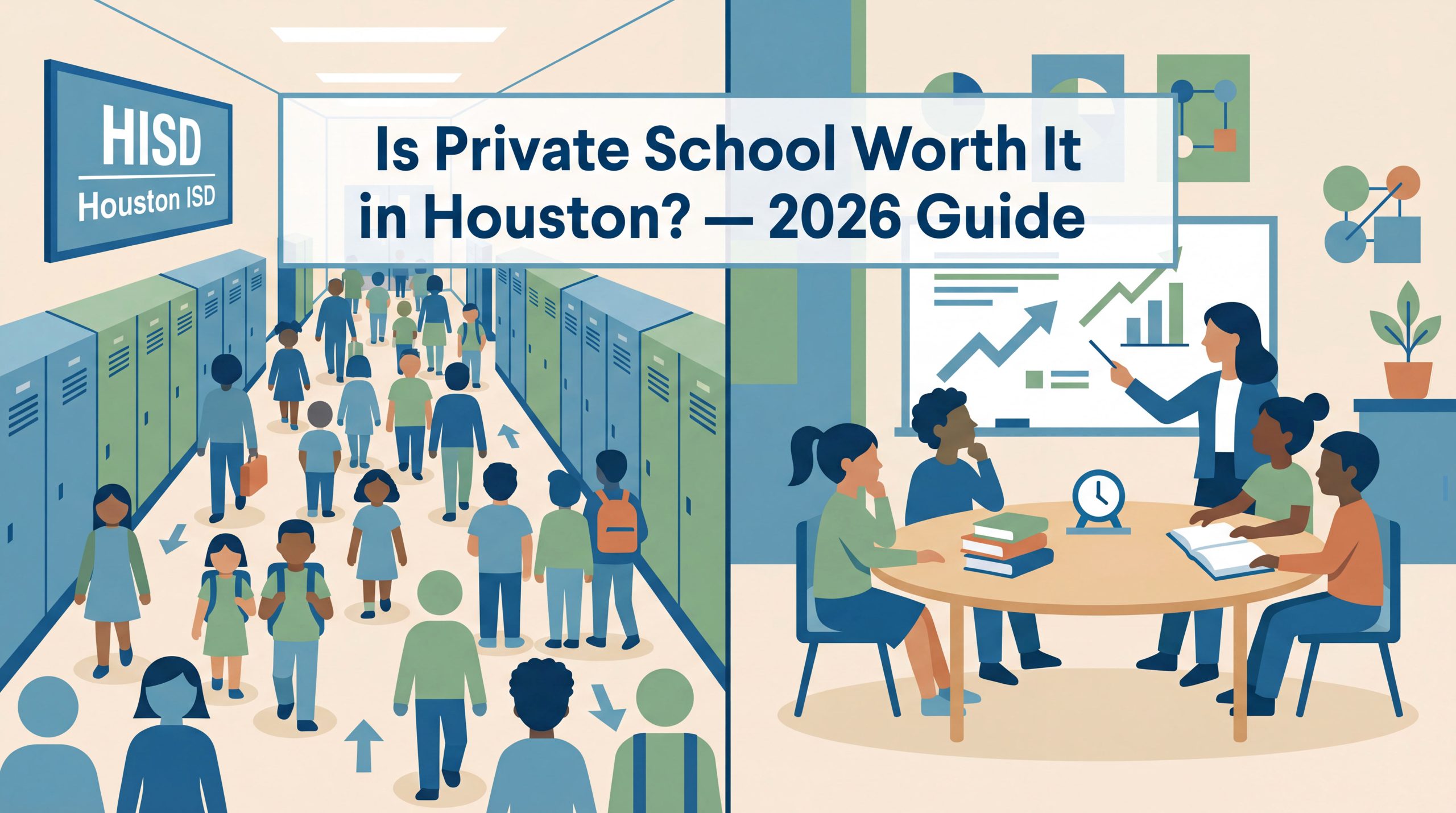
The private school deposit is due in three weeks, and your zoned elementary just cycled through another principal. You’re sitting at your kitchen table with cold coffee and a tuition spreadsheet, stuck somewhere deciding between the Katy Freeway traffic you’d face every morning and the $18,000 annual bill you’re not sure you want to sustain. The only question that matters: Is this worth it?
The answer looks completely different depending on which neighborhood you live in, your child’s needs and wants, and what your actual alternatives are. While there isn’t a universal answer, this guide will give you the framework needed to make the call based on your specific child, your actual zoned campus, and the private schools you’re genuinely considering — not based on fear, headlines, or what worked for someone else’s family three years ago.
The reality of timing: The main constraint affecting Houston families right now isn’t money or even school quality — it’s the calendar. Private school admissions deadlines, magnet lottery applications, and enrollment deposits come due in January through March, exactly when HISD’s staffing and policy decisions are still in flux. You’re being asked to commit before you have complete information, which makes disciplined, campus-specific fact gathering essential.
What you’ll find here:
- A rubric to define “worth it” for your family’s specific priorities — not a generic ranking
- Plain-English translation of what’s actually happening at HISD under state oversight and what it means for your day-to-day life
- Concrete questions to ask both public and private schools that reveal how they handle the situations that matter: struggling students, behavior issues, staffing changes
- Side-by-side comparison tools that hold both sectors to the same evidence-based standard
- Validation that staying in public school—or choosing a hybrid path—can be the right call
A critical note about currency: As of February 2026, HISD (Houston Independent School District) policies, staffing, and performance data can change quickly under state oversight. If you are reading this at a later date, re-check the latest Texas Education Agency (TEA) and HISD updates before deciding. What was true in fall 2025 may not hold in spring 2026.
What to do with this guide: Use one consistent rubric to compare your zoned HISD campus to specific private schools. Verify indicators that affect daily life—staffing stability, discipline and classroom climate, academic growth—rather than relying on district-level headlines alone. Your child won’t attend “HISD.” They’ll attend a specific campus with a specific principal, teachers, and community. Make the decision at this level of granularity.
What does “worth it” mean in Houston, and what are you actually paying for?
Meet a family in Meyerland with two kids, three years apart. When their older child started kindergarten, the zoned elementary was thriving: the principal had been there six years, teachers were returning every fall, and the PTA was engaged. Private school never crossed their minds. Why pay $22K for something they were already getting?
Fast forward, and their younger child is about to start at that same school. Now, that principal left, their replacement lasted one year, and the second replacement started in August. Half the teachers their older child had are gone. Plus, their younger child is different — more anxious, slower to warm up. She’s the one who asks every Sunday night, “Is my teacher going to be there tomorrow?” The same family that said “absolutely not” to private school three years ago is now touring campuses and running the numbers.
Nothing changed about this family’s values or finances — what changed was the school and the child. “Worth it” isn’t a fixed answer; it depends on which child you’re deciding for, which campus you’re comparing against, and what conditions look like right now.
Here’s a framework to think through what matters to you. A school doesn’t need to score high on everything, but it needs to score high on what you need most.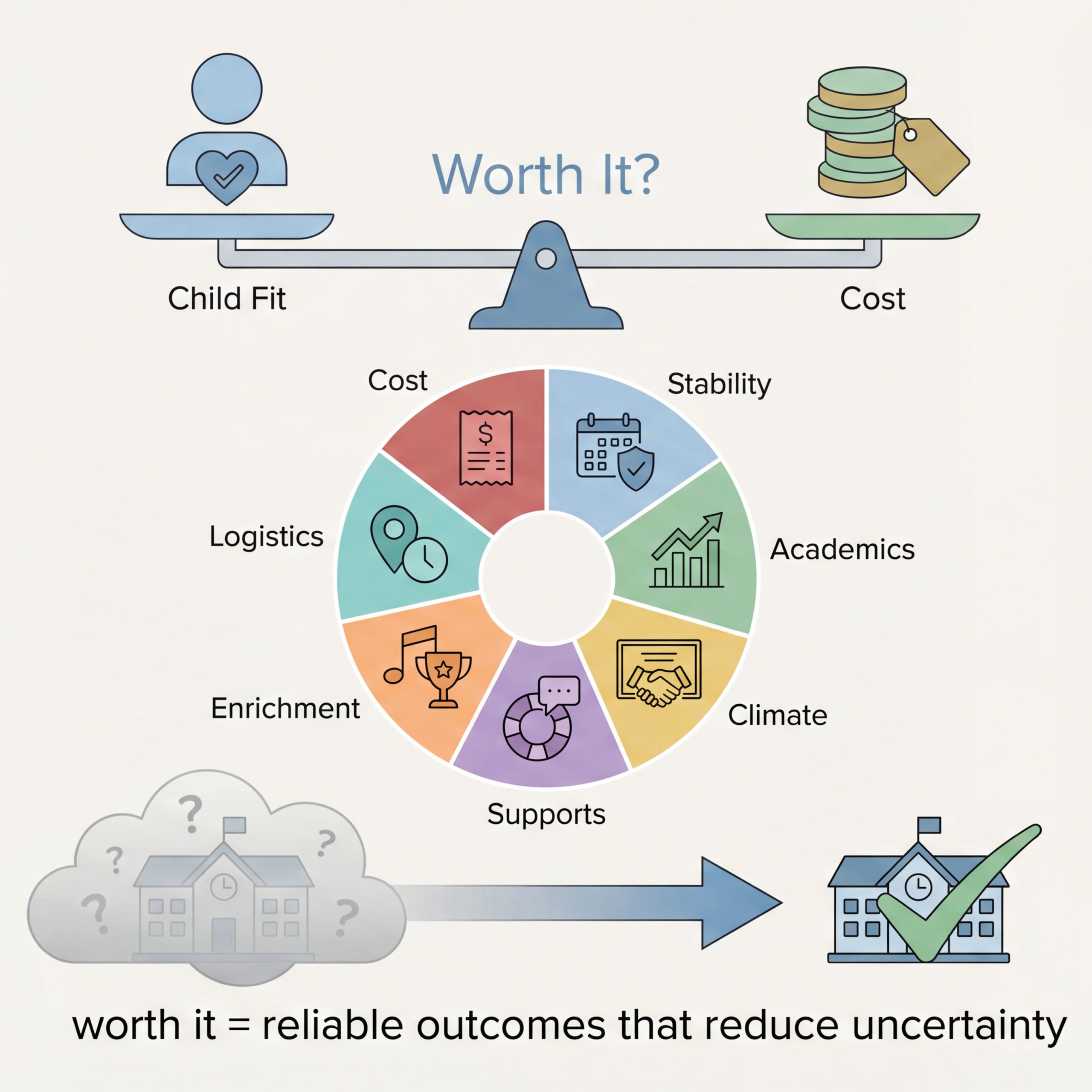
Stability and predictability:
This is especially important for change-sensitive kids. Does leadership stay consistent, do teachers return, and are schedules and policies stable — or does everything reset every August? For some kids, a new teacher in October means three weeks of stomachaches before school. If your child struggles with transitions, or if you’ve lived through multiple principals and policy overhauls, this might be your highest-weight category. Ask how long the current principal has been in place, what the teacher retention rate is, and how much has changed between this year and last.
Academics, growth plus proficiency:
This is a two-parter. Proficiency tells you where students are right now — are they working at or above grade level? Growth tells you whether the school moves students forward — is a campus with lower scores actually accelerating learning faster than one coasting on high baselines?
Don’t stop at a school’s overall rating or a district-level headline. A campus can earn a B overall while greatly struggling in a specific subject or grade band. If your eighth grader struggles with math, that campus’s Algebra I pass rate matters more than its aggregate score. Texas rates campuses across three domains:
- Student Achievement (are students at grade level now?)
- School Progress (are they improving?)
- Closing the Gaps (are gains reaching all student groups?)
Weaknesses in one domain can hide behind strengths in another. Pull your campus’s data directly from the TEA website and look at subject-by-subject results for the grades your child will actually attend. Look for two-to-three-year trends and not a single year’s snapshot, especially at smaller campuses where a handful of students can swing percentages dramatically.
Classroom climate and discipline:
This is most important for kids who are negatively affected by chaos. Your child won’t describe it as, “poor classroom climate.” They’ll say, “It’s too loud,” or, “Kids are mean and the teacher doesn’t do anything.” How does the school handle disruptions? Is discipline consistent across teachers, or does it depend on who your kid gets? Can teachers actually teach, or are they managing poor behavior all period? If they’ll let you, try to tour at mid-morning on a Wednesday—not during the admissions-office-scheduled visit—and watch transitions between classes. Ask current families: does your child feel safe? Can they concentrate?
Student support, counseling, learning services, special education:
Does your child have special needs? What’s the school’s counselor-to-student ratio? If your child has an IEP, how does the school implement it? (And if you’re looking at private schools: do they even provide the services your child is legally entitled to in public school? Many don’t.) If your child has ever needed intervention—academic, behavioral, social-emotional—this category might be your deal-breaker.
Enrichment and opportunities:
Arts, music, clubs, sports, advanced coursework. Enrichment matters, but it’s secondary to the foundations — stability, safety, and solid instruction. If those aren’t in place, a robotics program or theater department won’t make up the difference. If they are in place, and your child has a deep interest a school can sustain, that’s real added value.
Logistics, commute, aftercare, calendar:
Can you realistically do pickup and drop-off given your work schedule and Houston traffic? Does the school’s calendar align with your job’s flexibility? Is there aftercare that actually works? A “perfect” school you can’t logistically manage isn’t perfect. If you’re commuting from Pearland to Bellaire, you need to factor in what happens when 288 has traffic issues or floods.
Total cost, all-in:
Not just tuition — you need to add in to the total cost the fees, uniforms, fundraisers, the “optional” gala tickets, and after-school costs. Can you sustain this for multiple years, possibly for multiple children? If you’re stretching to afford one year, what happens in year three when tuition increases or your financial situation changes?
When you’re paying for private school, you’re not paying for guaranteed outcomes; no school can promise that. You’re paying for reduced week-to-week uncertainty through consistent school staff and routines, clearer pathways when a student falls behind, and access to specific support or enrichment your public option doesn’t reliably provide.
The goal isn’t perfection. It’s finding the best match for your child’s specific needs, given your real alternatives and constraints.
—
Before you can weigh whether private school delivers better value, you need to understand what’s actually happening at your HISD campus right now and which questions get you real answers.
Parent-relevant risks to monitor in HISD right now
You’re not looking for reasons to panic. You’re looking for information that helps you plan. These are practical, answerable questions where campus-level variation matters more than district headlines.
The backdrop you need to understand
In 2023, the Texas Education Agency took over HISD, replacing the elected board with a state-appointed Board of Managers and superintendent. Reporting in 2025 suggested oversight would likely continue through at least 2027. What this means is that district leadership can implement changes faster, but often with less advance notice to families. Meanwhile, enrollment has dropped by more than 30,000 students since 2016, and those losses ripple into individual campuses as staff get reassigned, class sections combine, and programs lose their sponsors. The debate on HISD’s governance itself carries a cost: community friction, stressed teachers, and a campus culture shaped as much by adult anxiety as by policy. However, none of this tells you what’s happening at your zoned school, but it’s the context behind the specific, campus-level questions below.
Here’s how to get the information you actually need:
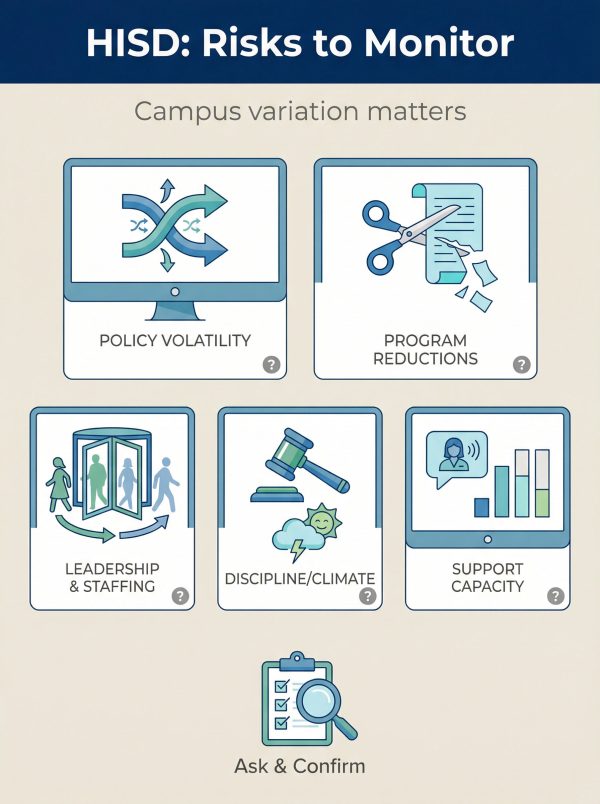
Policy volatility
Ask: “What district policies changed this year, and how were families informed?”
You’re not asking whether policies changed — they always do. You’re asking whether families got advance notice or found out from their confused child. For example, a Montrose elementary sent detailed emails in May about new pickup procedures starting in August, held a parent Q&A, and posted FAQs. This is managed change. In another example, a Gulfton campus switched to a new behavior system in October. Parents learned about it from their kids, and the principal didn’t respond to emails for three weeks. This is chaos. both schools are in the same district, but with very different experiences. Ask current families: how do you usually find out about changes?
Program reductions
Ask: “Have electives or sections been cut recently?”
This tells you whether the campus is stable or scrambling. A Memorial-area middle school cut its orchestra program last year when enrollment dropped and the teacher retired. Families who had chosen that school specifically for music were blindsided. If your child is in fourth grade and the campus once offered two sections per grade but now only offers one, ask what happens when your kid reaches fifth — will class sizes jump to 28? Will they combine classes? Cuts reveal budget stress and priorities, and they also reveal whether leadership plans ahead or reacts in August.
Leadership and staffing turnover
Ask: “How long has the current principal been in place?”
A principal who’s been at a campus for five years knows the families and has built a team. A principal starting their second year is still figuring it out — higher uncertainty, not necessarily bad. Three principals in three years? That’s a culture problem your child will feel. They won’t know what “leadership turnover” means — they’ll just notice that the rules changed again and nobody explained why.
Ask: “How many core teachers are returning this year?”
High teacher retention signals that adults want to stay; they feel supported, the culture is decent, and leadership is stable. High turnover signals the opposite. If 40% of teachers are new, your child will spend September and October in classrooms where the teacher is still learning names and routines.
Discipline and climate
Ask: “How are minor versus major behaviors handled?”
This reveals whether the school has a coherent system or whether discipline is arbitrary. At one Bellaire campus, minor issues (talking back, not following directions) are handled by teachers with consistent consequences. Major issues (fighting, threats) go to the principal immediately. Parents know what to expect. At another campus, the same behavior might get a call home from one teacher, detention from another, or nothing from a third. Inconsistency can lead to anarchy. Ask schools: what does your discipline matrix look like? Can I see it? Ask parents: do consequences feel fair and predictable?
Support capacity
Ask: “What is the counselor-to-student ratio and special education staffing level?”
If your child has an IEP, this is non-negotiable. Ask how many special education teachers and aides are on campus and whether they’re full-time or split between campuses. If your child doesn’t have an IEP but might need academic or behavioral support, ask how quickly can a struggling student access help? What does Tier 2 intervention look like here? One counselor for 600 students means your child will have access to support only when there’s a crisis (maybe). One counselor for 350 students, plus dedicated intervention staff, means earlier, more consistent help.
These aren’t “gotcha” questions — these are planning questions. A school doesn’t have to be perfect on all seven, but if you’re considering paying $20K+ for private school primarily because of HISD instability, you need to make sure that instability actually exists at your specific campus. You just might find out that your zoned school is steadier than you thought… or, you might confirm your concerns and can make the private school decision with confidence.
—
Now that you know what to look for at your HISD campus, let’s examine what private schools offer — and more importantly, what they promise versus what they deliver.
What advantages can Houston private schools offer, and what varies school to school?
Well-run private schools can offer real advantages, and the key word here is “well-run.” The advantages aren’t automatic — they’re possibilities that depend on the specific school, its resources, and how it operates. Here’s what you might get, what it actually looks like in practice, and when it doesn’t materialize.
Smaller class sizes — and what that actually affords you
The promise: Your child gets more individual attention, teachers know each student, and no one falls through the cracks.
When it works: A River Oaks prep school with 12 students per class and two teachers can genuinely individualize instruction. Your seventh grader who struggles with writing gets daily check-ins. The math teacher notices when your child zones out during fractions and reteaches the concept before moving on. Small classes create space for relationships, and relationships drive learning.
When it doesn’t: A Montessori school near the Medical Center has 18 students per class — smaller than HISD’s 22-student average, but if your child needs significant intervention, then that gap might not be the difference that matters. Plus, private schools are not immune to teacher turnover. If the private school has high teacher turnover, then you’re paying for small classes with a new teacher starting from scratch every year.
The trade-off: Smaller classes sometimes mean fewer sections, which can limit schedule flexibility. That elective your child wanted? It might not run if only six kids sign up. The advanced math class? It might combine seventh and eighth graders, which works for some kids and frustrates others.
More consistent culture and discipline — when it’s real
The promise: Everyone’s on the same page about behavior expectations. No chaos, no constant policy shifts.
When it works: An Episcopal school in Bellaire has a clear discipline philosophy, trains all teachers in it, and applies it consistently. Parents know what to expect. Students know what to expect. When your child makes a mistake, the response is proportional and educational, not punitive or arbitrary. Consistency creates safety, and safety allows kids to focus on learning.
When it doesn’t: A newer private school near the Galleria has behavior expectations on paper, but in practice, enforcement depends on which teacher your child has. One teacher sends kids to the office for minor infractions. Another lets disruptions slide. Parents complain, but the school doesn’t address it. You’re paying private school tuition for the same inconsistency you’d get at some public schools.
The trade-off: “Consistent culture” can also mean “not flexible for your kid.” If the school has a strict, traditional approach and your child needs movement breaks or learns differently, that consistency will work against you, so make sure the approach fits your child before you pay for it.
More predictable calendars and communication — except when it’s not
The promise: No mid-year policy changes. Clear communication. Stable schedules.
When it works: A Catholic school in the Heights publishes next year’s calendar in February. The principal sends a weekly email that contains important information. When something changes, families hear about it in advance with a clear rationale. Predictability reduces stress for parents who need to plan work travel, childcare, and logistics months ahead.
When it doesn’t: A private school in Sugar Land changes its start time in July, announces a new homework policy three weeks into the school year, and communicates primarily through a parent portal that half the families don’t check. Just because a school is private doesn’t mean it’s well-organized. Small schools sometimes lack the infrastructure to communicate effectively.
The trade-off: Private schools can be more volatile than public schools in some ways. If enrollment drops, then they might cut staff mid-year; if a head of school leaves, then the whole culture can shift. You could be trading district-level policy instability for school-level financial or leadership instability.
Broader enrichment and specialized programs — if you can access them
The promise: Robust arts, music, languages, clubs, and sports that survive budget cuts.
When it works: A prep school in West University offers Mandarin, theater, debate, robotics, and three competitive sports teams — all sustained even when enrollment dips slightly, because tuition revenue and donor support keep programs funded. Your child who’s passionate about Model UN can actually participate in Model UN all four years of high school.
When it doesn’t: A small private school near Rice has wonderful enrichment on paper, but many programs require a minimum enrollment to run. Your child signs up for Latin, but the school cancels it when only four students enroll. The robotics club exists, but the one teacher running it is overloaded and exhausted. Enrichment is only an advantage if it’s reliably available and well-supported.
The trade-off: Enrichment at private schools sometimes costs extra on top of tuition. That spring theater production? There’s a $300 participation fee. Club sports? Pay-to-play with additional travel costs. Make sure you understand the all-in cost, not just tuition, before committing.
The accountability gap — and why it matters
Here’s the hard truth: public schools publish STAAR and accountability data. You can see exactly how students perform, year over year, by subject and subgroup. Private schools generally do not. They’re not required to, and most don’t. That means you’re evaluating them through different, less transparent measures: curriculum documentation, internal assessments (which they design and may not share), college placement lists, and anecdotal parent reviews.
What this means practically: If your child struggles academically, you can look at HISD data and see whether a campus effectively supports students who start behind. You can see growth trends. With private schools, you’re often relying on what they tell you during the tour, not independent data. Ask hard questions: How do you measure growth? What percentage of students need intervention, and what does that intervention look like? Can I see trend data, or talk to parents whose kids needed extra support?
A critical note for families with special needs: Independent schools are not legally obliged to provide IEPs or the special education services your child is entitled to in public school. Many don’t. Some private schools have strong learning support programs, but you need to verify exactly what’s offered, what it costs (often additional fees), and whether it matches your child’s needs. Don’t assume “private school” equals “better support.” For many students with IEPs, public school is actually the stronger option.
The questions you should ask any private school
Don’t accept vague answers. Schools that are doing this well can be specific:
- “How do you measure and track student growth?” You want to hear about specific assessments (MAP, NWEA, internal benchmarks), how often they’re given, and what the school does with the data. If they say “we know our students well,” that’s not a measurement system.
- “How do you support students who are struggling academically or behaviorally?” You want to hear about Tier 2 and Tier 3 interventions, staff who provide them, and how quickly students can access help. If they say “we have small classes, so teachers can help,” ask what happens when small-class attention isn’t enough.
- “How do you handle disruptive behavior, and what does your discipline data show?” If they don’t track discipline data—how many referrals, for what, and what the outcomes were—they can’t tell you whether their approach actually works. You’re paying for consistency; ask them to prove they deliver it.
“Private school” isn’t a single category — Houston’s options range from Catholic and Jewish day schools to secular prep schools to Montessori to schools focused on learning differences. For example, the St. John’s experience is not the Emery/Weiner experience, nor is it the smaller parish school experience. Be sure to research the specific school, and not the category.
—
Understanding what private schools might offer is one thing, but comparing them to your public option in a fair, evidence-based way is another. Here’s how to do it right.
How do you compare your zoned HISD campus to a specific private school?
Hold both schools to the same standard. Don’t give your zoned HISD campus a pass because it’s free, and don’t give the private school a pass because you’re paying for it. Make both sectors prove their claims using the same framework, which means collecting the same evidence from both, visiting under the same conditions as possible, asking the same hard questions, and weighing what you find — not what either school’s marketing promises.
Step 1: Collect the same evidence from both schools
Make a simple spreadsheet with columns for “Our HISD Campus” and “Private School Option,” with rows for the information that matters to you.
For the HISD campus: Pull the latest TEA accountability rating, STAAR results, and campus improvement plan directly from the Texas Education Agency website — the actual data, not a news article interpreting it. Look up the staff directory to confirm principal tenure and grade-level staffing, and note which programs are available, such as gifted and talented, music, art.
For the private school: Request the same level of detail during your tour. “Can we see your internal assessment data and how students grow year over year?” Ask for confirmation of teacher tenure and qualifications, the actual curriculum scope and sequence (not just a brochure), and whether current programs continue as students get older or get cut.
Don’t assume nice facilities mean transparency — ask the same hard questions you’d ask of any school.
Step 2: Visit both campuses — and know what to look for even on a curated tour
Most families won’t get to observe a random Wednesday morning at their zoned HISD campus — public schools generally don’t offer drop-in visits during instruction. You’ll likely see the school during an open house, a scheduled tour, or drop-off and pickup. Private schools offer more access, but their tours are still sales events. Either way, a curated visit is still useful if you know what to pay attention to.
What you can learn even from a polished tour:
Watch the edges, not the showcase. How do adults in the hallway interact with students who aren’t performing for visitors? Is the front office calm or chaotic? Are hallway transitions orderly, or does the energy shift the moment you leave the tour route? Listen for what the guide doesn’t mention — if they talk at length about facilities and skip over academics or discipline, that’s telling.
Ask to see common spaces — the cafeteria, the pickup line, the hallway between classes. These are harder to stage than a hand-picked classroom. If the school resists showing you anything beyond a curated path, note that.
For private schools specifically:
Push for a visit during regular instruction, not just an admissions event. If the admissions office steers you toward a Friday afternoon shadow day or a weekend open house, ask why you can’t see a typical Tuesday. Schools that are confident in their daily operations will accommodate this; schools that aren’t will keep steering you toward the showcase.
During any visit — curated or not — ask:
- “What happens when a student is struggling academically?”
- “How do you handle behavior issues?”
- “Can we talk to a current parent whose child is similar to ours?” (Specify: a student who’s academically middle-of-the-road, not the star student the school wants to showcase.)
Step 3: Talk to current families
Don’t just ask “Do you like this school?” Ask specific, context-rich questions:
- “How does the school communicate when something changes?” (You want to know about transparency, not just friendliness.)
- “Has your child ever struggled, and how did the school respond?” (You want to know about support systems, not just happy stories.)
- “Why did you choose this school, and has it delivered on what you expected?” (You want to hear about the gap between promise and reality.)
For the HISD campus, talk to families in your neighborhood. For the private school, ask the admissions office for parent references — then find parents through a local Facebook group or parent network, because the school will only connect you with its happiest families.
Step 4: Check the consistency of what you hear
As you talk to families, take notes and look for patterns. Do parents tell consistent stories about the school’s strengths and weaknesses? Or do you hear wildly different accounts — one family raving about communication while another says they never hear anything until the last minute?
Consistency across families suggests a school with reliable systems. Inconsistency suggests that your child’s experience will depend heavily on which teacher they get, which grade they’re in, or how proactive you are as a parent. That’s not automatically disqualifying — it might mean the school is in transition, or that some grades are stronger than others — but it’s a flag to investigate further.
Step 5: Weigh the evidence, not the marketing
Lay your evidence side by side:
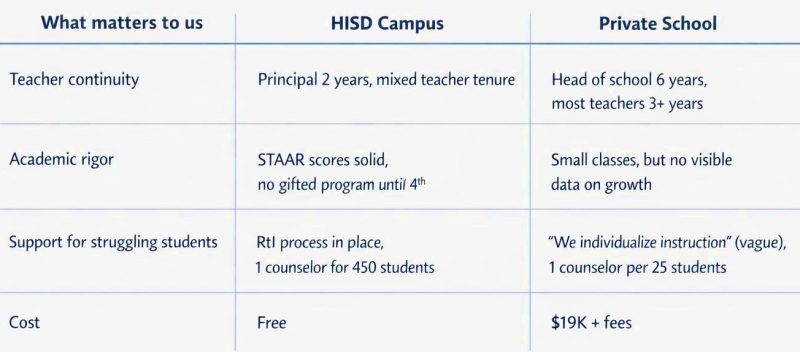
Your HISD campus might have more stability and clearer academic data. The private school might have smaller classes but can’t show evidence of better outcomes. Or it might be the reverse. The point isn’t which direction you land — it’s that you’re comparing based on parallel evidence, not gut feeling versus glossy marketing.
The evidence you should collect for both schools
Here’s your checklist:
- Academic evidence:
- Published data (STAAR for public schools; ask private schools for internal assessment trends and college placement data)
- Curriculum documents and program lists (what’s offered, and is it sustained across grades?)
- Evidence of how they support struggling students (not just claims — ask for specifics)
- Stability evidence:
- How long has current leadership been in place?
- Staff directory or teacher tenure information (how many teachers return year over year?)
- Recent major changes (schedule shifts, program cuts, leadership transitions)
- Observation evidence:
- Tour during regular school hours on a regular school day
- Watch transitions, student engagement, adult-student interactions
- Ask to sit in a classroom if possible
- Parent evidence:
- Talk to at least three current families (if possible, families whose child is similar to yours)
- Ask specific questions about communication, support for struggling students, and promises versus reality
- Policy evidence:
- Discipline procedures and data (how often are students referred, for what, and what happens)
- Written policies on accommodations, re-enrollment, tuition refunds (especially for private schools — read the fine print)
Keep in mind that you’re building a body of evidence, and not just checking boxes. If one school provides detailed answers and the other deflects, then that’s important information. If one school’s story is consistent across parents and the other school’s story varies wildly, that is another data point.
Red flags to watch for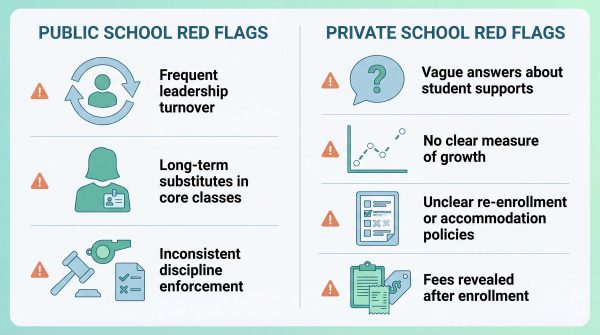
Red flags aren’t automatic dealbreakers, but they’re signals to slow down, ask more questions, and verify what you’re hearing. Here’s what to watch for during tours and conversations, with examples of what these flags actually look like in practice.
Red flags at your zoned HISD campus
Frequent leadership turnover
What it looks like: You’re touring an elementary in Sharpstown. The front office staff mentions the current principal started in August. You ask how long the previous principal was there. “Oh, she left after one year. The one before her stayed two years.” Three principals in four years means families and teachers never have time to build trust. You’re evaluating a school in constant transition. Ask: what caused the turnover? District reassignments (somewhat normal) or people leaving because the job was untenable (red flag)?
Long-term substitutes in core classes
What it looks like: You’re visiting a middle school in Braeswood in November. You ask to observe a math class, but the person teaching isn’t the teacher of record; it’s a long-term substitute who’s been covering since October when the teacher left. You ask the principal when they’ll hire a replacement. “We’re working on it.” By November, if a core position hasn’t been filled, then it likely won’t be filled well until next school year. Your child would have a substitute for seven months of instruction in a critical subject. That’s not a minor gap.
Inconsistent discipline enforcement
What it looks like: You’re talking to three families at a Montrose campus. One parent says minor disruptions are handled quickly and fairly. Another says her child’s classroom has constant interruptions with no consequences. A third says discipline seems arbitrary: some teachers enforce rules strictly, others don’t. When you tour, you see it yourself: one classroom is calm and focused, the adjacent classroom is chaotic, same grade level. Inconsistency means your child’s experience depends on which teacher they get, not on school-wide systems.
Red flags at the private school you’re considering
Vague answers about student supports
What it looks like: You’re touring a private school in Memorial. You ask, “What happens when a student is struggling in reading?” The admissions director smiles and says, “Our teachers are very attentive. We have small classes, so students get individualized help.” You ask for specifics: “What does that help look like? Who provides it? How often?” The answer stays vague: “It depends on the student’s needs.” You’re paying $20K+ for clarity. If the school can’t articulate its support structure, it either doesn’t have one or doesn’t want to admit its limitations.
No clear measure of growth
What it looks like: You’re visiting a prep school in West University. You ask how they track academic progress. The director says, “We give regular assessments, and our teachers know their students well.” You ask to see sample growth data: “Can you show me, on average, how much students grow from fall to spring?” The answer is evasive: “Every child is different, so we don’t track it that way.” Private schools aren’t required to publish growth data like public schools are, but good schools track it internally and can share trends. If they’re not measuring growth, how do they know their instruction is working?
Unclear re-enrollment or accommodation policies
What it looks like: You’re reading the enrollment contract for a school in Sugar Land. The language around re-enrollment is vague: “The school reserves the right to determine student fit on an annual basis.” You ask what “fit” means. The admissions director says, “We work with families to ensure every student thrives.” You push: “But what happens if my child doesn’t thrive? What’s the process?” She deflects. Vague policies give the school maximum flexibility, and give you minimum protection. If your child struggles behaviorally or academically, the school can decline to re-enroll them. You won’t know you have a problem until you get a “we’re not inviting you back” letter in April, too late to secure another spot for fall.
Fees revealed only after enrollment
What it looks like: You enroll at a private school in the Heights. Tuition is $18K, which you budgeted for. In September, you get a request for a $500 “technology fee” not mentioned during the tour. In October, there’s a $300 “facilities improvement” ask. In December, your child wants to join the robotics club, and there goes another $400. By spring, you’ve paid $2,500 beyond tuition, and none of this was on the fee schedule you reviewed before enrolling. Ask during the tour: “What’s the true all-in cost? Are there any fees or expected contributions beyond tuition? Can I see last year’s full fee schedule?” If they can’t produce it, or if the answer keeps changing, that’s a flag.
Universal red flags that apply to both sectors
Some red flags transcend the public-private divide. Watch for these anywhere:
- Deflection when you ask hard questions. If a school—public or private—won’t give you straight answers about teacher retention, discipline data, or how they support struggling students, then they’re either hiding problems or don’t track the information (both bad signs).
- Parents who left recently but won’t talk about why. If you’re in a parent Facebook group and mention you’re considering a school, and multiple people DM you privately to say “call me, I don’t want to post publicly,” listen to them. Schools that families flee without public explanation usually have reasons families don’t want attributed to them.
- Tours that feel overly curated. If the school will only show you specific classrooms during specific times, or if the students you meet are clearly the “showcase” students, what are they not showing you? Insist on seeing a regular day, not a performance. If they refuse, keep your eyes peeled for those things we mentioned earlier in the article.
- Promises that don’t match what current families experience. If the tour emphasizes small classes but current parents tell you their child’s class has 24 students, someone’s not being honest. If the brochure highlights arts and music but current parents say those programs are underfunded or cut, trust the parents, not the marketing.
Red flags aren’t automatic disqualifiers — a school in transition might have leadership turnover but a solid plan, and a new private school might not have growth data yet but can articulate how they’ll measure it. The key is whether the school acknowledges the flag honestly or minimizes and deflects. Trust your instincts: if something feels off, then it probably is.
—
You’ve done the comparison work. You might have concluded that private school isn’t worth the cost for your family, or maybe it just doesn’t solve the problems you actually have. Either way, the decision doesn’t have to be all-or-nothing.
Public vs. Private — Is there a third option?
Here’s the thing nobody mentions during private school tours or HISD open houses: the choice isn’t binary. Regardless of which school your child attends, you can strategically supplement to fill specific gaps at a fraction of private school tuition. Any school might deliver on four of your five priorities, but the question is whether you can address that fifth priority yourself, rather than uprooting everything or writing a $20K check.
What this looks like in practice
A family in Bellaire has a child at their zoned HISD elementary. The school is stable, the principal’s been there six years, and their child has friends in the neighborhood. However, reading is a struggle, and the school’s intervention support isn’t moving the needle fast enough. Instead of switching to a private school for smaller classes and hoping that this solves a specific literacy problem, they hire a private tutor for structured literacy instruction twice a week. Annual cost: $5,000–$7,000 — roughly a third of what they’d pay in private school tuition, and targeted at the actual problem. The intervention is targeted, evidence-based, and addresses exactly what their child needs — not a general “small class” promise.
Another example: A family in Memorial is happy with their private school’s culture and community, but their rising ninth grader needs serious SAT and ISEE prep that the school doesn’t offer. They layer in a self-paced platform like Piqosity for adaptive test practice their child can do on their own schedule, plus periodic check-ins with a tutor to target weak areas. The school handles the day-to-day education; the family handles the specific skill-building the school wasn’t designed for.
The principle is the same whether you’re in public or private school
Even the highest-rated HISD campuses have subjects or grade bands where instruction thins out, and even the most expensive private schools have gaps they weren’t designed to fill — a child who needs structured literacy intervention won’t get it from a 12-person class if the teacher isn’t trained in it. The families who navigate Houston’s school landscape most effectively aren’t the ones who find the “perfect” school. They’re the ones who identify what their school does well, figure out where the gaps are, and fill those gaps with targeted, high-quality supports — private tutoring, adaptive edtech, enrichment programs, or some combination.
Houston’s size works in your favor here. General Academic, for example, employs more than 70 tutors across two Houston offices with in-home availability across the Inner Loop and west Houston. Families use us for everything from structured twice-a-week reading intervention for elementary students to ISEE prep for private school admissions to SAT and ACT courses for high schoolers. Our adaptive platform, Piqosity, lets students build specific skills on their own schedule between sessions. The point is that you can target the exact gap your school leaves open rather than paying to replace the entire experience.
The bottom line: The most important decision isn’t “public or private.” It’s “What does my child specifically need, and what’s the most effective way to deliver it?” Give yourself permission to mix and match.
—
The decision you can live with
The difficult truth is that you won’t know for certain if you made the “right” choice until years from now, and maybe not even until your child is an adult looking back. That uncertainty is uncomfortable, but it’s also unavoidable.
You’re making this decision in Houston in 2026, under conditions that might look completely different in 2 to 3 years — HISD could stabilize, your zoned campus could get a transformative principal, the private school could change leadership, or simply your child’s needs could shift. What you can control is this: making the most informed decision possible with the information available right now, and staying open to adjusting course if circumstances change.
If you’ve done the work outlined in this guide and talked to current families, compared data across schools using the same framework, asked hard questions and evaluated whether you got straight answers, then you’re not guessing. You’re making a grounded choice.
If that choice is staying at your zoned HISD campus because it meets your criteria, you’re supplementing your child’s needs, or financial sustainability matters more than a marginal upgrade, then that’s a rational, defensible decision. You’re not failing your child by choosing public school.
If that choice is private school because your zoned campus has deal-breaker problems, you’re choosing stability in a period of volatility, or your child needs support the public option can’t provide, then that’s also rational and defensible.
Your child doesn’t need the perfect school. They need a school where they know what to expect, where someone notices when they’re struggling, and where they’re glad to walk in most mornings. That’s the bar. It’s achievable at more places than you think. So when you’re lying awake at 11 PM next Tuesday, second-guessing everything, remember: you are going to be okay, and your child is going to be okay. Not because you made the perfect choice, but because you’re the kind of parent who does their due diligence, tracks down current families for honest feedback, and asks admissions directors hard questions until you get real answers.
About General Academic’s Research and Analysis
For more than 22 years, General Academic has provided tutoring, test preparation, and consulting services in addition to producing publications like this one.
More Articles from General Academic
- Texas School Vouchers (TEFA): What Houston Families Need to Know
- Houston Private School Tuition 2025-2026
- How to Qualify for Houston ISD’s Gifted & Talented Program
- Houston’s Richest Public Schools, Best Home Values, and Most Gentrified Neighborhoods
- Top Houston ISD Magnet Schools of 2025
This article was last updated on February 25, 2026.