

What is Executive Function
 Every evening in households across Houston, parents find themselves asking the same frustrating question: “You are so smart, so why are you making this so hard on yourself?” We watch brilliant students lose points not because they don’t understand the material, but because they forgot to hit “submit” on Canvas, left their study guide in their locker, or waited until 11:00 PM to start a history project assigned three weeks ago.
This isn’t laziness, and it isn’t a lack of intelligence. It is a breakdown in executive function.
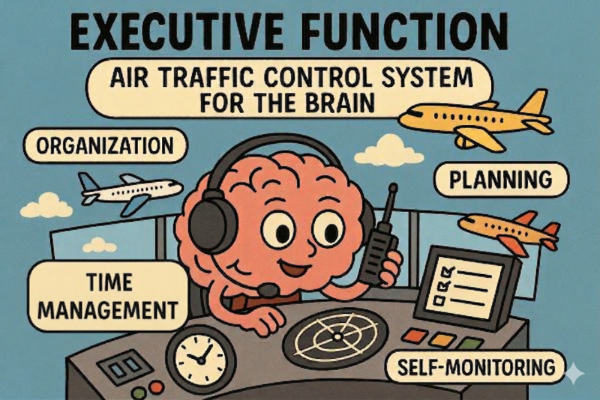
According to the Center on the Developing Child at Harvard University, executive function acts as the “air traffic control system” of the brain. Just as a busy airport requires a highly synchronized system to manage the arrivals and departures of dozens of planes on multiple runways, a student’s brain requires a neurological management system to process information, prioritize tasks, and execute them without colliding into distractions.
While a student’s intellect determines what they can learn, their executive functioning determines how they manage that learning in the real world. Harvard researchers categorize this complex system into three core pillars:
- Working Memory: The ability to hold and manipulate information over short periods. It is what allows a student to remember the multi-step directions their AP Chemistry teacher just gave while simultaneously setting up the lab equipment.
- Cognitive Flexibility: The mental agility to pivot when a plan changes or a mistake is made. If a study strategy isn’t working for an upcoming mid-term, cognitive flexibility allows the student to switch tactics rather than freezing, melting down, or giving up.
- Inhibitory Control: The capacity to master impulses and delay gratification. In today’s hyper-connected world, this is the crucial skill that allows a student to silence their phone, ignore a buzzing group chat, and sustain focus on a difficult essay.
The “Smart but Scattered” Houston Student
In Houston’s highly competitive educational landscape—whether your child is navigating the rigorous IB program at a top public magnet or managing the intense workload of an elite private school—raw intelligence is no longer enough to guarantee success. The modern curriculum demands sophisticated project management. Students must independently juggle multiple digital portals, shifting deadlines, and complex rubrics, all while balancing athletics and extracurriculars.
When executive function lags behind a student’s cognitive ability, we see the “smart but scattered” syndrome. They understand the calculus concepts perfectly during a tutoring session, but fail the test because they rushed through and made careless sign errors. They write a brilliant English paper, but receive a letter-grade deduction because they turned it in a day late. The result is a transcript that doesn’t accurately reflect their true capability, and a household filled with nightly stress and friction.
A Trainable Skillset, Not a Fixed Trait
Researchers are quick to emphasize a critical, empowering point: children are not born with these skills—they are born with the potential to develop them. Just as a corporate CEO isn’t born knowing how to run a Fortune 500 company, students do not inherently possess flawless time-management systems. These are highly specific, trainable skills that reside in the prefrontal cortex—a part of the brain that neurobiology shows continues developing well into a person’s mid-twenties.
Through targeted Executive Function Coaching, we can actively train these neurological muscles. By introducing structured routines, visual planning tools, and metacognitive strategies (teaching students to “think about their thinking”), we help them build the scaffolding they need to succeed independently.
The goal isn’t just to help them survive this semester’s finals; it’s to equip them with the self-management skills they will need to thrive in a demanding college environment and in their eventual careers. When we solve the executive function puzzle, we remove the daily friction of schoolwork, restoring peace to your household and allowing your child’s true potential to finally shine through.
Executive Function Service Offerings
We can support students with their executive function skills through different mediums including private tutoring, Study Lounge, and courses.

Our Latest News and Analysis

Conquering Test Anxiety: A Research-Backed Guide for Parents and Students
For more than 23 years, General Academic has guided tens of thousands of Houston families through high-stakes exams like the [...]

Why Take AP or IB Courses? Houston AP & IB Programs and 2026 Test Dates
High school students interested in learning college-level material, boosting their GPAs, and even earning college credit well before getting [...]

ISEE Course Survey Results: Students Understand the Stakes
For Houstons students applying to highly competitive private schools—such as Awty, Kinkaid, and St. John's—the ISEE admissions test is a [...]

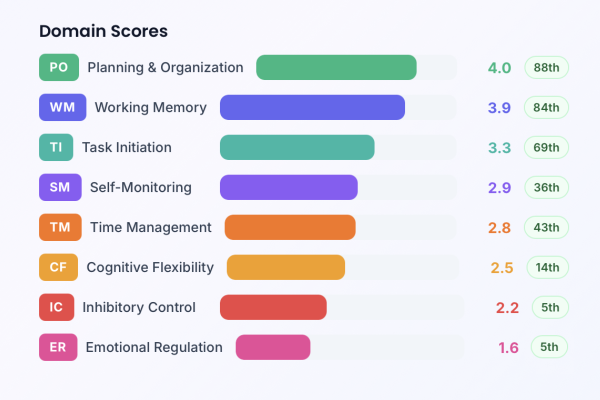
Executive Function Self-Assessment for Students
Many parents find themselves in a familiar situation: they have a smart, curious child, whose grades are not reflective of [...]