At General Academic we are investing heavily in a bespoke English Language Arts (ELA) curriculum to support our Elementary Learning Program. Integrated into our Piqosity e-learning platform, the upcoming “ELA-2” curriculum will enable powerful new analytics and tools for our youngest learners and their tutors. There will also be thousands of pages of original reading content across a wide range of topics to pique every learner’s curiosity.
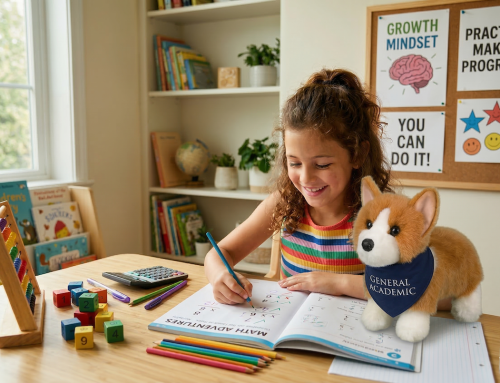
We are especially proud of our new children’s reading series, “Pembroke Pups.” Designed for students in grades 3-5 (or younger when read out loud with an adult), this series follows the Pembroke family of bayou-dwelling corgis as they navigate the trials and tribulations of a modern world—with amusingly pointy ears, long bodies, and stubby legs. Each story follows Mama, Papa, Patrick, Pippa, and Puppy and is beautifully illustrated.
A sample story follows below with reading comprehension questions. Enjoy and let us know your feedback!
Patrick Pembroke and the Bayou Backup
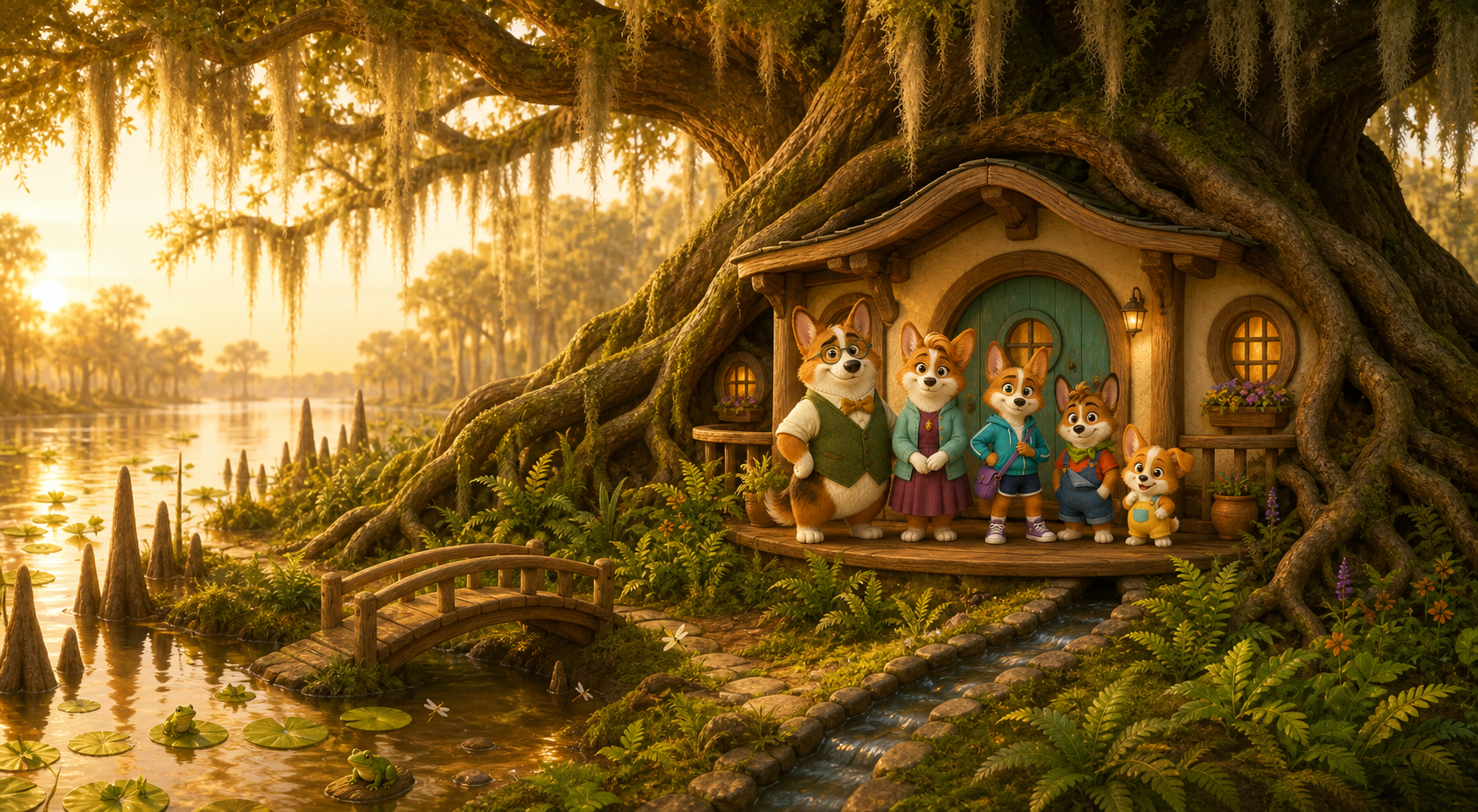
In Corginia, every citizen had short legs, bright eyes, and ears that could hear a biscuit tin open from three rooms away.
The Pembroke family lived in a snug house tucked beneath the roots of a giant live oak beside Barking Bayou. Silver moss hung from the branches. Green frogs plink-plonked from lily pads. At sunset, the bayou shone like a long ribbon of honey.
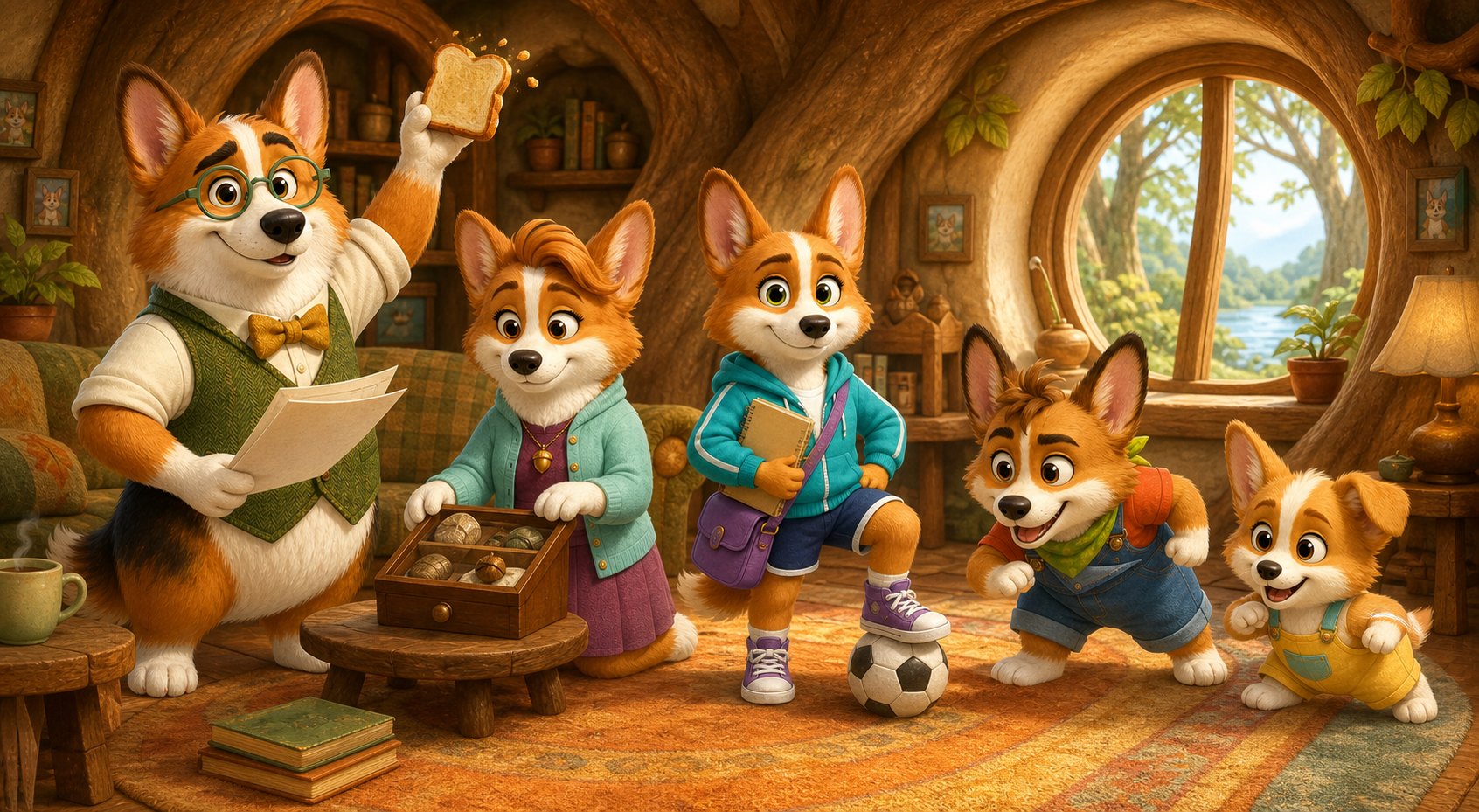
There were five Pembrokes.
Dad was a professor at Kibble University. He knew a great deal about stars, numbers, and why toast always landed jam-side down. He also knew a great many terrible jokes.
Mom the mother, was a veterinarian who cared for all the corgis in town. If something needed organizing, repairing, or rescuing, Mom usually had a plan.
Pippa, the oldest pup, was in fifth grade. She liked full notebooks, winning soccer games, and finishing what she started.
Patrick, her younger brother, was in fourth grade and liked everything fast—especially himself. Sitting still made his paws itch. Chores made them itch even more.
And Puppy, the littlest Pembroke, followed Pippa and Patrick everywhere, copying every hop, howl, and hiccup.
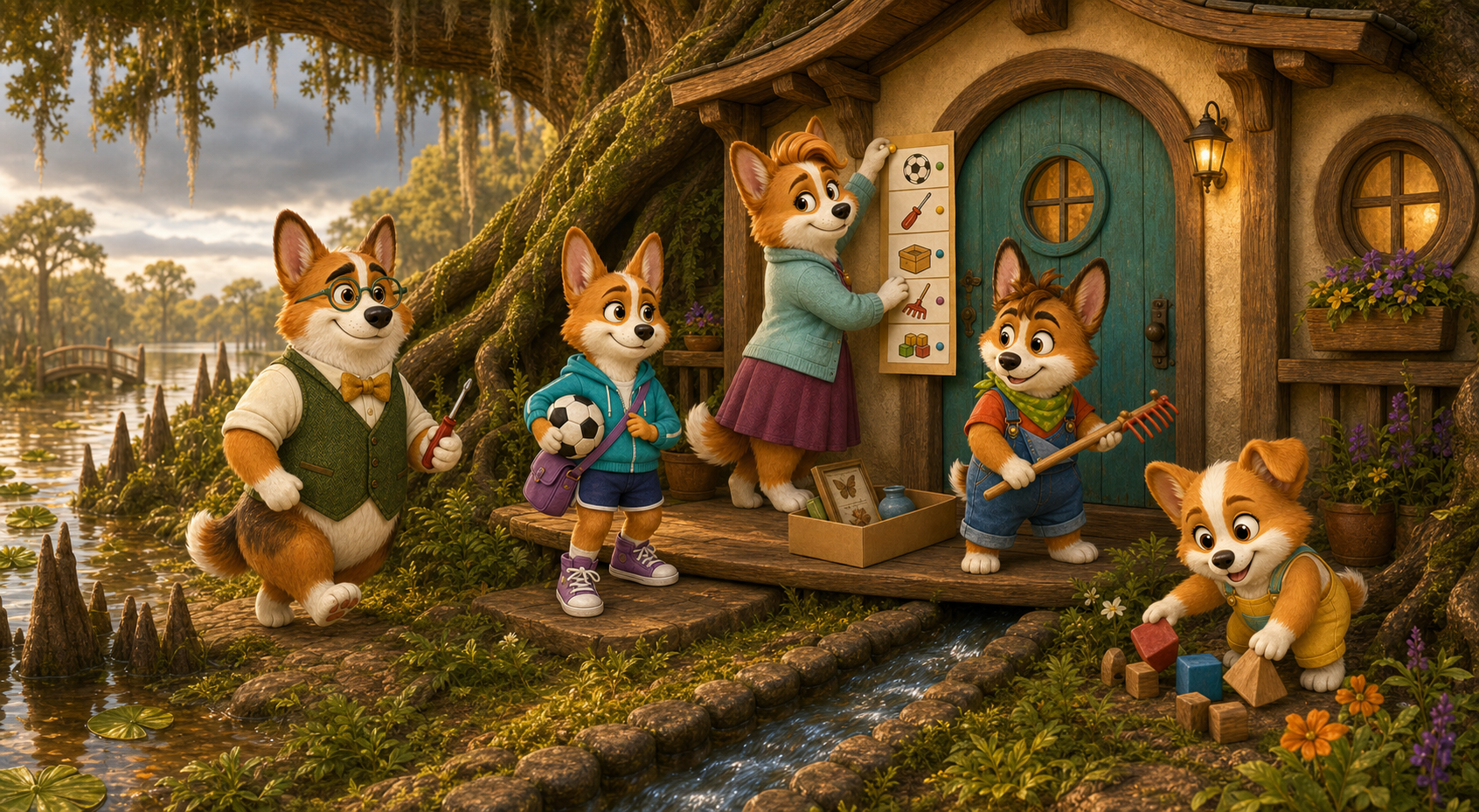
One Saturday morning, Mom pinned a short chore list beside the round front door.
“Rain is coming this afternoon,” she said. “Let’s finish before lunch.”
Pippa needed to put away her soccer gear. Dad would tighten a loose shutter. Mom would tidy the yard and move things inside that could get damaged by the rain. Puppy was to gather all the toys they had left beneath the porch.
Patrick had one job: clear leaves and twigs from the rain-runner.
The rain-runner was a shallow stone channel around the great oak. During storms, it guided water away from the family’s root-house and back toward Barking Bayou.
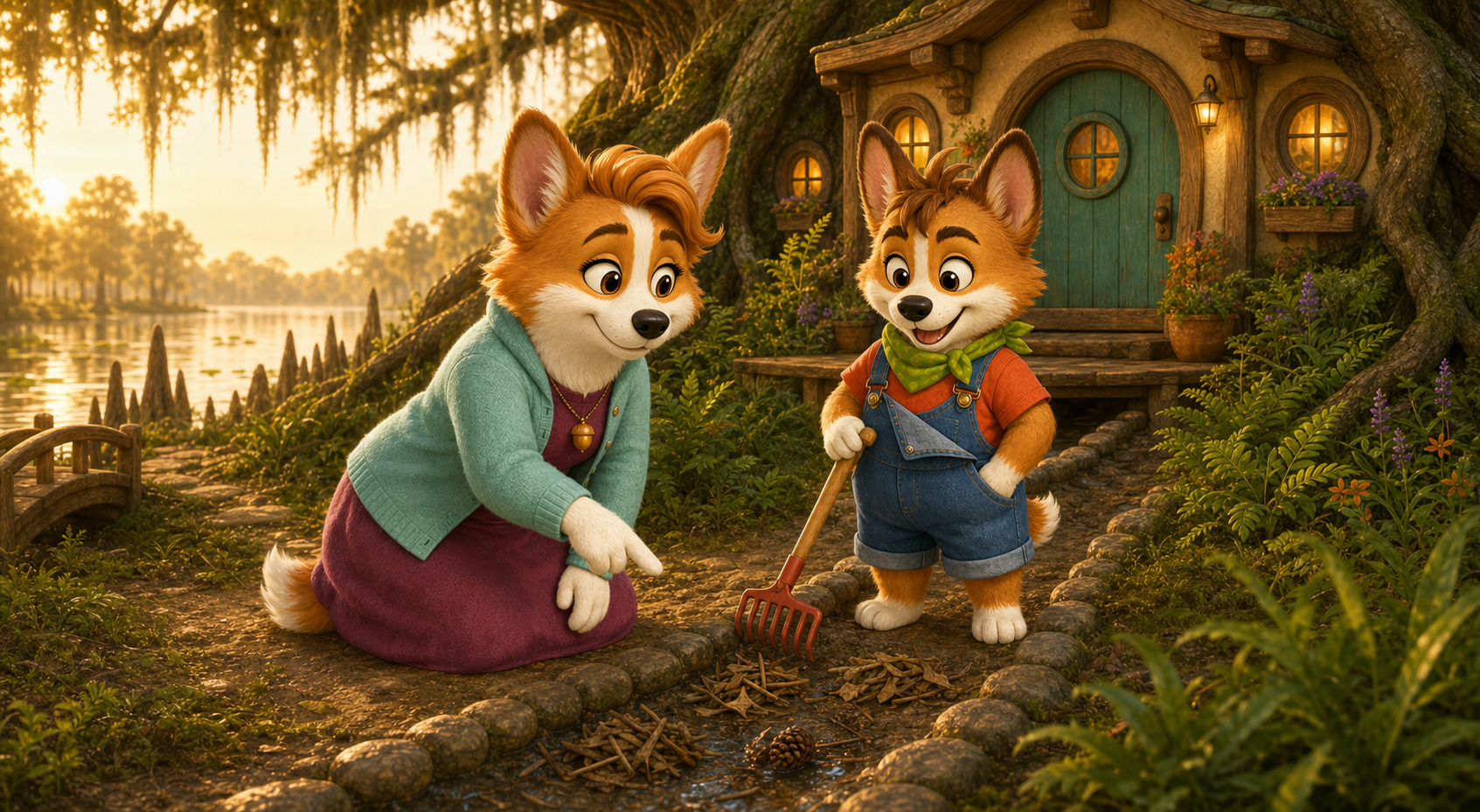
Patrick looked at the channel. It held three leaf piles, six twigs, and one soggy pinecone.
“Easy,” he said. “I’ll do it later.”
“Later often comes quicker than you expect,” Mom warned.
“Nothing’s quicker than me!” Patrick replied.
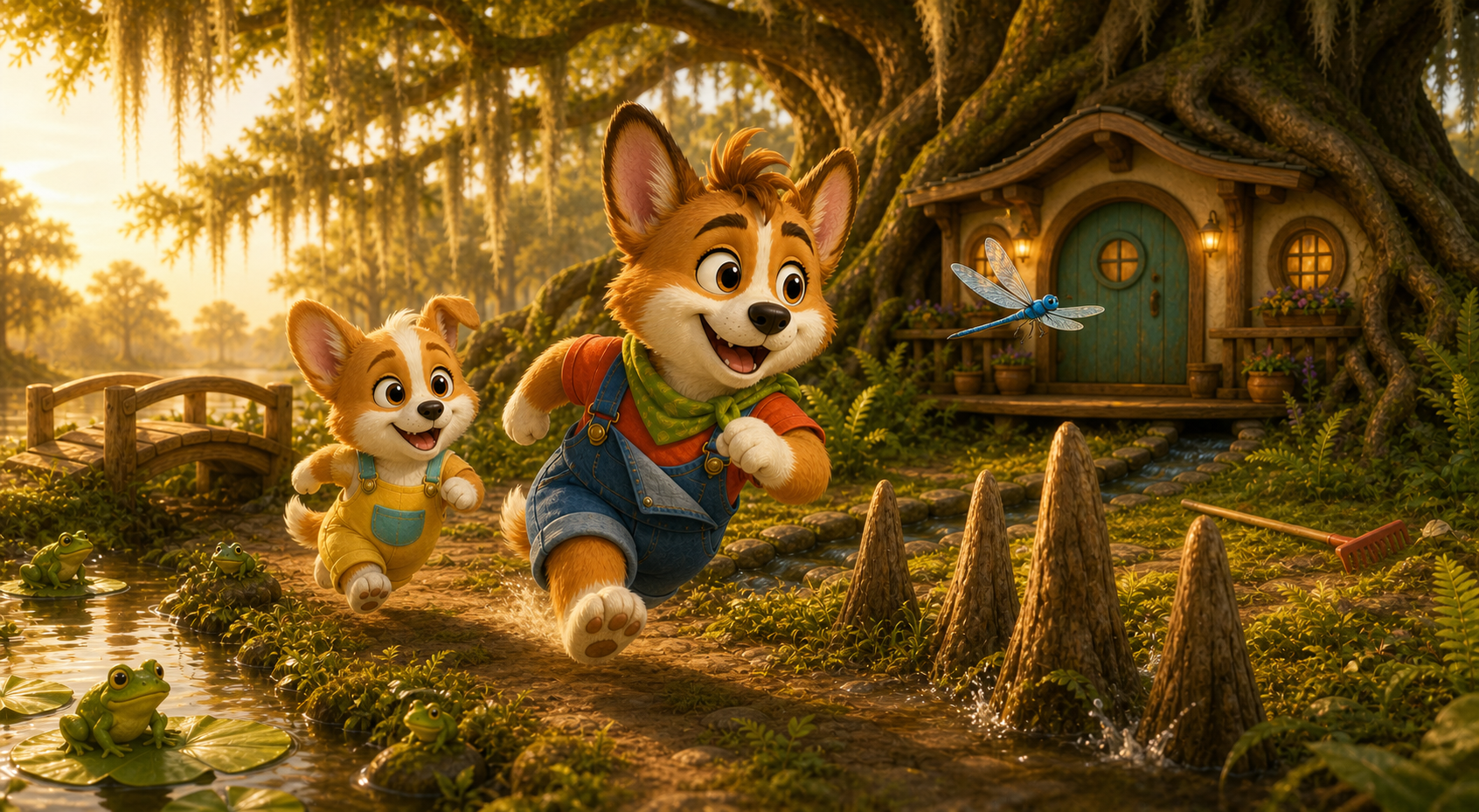
Just then, a blue dragonfly zipped past his nose.
Patrick zipped after it.
He chased it under the porch, over the footbridge, and around three cypress knees. Puppy galloped behind him, shouting, “Later! Later!”
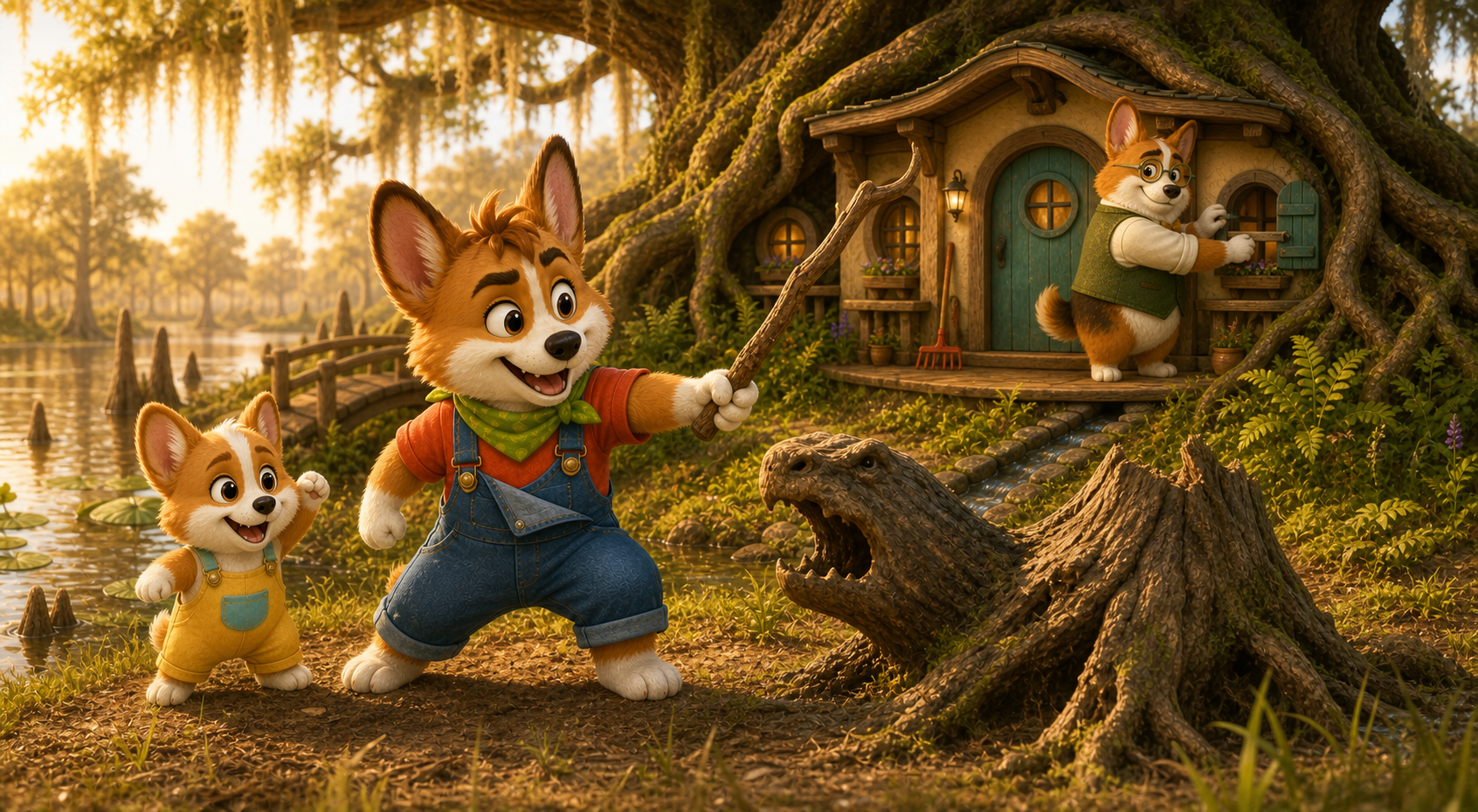
The dragonfly escaped. But Patrick discovered a stick shaped exactly like a pirate sword.
Soon Captain Patrick was defending Barking Bayou from a snapping-turtle sea monster. The turtle was actually an old stump, but it looked very villainous if Patrick squinted.
From the porch, Dad called, “How’s the rain-runner?”
“Almost started!” Patrick called back.
Dad tightened the shutter. “Ah. The longest part of any chore.”
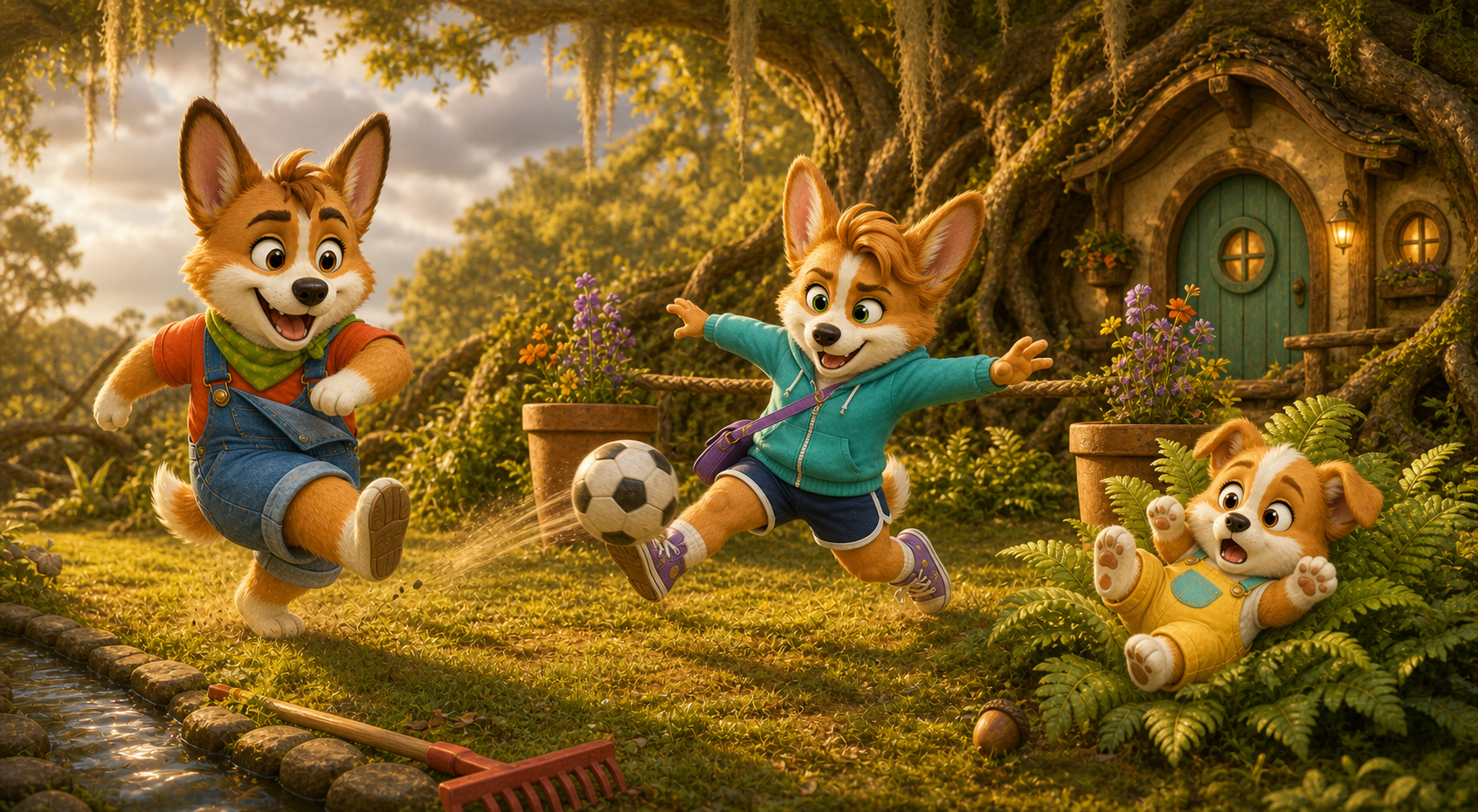
Patrick carried his pirate stick home. He meant to begin, truly. But Pippa’s soccer ball rolled across the yard.
“One shot,” he said.
Pippa planted herself between two flowerpots. Patrick kicked. Pippa blocked. Puppy kicked an acorn and fell backward into a fern.
“One more shot!” Patrick cried.
They played until Pippa glanced at the darkening sky.
“I’m putting my gear away,” she said. “You should clear the channel.”
“I have plenty of time.”
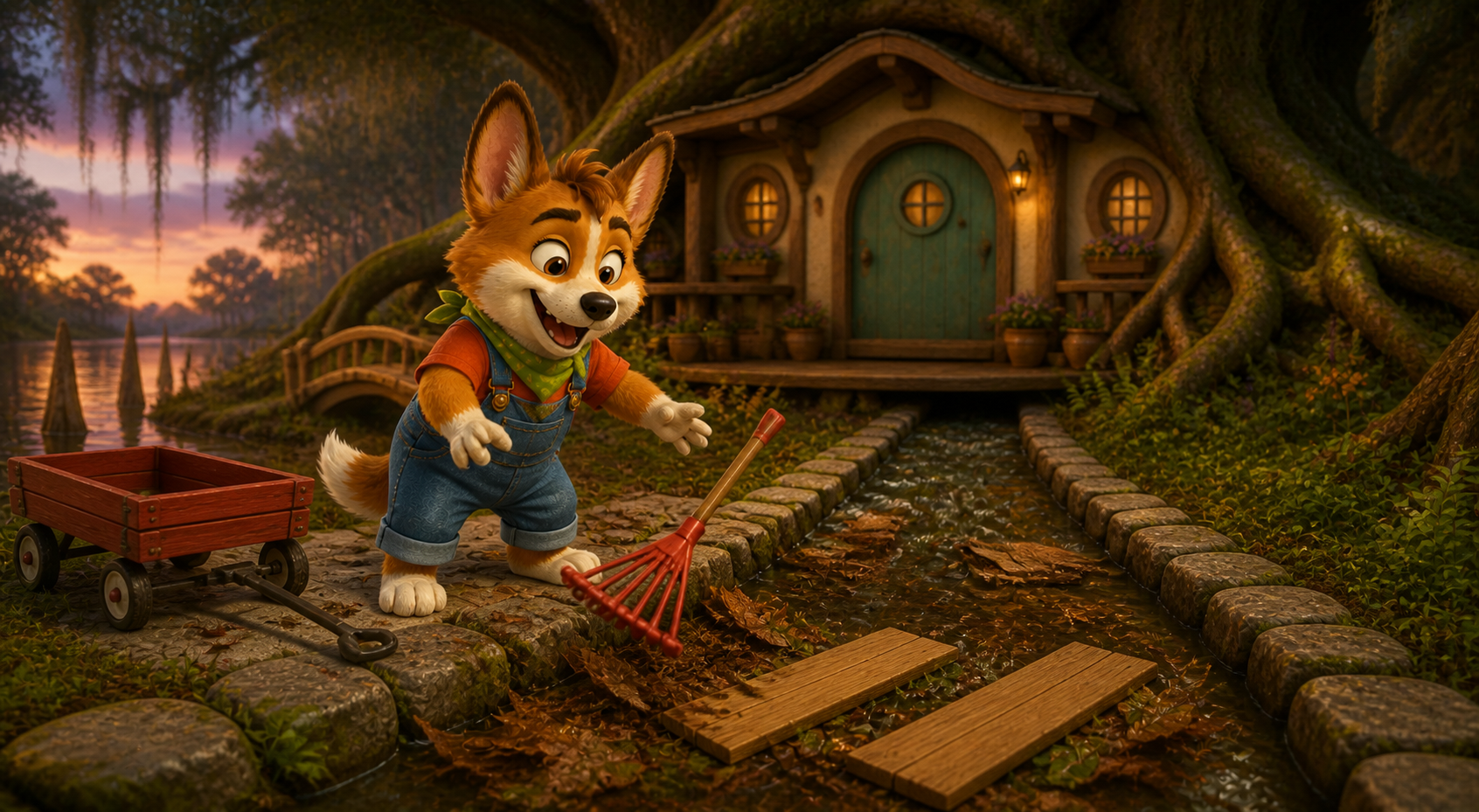
Patrick used his rake to scoop one leaf pile from the channel. That was when he found two smooth boards beneath the leaves.
A ramp!
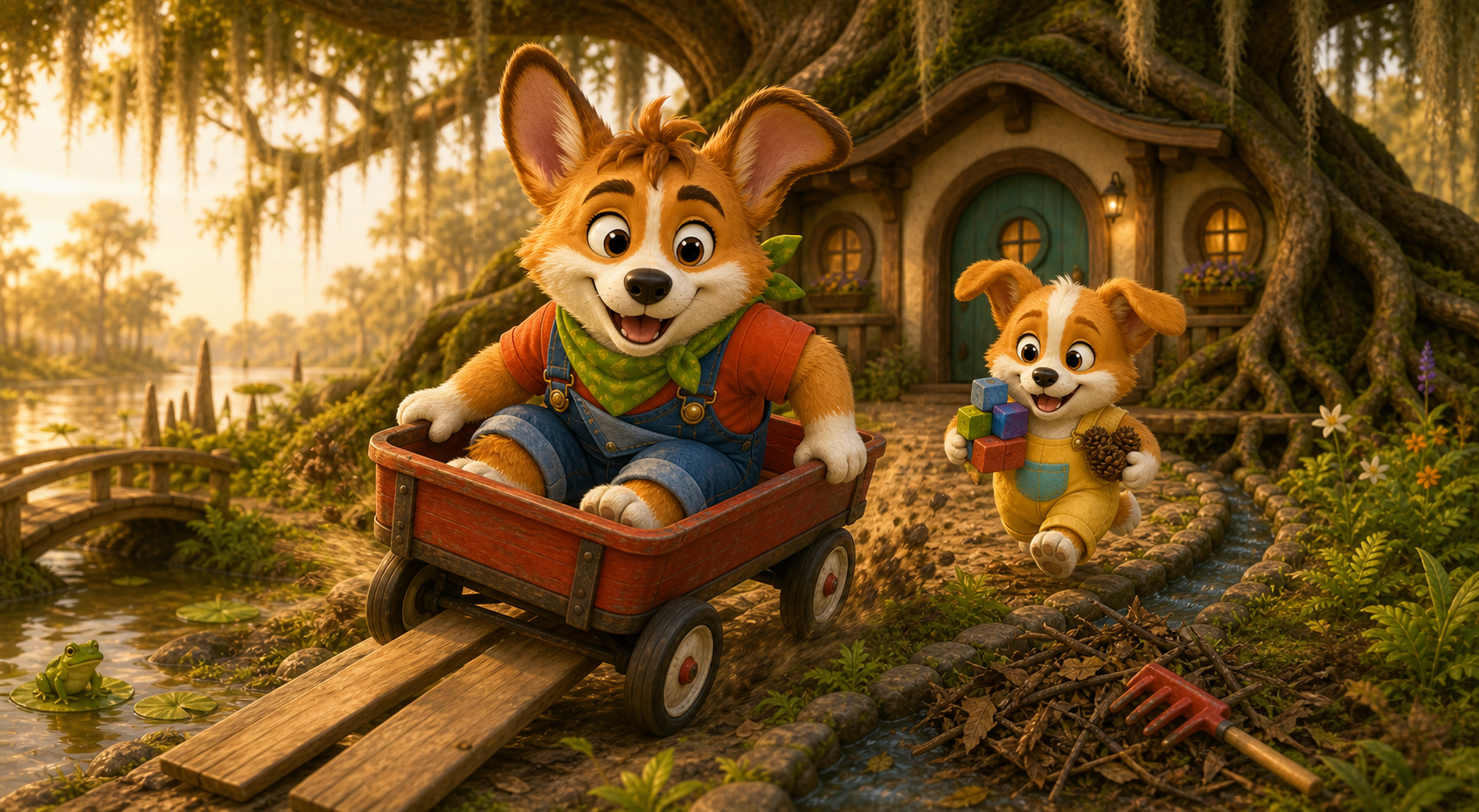
Patrick set the boards over his red wagon. He zoomed down the ramp, ears flapping. Puppy toddled after him, loading pinecones and toy blocks into the wagon.
“Again!” Puppy squealed.
Patrick forgot the rake. He forgot the leaves. He even parked the wagon on top of the pile he had scooped out—right beside the narrow drain where the rain-runner emptied into the bayou.
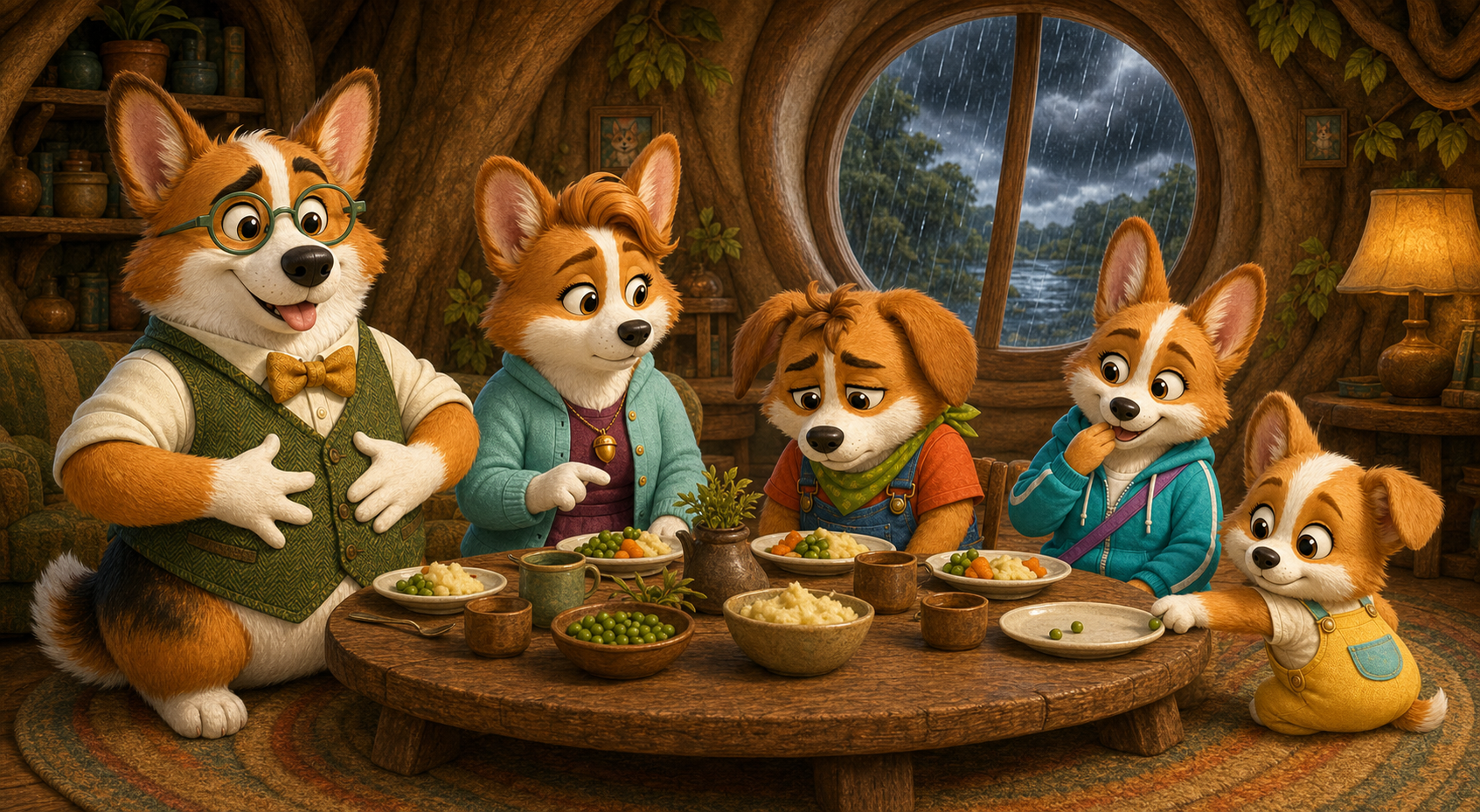
At lunch, thunder grumbled far away.
“Sounds like the clouds have empty stomachs,” Dad said. “They’re thunder-grumbling.”
Mom looked through the window. “Patrick, did you finish all of your chores?”
Patrick’s ears drooped for half a second. Then he saw only a few drops ticking against the glass.
“Not yet. But I can do it after lunch.”
Puppy pushed one pea to the edge of the plate. “Pea later!”
“I don’t think so,” Mom, said, laughing. She picked the pea up with her fork and popped it into Puppy’s mouth.
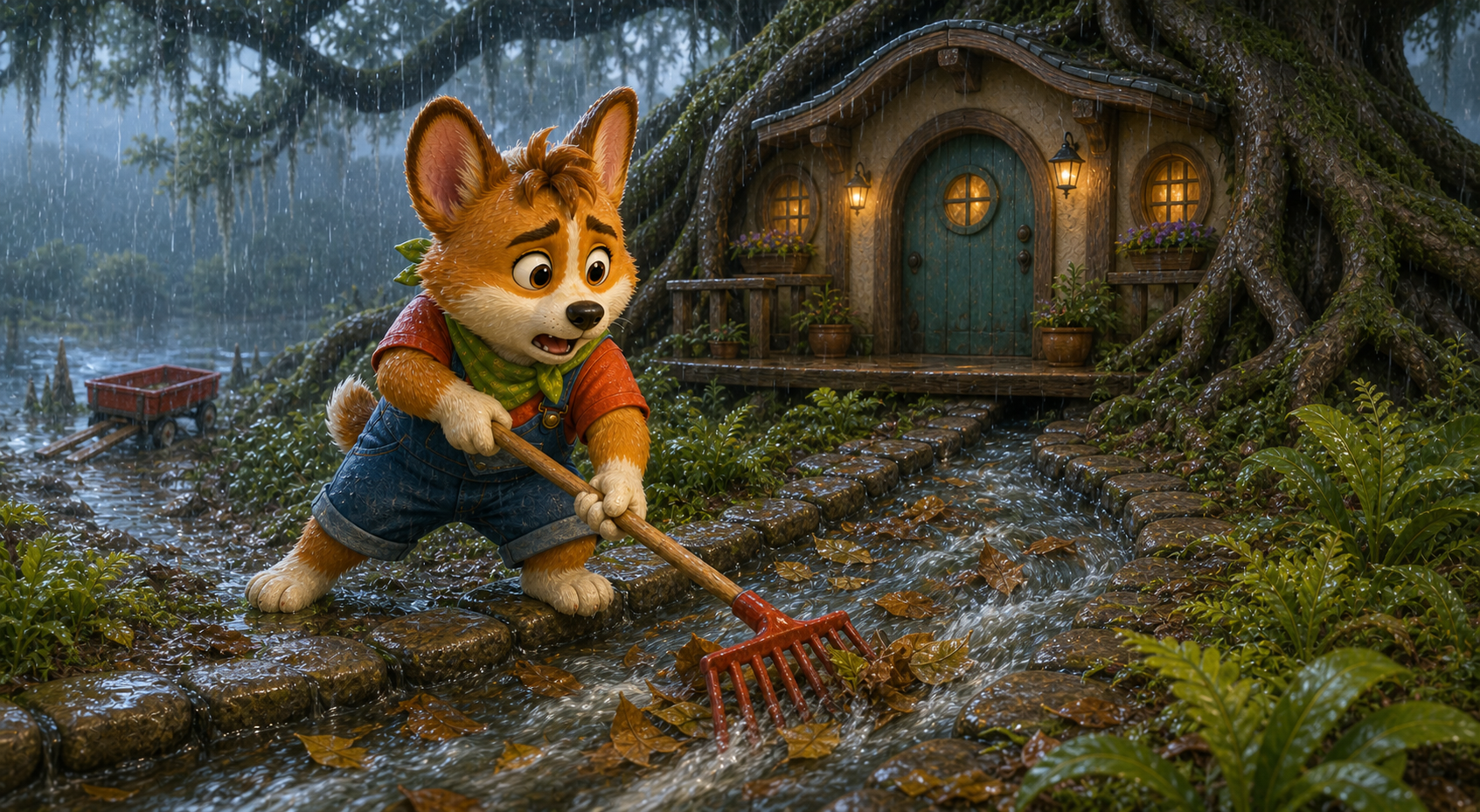
By the time lunch ended, rain drummed on the leaves overhead. Patrick dashed outside with his rake.
Water already rushed along the rain-runner, spinning the loose leaves in soggy circles. Patrick raked left. The water swept the leaves right. He raked right. The water slapped them left.
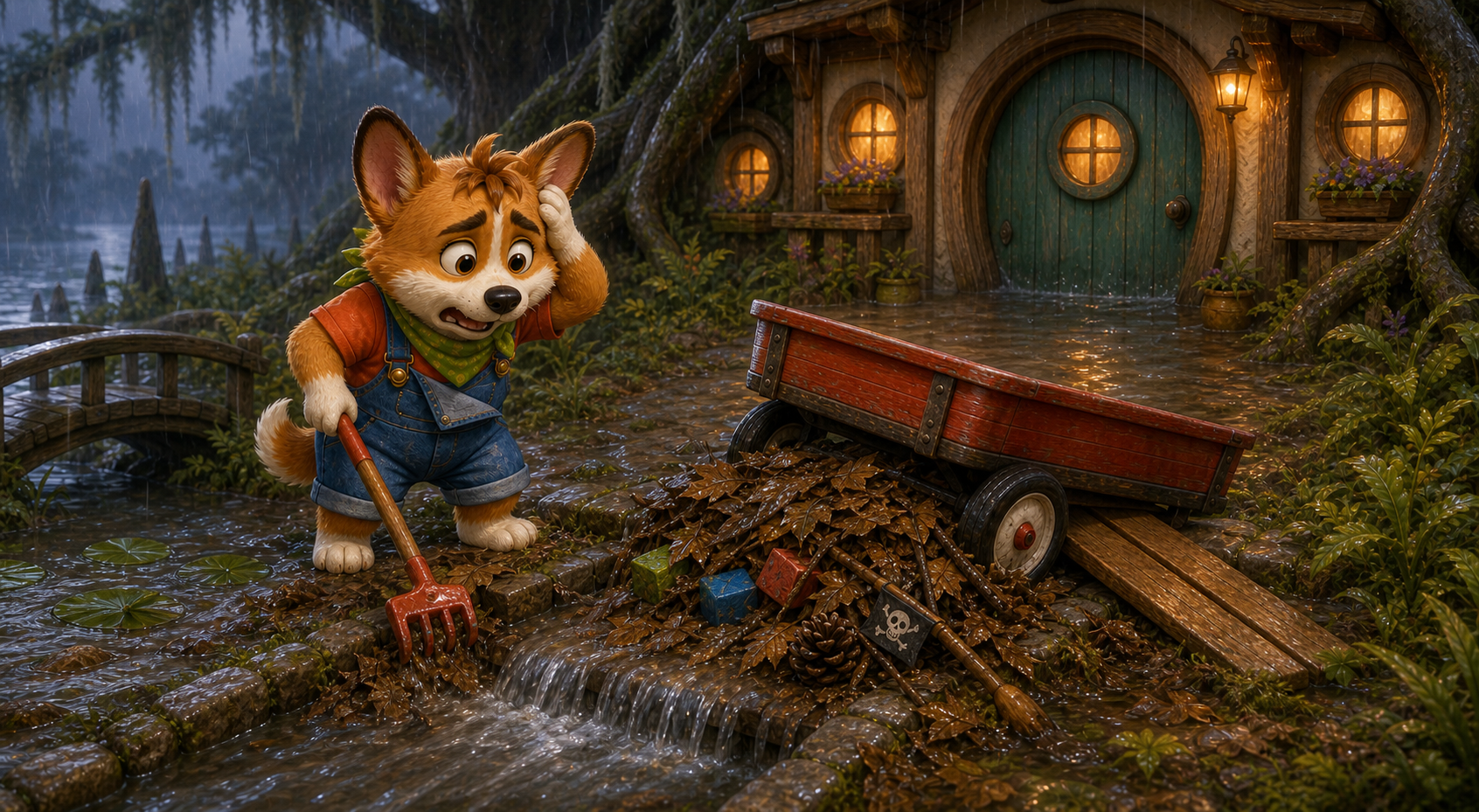
Then he saw his wagon.
Its wheel pinned the leaf pile against the drain. Toy blocks, pinecones, and the pirate stick were tangled beneath it. The small chore had grown into a thick, muddy plug.
Water spilled over the channel. It crept across the yard. It lapped against the family’s round front door.
“Oh, biscuits,” Patrick whispered.
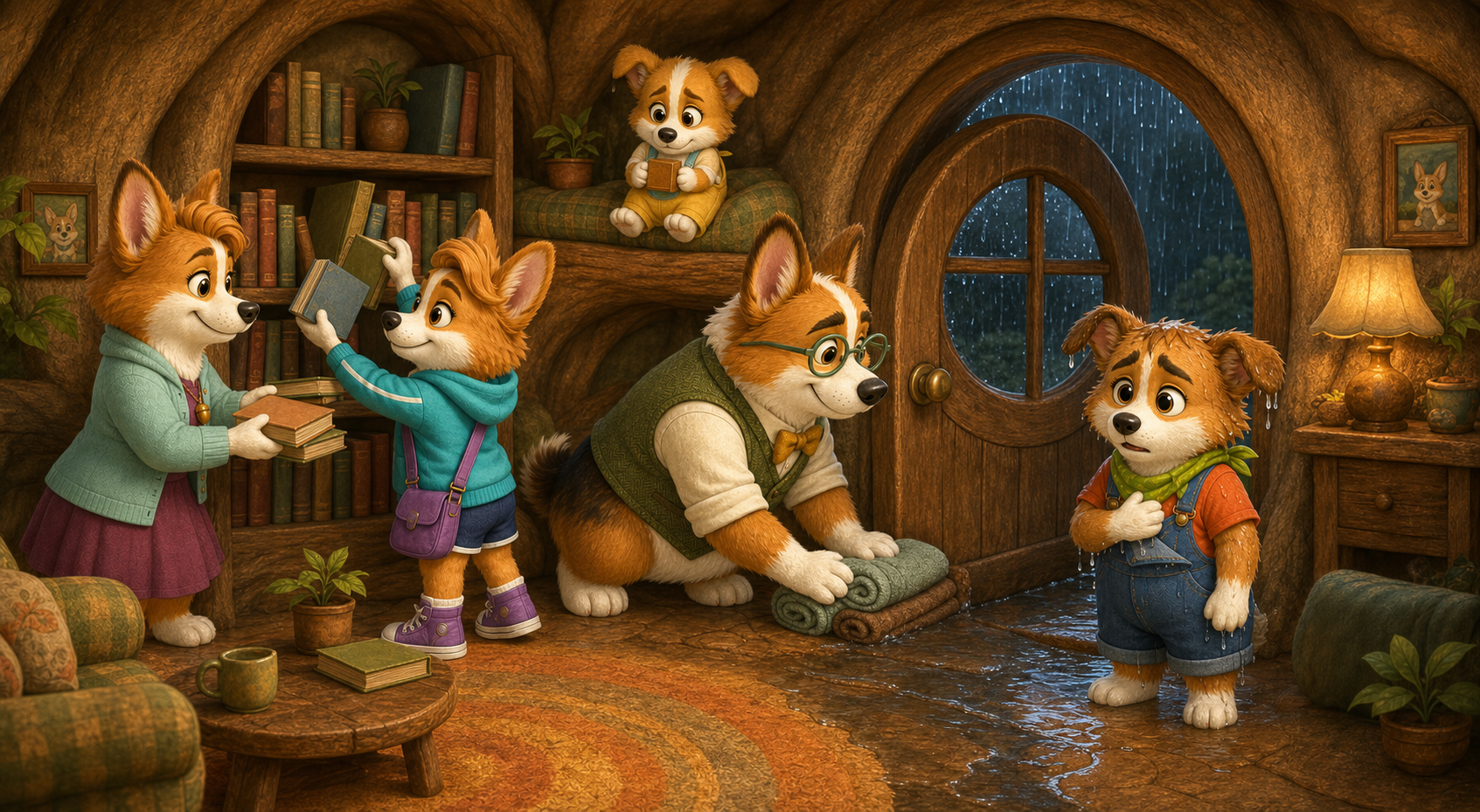
Inside, Mom and Pippa were lifting books from the lowest shelf. Dad stuffed towels beneath the door.
“This is my fault,” Patrick said. The words felt heavier than wet fur. “I kept saying later. I blocked the drain with my wagon.”
Mom gave one quick nod. “Thank you for telling us. Now, what can we do?”
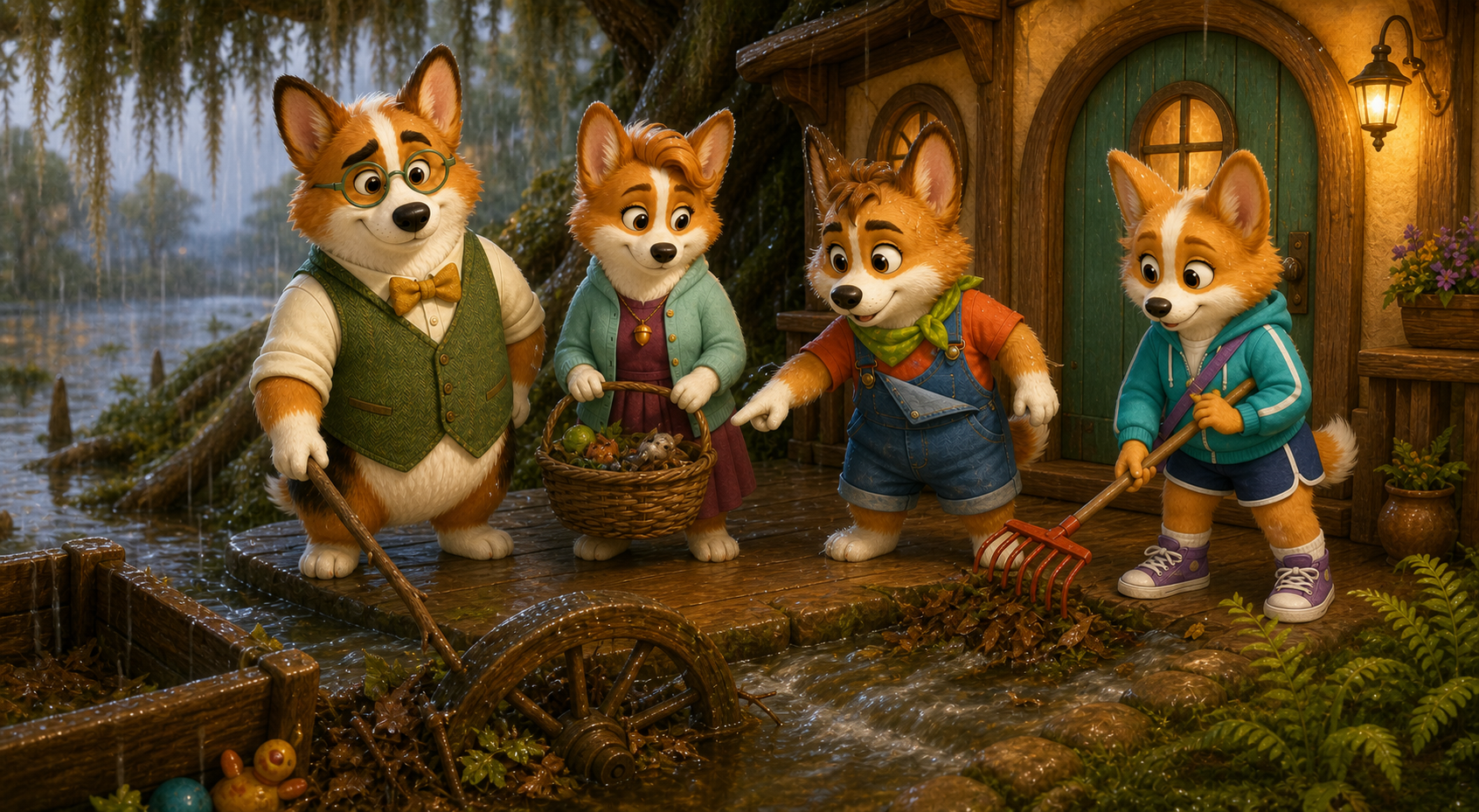
Patrick studied the rushing water. At Kibble University, Dad always said that a good answer began with a good question. At her veterinary office, Mom always tested a plan before executing it.
“We can’t pull the wagon straight back,” Patrick said. “The water is pushing too hard. But if we lift the wheel, Pippa can rake the leaves loose.”
“And I can catch the toys before they float away,” Mom said, grabbing a large basket.
“I’ll handle current events,” Dad said, picking up a branch to steer the water. “Get it? Current?”
Nobody groaned. They were too busy.
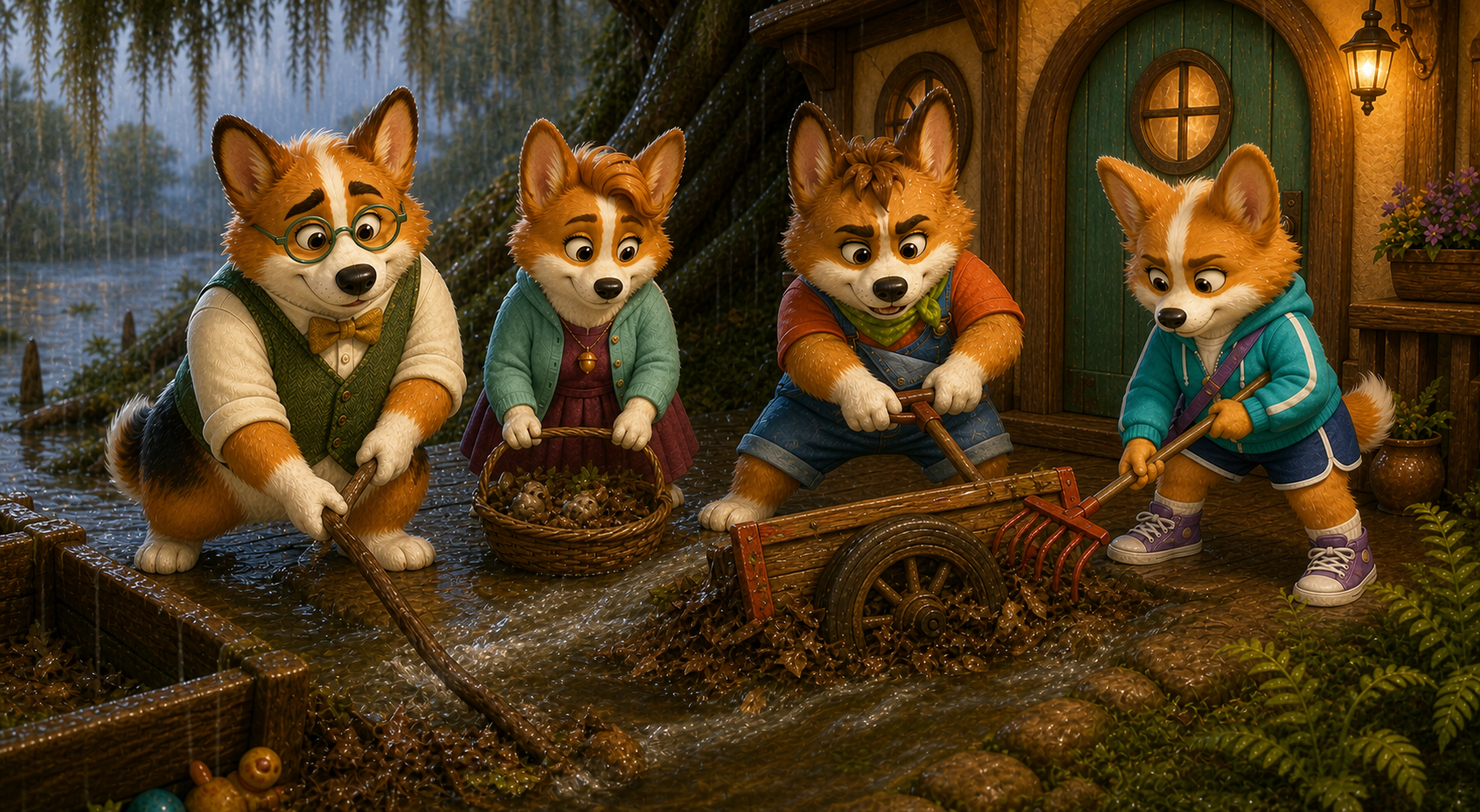
Rain soaked their coats. Dad guided the strongest stream toward an empty garden bed. Mom held the basket below the drain. Pippa braced her paws in the mud.
Patrick grabbed the wagon handle and pulled.
It did not move.
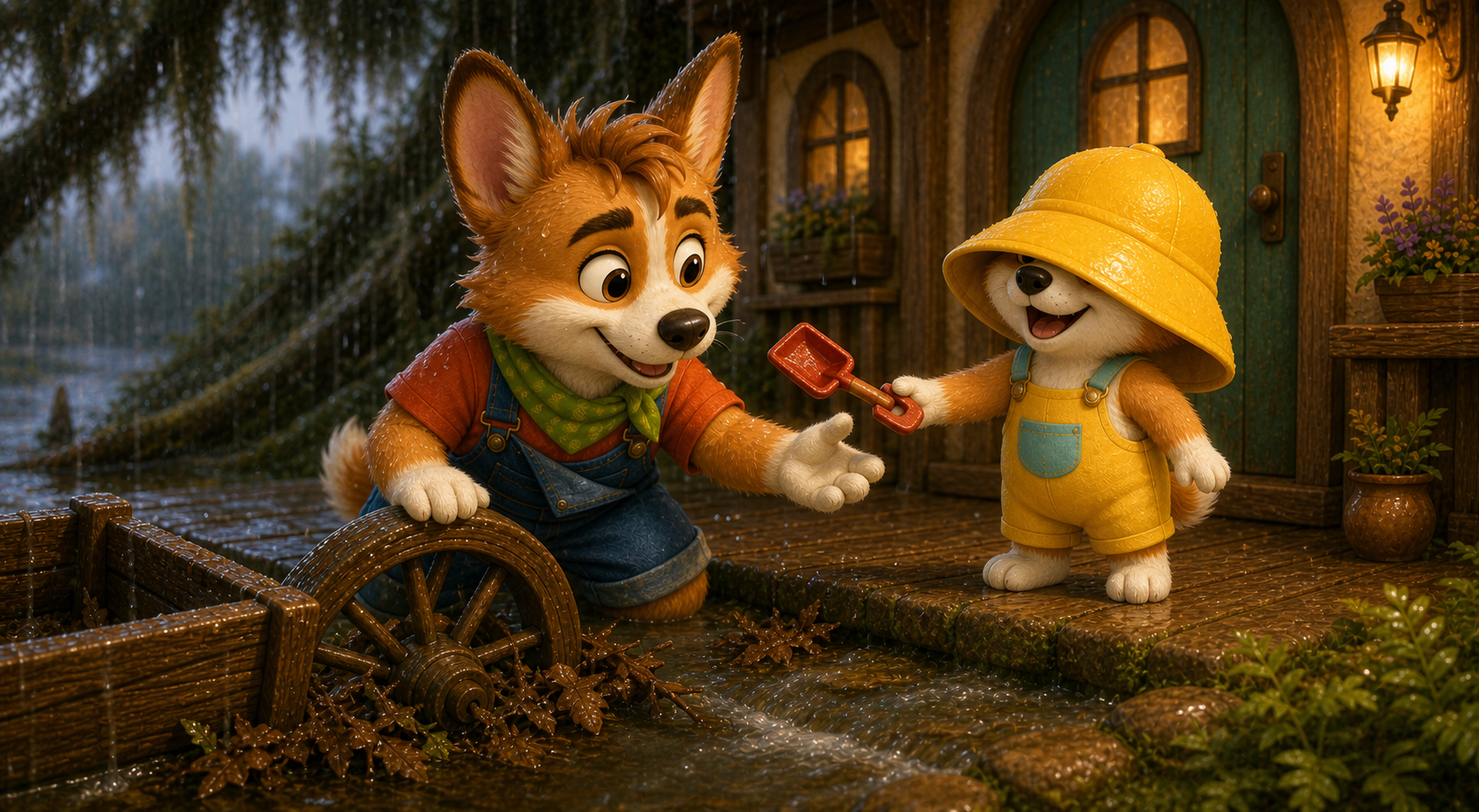
Puppy appeared beneath the porch wearing a yellow rain hat that covered both eyes. Puppy held out a tiny red shovel.
“Help Patrick!”
Patrick smiled. “Yes. Help Patrick.”
He wedged the shovel under the trapped wheel. “On three! One, two, three!”
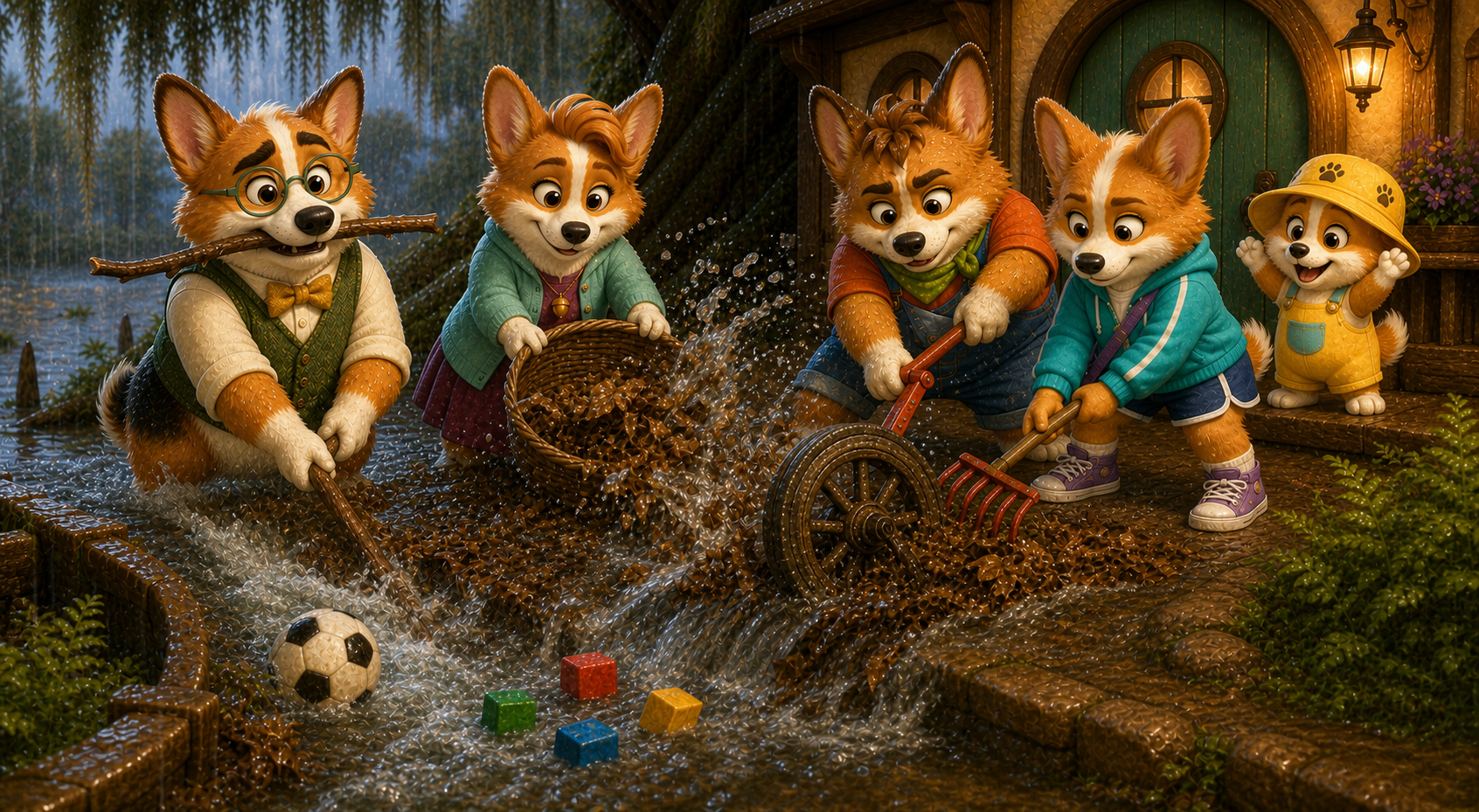
Patrick lifted. Pippa raked. The muddy plug shuddered, slurped, and burst free with a tremendous—
GLOOP-WHOOSH!
Leaves shot into Mom’s basket. The soccer ball bobbed through the channel. Toy blocks rattled after it. Dad caught the pirate stick between his teeth.
Clear water rushed down the rain-runner and into Barking Bayou. The puddle at the front door stopped growing.
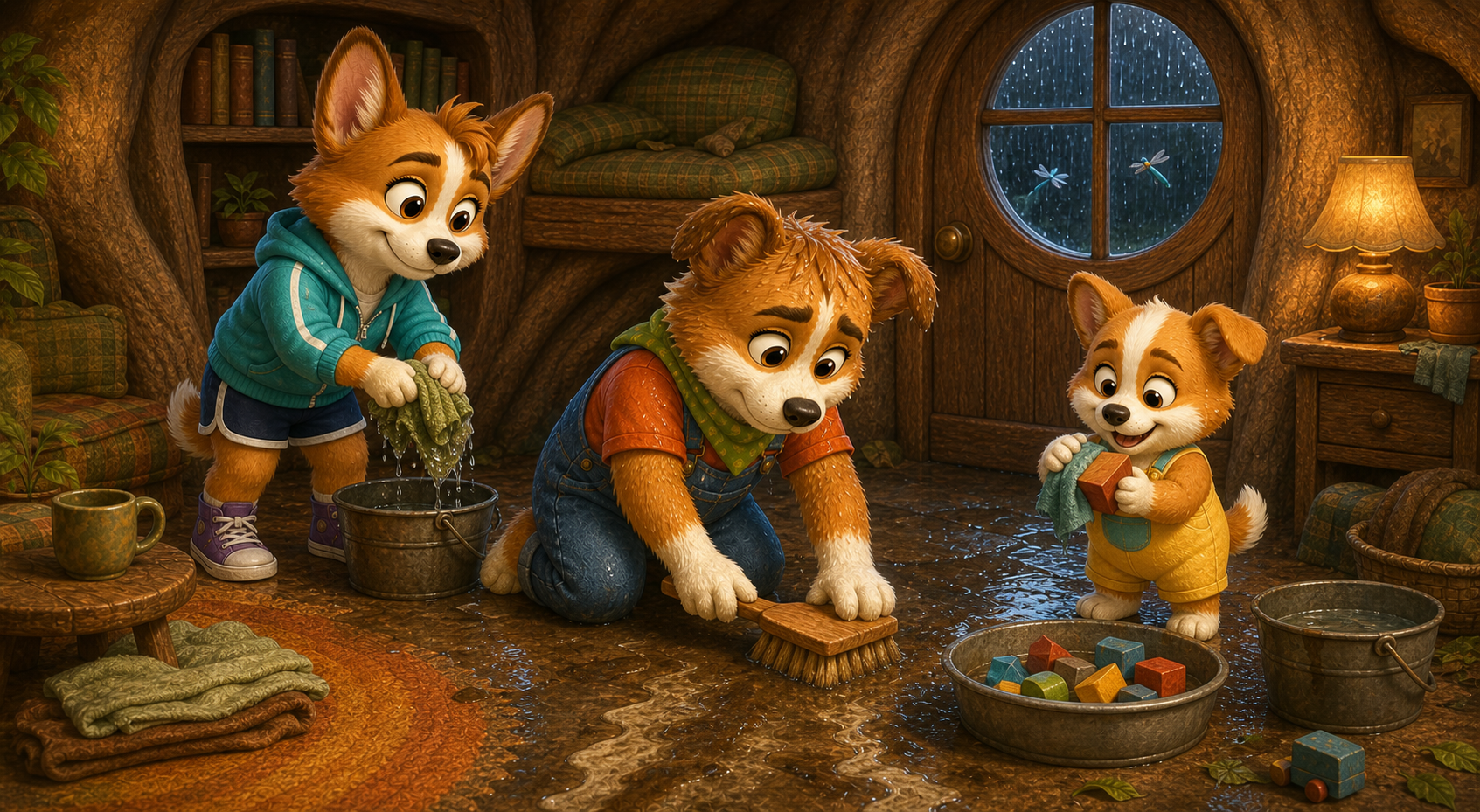
They had saved the books, but the work was not over. Mud streaked the floor. Wet leaves clung to the porch. Puppy’s blocks needed washing, and every towel in the house was soggy.
Cleaning the small channel would have taken Patrick ten minutes.
Cleaning the giant mess took the whole afternoon.
Patrick scrubbed mud from the floor. He rinsed the toys. He wrung out towels beside Pippa. He did not race away, even when the blue dragonfly returned.
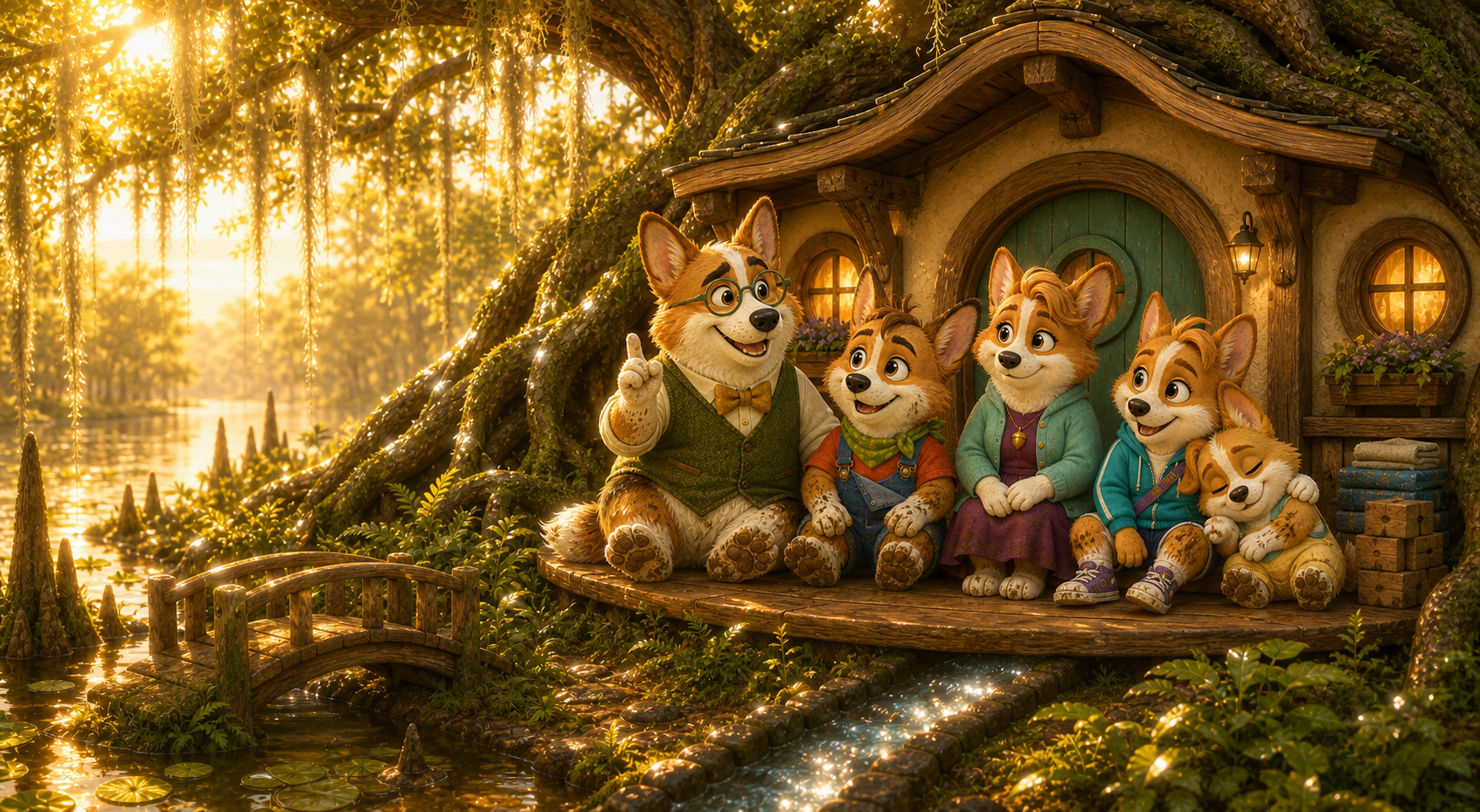
At last, the storm wandered down the bayou. Sunlight sparkled on every dripping leaf.
Dad looked at the clean floor, the clear channel, and the tired pups. “I have discovered an amazing scientific fact.”
“What?” Patrick asked.
“The law of procrastination: when you put something off it takes twice as much effort to do later!”
Patrick laughed. He knew exactly what Dad meant.
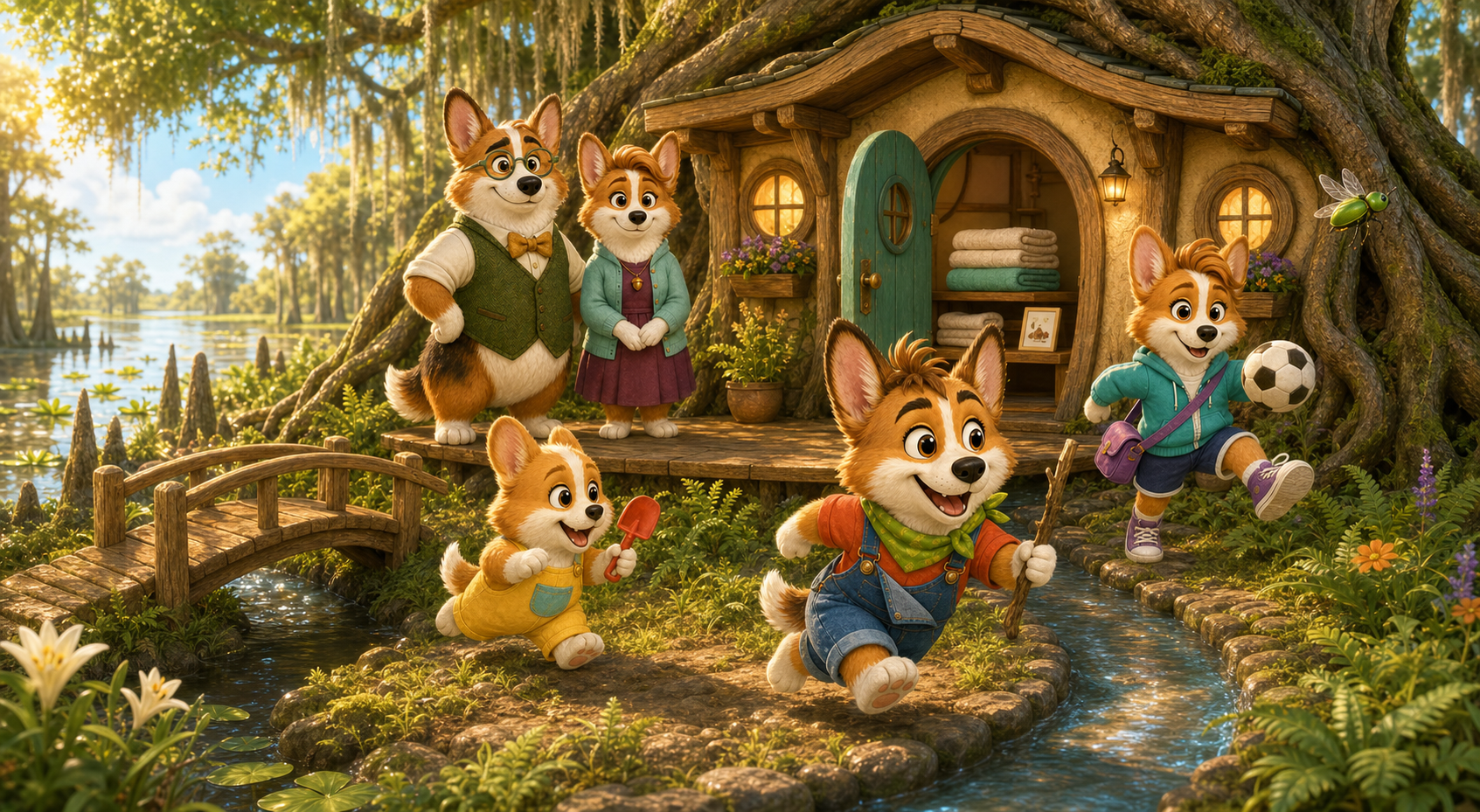
The next morning, Mom pinned a new list beside the door. Patrick’s job was to return the dry towels to the shelf.
A bright green beetle buzzed past. The pirate stick waited by the porch. Pippa was bouncing her soccer ball.
Patrick looked at the towels.
Then he put them away.
It took two minutes.
“Now,” he shouted, racing outside, “who wants to battle the sea monster?”
“Me!” cried Puppy, charging after him with the tiny red shovel.
Behind them, the rain-runner gleamed clean and ready beside Barking Bayou.
Reading Comprehension Questions
- What chore was Patrick supposed to complete, and why did Mom want him to finish it before the rain began?
Patrick was supposed to clear leaves and twigs from the rain-runner. It was important to finish before the rain because the channel carried storm water away from the house and into the bayou. - Why did Patrick keep delaying his chore? Give two examples of things that distracted him.
Patrick kept delaying his chore because he would rather play than work. For example, he chased a dragonfly and played soccer with Pippa instead of clearing the rain-runner. - Put these events in the order they happened in the story:
- Patrick played soccer with Pippa.
- Patrick discovered that the drain was blocked.
- Patrick chased a dragonfly.
- Patrick helped clean mud from the house.
First, Patrick chased a dragonfly. Next, he played soccer with Pippa. Then, he discovered that the drain was blocked. Finally, he helped clean mud from the house.
- In the story, Patrick repeatedly decides to procrastinate instead of doing his chore. What does the word procrastinate mean?
A. To complete something very carefully
B. To put off doing something until later
C. To forget how to complete a task
D. To ask someone else to do a task
The correct answer is B. To procrastinate means to delay doing something that needs to be done.
- Why does Puppy say, “Pea later!” during lunch? What does this reveal about Puppy’s behavior?
Puppy says “Pea later!” because Puppy has heard Patrick keep saying that he will do his chore later. This shows that Puppy copies the things Patrick says and does. - How did Patrick’s unfinished chore lead to a much larger problem during the storm? Use at least two details from the story in your answer.
Patrick left leaves and twigs in the rain-runner and parked his wagon on top of a leaf pile near the drain. When the rain came, the leaves, wagon, toys, and other objects formed a muddy plug. Water overflowed the channel and reached the family’s front door, creating a much bigger mess to clean. - When Patrick admits, “This is my fault,” Mom responds, “Thank you for telling us. Now, what can we do?” What does Mom’s response suggest about how she handles problems?
Mom’s response shows that she stays calm and focuses on finding a solution. Instead of wasting time blaming Patrick, she encourages everyone to figure out how to fix the problem. - How does Patrick help solve the problem with the blocked drain? What does his plan show about him that was not as clear at the beginning of the story?
Patrick realizes that they should lift the wagon wheel while Pippa rakes the leaves loose. His plan shows that he can think carefully, solve problems, and work with others when he takes a situation seriously. - Why is it important that Patrick puts away the towels immediately at the end of the story, even though several more interesting things are happening outside?
Putting away the towels right away shows that Patrick has learned from what happened. He no longer puts off a small responsibility just because something more fun catches his attention. - Which statement best expresses the moral, or lesson, of the story?
A. Difficult jobs should always be completed with help from your family.
B. Having fun is more important than finishing ordinary chores.
C. Putting off a small responsibility can create a much bigger problem later.
D. People learn best when they are allowed to make mistakes without consequences.
The correct answer is C. Patrick learns that delaying a small chore can make it much harder later. If he had cleaned the rain-runner when he was first asked, the family could have avoided the flooding and hours of extra work.
Short Essay Question
Think about a time when you put off doing something you needed to do. What happened, and how could doing it sooner have made things easier?