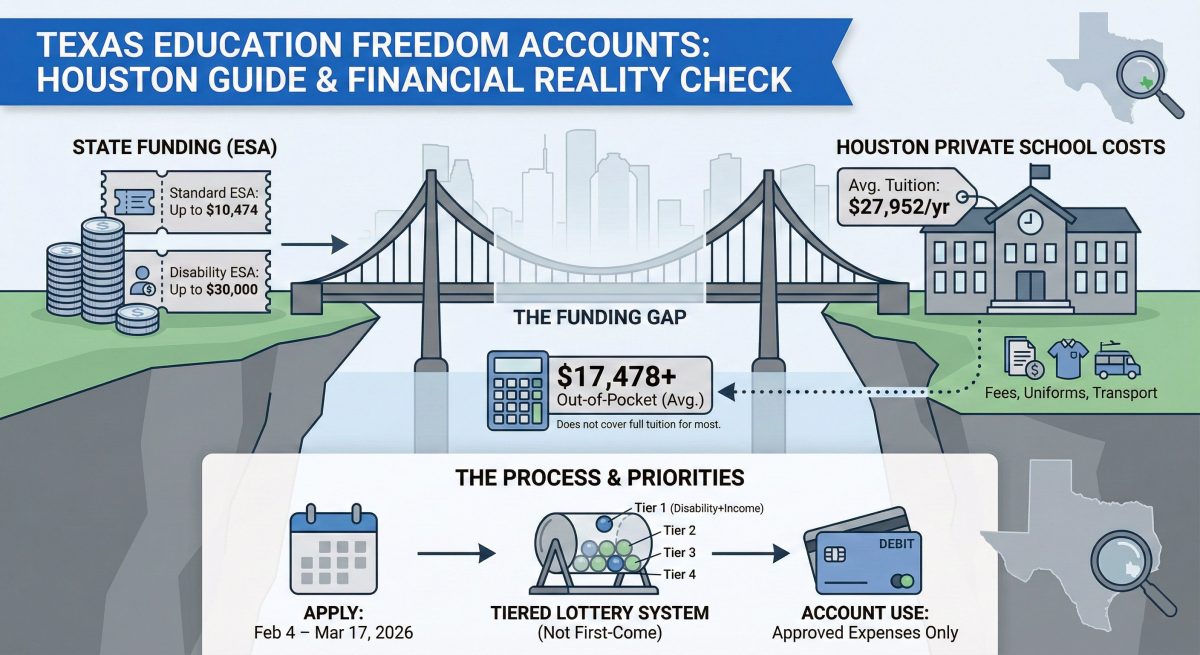
The Texas School Voucher Program, “Education Freedom Account (TEFA)” program officially launched on February 4, 2026, offering Houston families up to $10,474 for private school tuition and up to $30,000 for students with qualifying disabilities.
However, with Houston’s average private school tuition nearing $28,000, a significant funding gap remains. This guide explores the “priority tier” lottery system, the critical differences between 504 accommodations vs. IEP funding, and the timeline and requirements of applying to a competitive Houston private school. Learn how to calculate your out-of-pocket costs and navigate the March 17 application deadline.
The application window for 2026-2027 school year of Texas Education Freedom Accounts closes March 17, 2026. If your family qualifies, the program offers up to $10,474 in annual funding toward private school tuition or other approved educational expenses. For families with children who have qualifying disabilities, that amount increases up to $30,000.
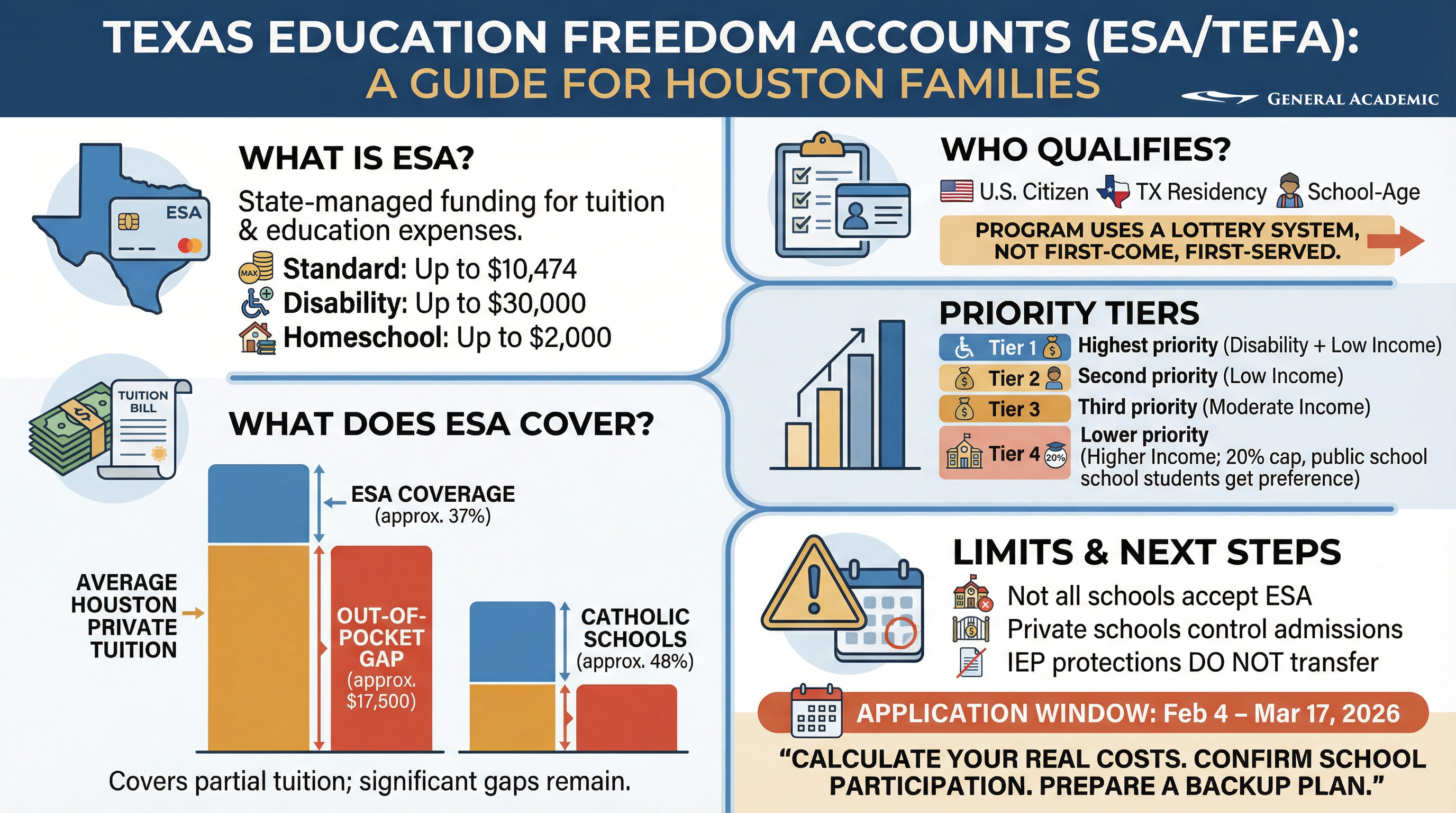
But here is what Houston families must understand before applying: The average private school tuition in Houston runs $27,952 per year. That means the standard ESA funding covers only about 37% of what most Houston private schools charge. The remaining $17,478—plus all the other fees and hidden costs—comes out of your pocket. This gap does not make ESA funding worthless, but it does require honest financial planning.
This guide breaks down exactly how Texas Education Freedom Accounts work, who qualifies, how funding tiers are determined, and what your family will actually pay after ESA funds are applied. Whether you are considering private school for the first time or already paying tuition and hoping for relief, you will leave with a clear picture of whether this program makes financial sense for your situation.
What are Texas Education Freedom Accounts and how much money do they provide?
Texas Education Freedom Accounts, commonly called TEFAs or ESAs (Education Savings Accounts), represent the state’s new school choice program. The program allocates $1 billion in state funding to help families pay for private school tuition, homeschool curriculum, tutoring, and other approved educational expenses.
The program does not send money directly to families. Funds are deposited into a state-managed account that parents can access through an approved vendor to pay for qualified expenses. Think of it as a restricted debit card for education costs.
Funding amounts vary based on your child’s needs and your family’s chosen educational path:
| Funding Category | Annual Amount | Who Qualifies |
| Standard ESA | $10,474 | Students attending approved private schools |
| Disability ESA | Up to $30,000 | Students with qualifying disabilities |
| Homeschool ESA | $2,000 | Families choosing home education |
The disability funding tier provides the most substantial support, recognizing the higher costs associated with specialized educational services. The homeschool allocation is notably smaller, reflecting that home education typically involves lower overhead costs than private school tuition.
Understanding what funding is available is only the first step. The more pressing question is whether your family can access it at all.
Who qualifies for Texas ESA funding?
Basic eligibility requires three things.
- Your child must be a U.S. citizen or have lawful presence status.
- Both the child and at least one parent must be Texas residents.
- The child must be of school age, generally between 5 and 18 years old.
Meeting these requirements makes you eligible to apply, but it does not guarantee funding.
This distinction matters because many families assume that qualifying means receiving money. The program uses a lottery system, not first-come, first-served allocation. Submitting your application on February 4 provides no advantage over submitting it on March 15.
The lottery exists because demand may exceed available funding. The state has allocated $1 billion, which sounds substantial until you consider that over 5 million children attend Texas public schools. Even if only a fraction of families apply, the program may not fund everyone who qualifies.
So if everyone enters the same lottery pool, who gets funded first? The answer lies in the state’s priority tier system.
How does priority-tier funding work, and which tier am I in?
Not all applicants enter the same lottery pool. Texas assigns families to priority tiers based on income and disability status. Higher-priority tiers receive funding before lower-priority tiers are considered.
- Tier 1 receives first priority. To qualify, your child must have a qualifying disability AND your family income must fall at or below 500% of the Federal Poverty Level (FPL).
- Tier 2 includes families with income at or below 200% of the Federal Poverty Level, regardless of disability status. For a family of four, this threshold is approximately $64,300 in annual household income.
- Tier 3 covers families with income between 200% and 500% of the Federal Poverty Level.
- Tier 4 includes all families above 500% of the Federal Poverty Level. The program caps Tier 4 participation at 20% of total funding. Additionally, students in Tier 4 who attended public school in 2025-26 are prioritized over students who attended private school the same year or were homeschooled.
| Priority Tier | Requirements | Income Threshold (Family of 4) |
| Tier 1 | Disability + Income at or below 500% FPL | Up to $160,750 |
| Tier 2 | Income at or below 200% FPL | Up to $64,300 |
| Tier 3 | Income 200-500% FPL | $64,301 – $160,750 |
| Tier 4-a | Income above 500% FPL, from public school | Above $160,750 |
| Tier 4-b | Income above 500% FPL, from private school | Above $160,750 |
The tier system means that a lower-income family without disability considerations has a better chance of receiving funding than a higher-income family. If you fall into Tier 4, understand that your application enters a more competitive pool with a hard funding cap.
Knowing your tier tells you your odds of receiving funding. But receiving funding and affording private school are two different things entirely.
How do I get the $30,000 for a Disability?
Many parents are confused by the “Up to $30,000” disability tier, specifically regarding whether a “Learning Difference” like Dyslexia or ADHD qualifies for the higher amount. There is a massive financial distinction between having 504 Accommodations and an IEP (Individualized Education Program).
- Section 504 (Accommodations): Under the Rehabilitation Act, a 504 plan provides “level the playing field” supports—like extra time on tests or preferential seating. It focuses on access but does not provide any modifications to the curriculum.
- Individualized Education Plans, IEP, (Specialized Instruction): Under the IDEA (Individuals with Disabilities Education Act), an IEP is for students who require specialized instruction or modifications to the curriculum itself.
To unlock the higher funding tier of up to $30,000, the state generally requires a Texas IEP to be on file with the Texas Education Agency (TEA) by the March 17 deadline. Furthermore, you will not automatically receive a flat check for $30,000. The state calculates your specific award based on the instructional arrangement codes in the IEP—essentially, the state gives you the same amount of money the public school district would have received to educate your child. If your child’s IEP only requires “speech therapy” once a week, your funding will be significantly lower than a child requiring a full-time “self-contained” classroom.
Curriculum modification like a self-contained classroom can be very expensive since students with an IEP may spend significant time outside of the classroom with mainline students. Very few private schools have the resources to modify curriculums for students with significant IEPs, and the schools that do, like the Joy School, cost more than $45,000 a year. Because public schools are required to serve IEP students at any cost, many of General Academic’s affluent clients choose to remain in public school when their child requires significant curriculum modifications as called for by an IEP.
Will Texas School Vouchers fully pay for my Houston private school tuition?
This section requires your full attention because it determines whether ESA funding creates a genuine opportunity or a financial strain.
The average private school tuition in Houston runs $27,952. With standard ESA funding of $10,474, you face an annual gap of $17,478. That means ESA covers approximately 37% of the average private school tuition.
Catholic schools offer more accessible pricing. The average Catholic school tuition in Houston is $21,649, which means ESA funding covers about 48% of costs. Your out-of-pocket expense drops to roughly $11,175 per year.
These figures represent tuition only. Most private schools charge additional fees:
- Application fees: $50 – $500
- Registration fees: $200 – $1,000
- Technology fees: $500 – $3500 annually
- Activity fees: $100 – $500 per activity
- Uniforms: $300 – $800 initial investment
- Transportation: Varies widely, often $2,000+ annually
The disability funding tier of $30,000 changes this calculation substantially. For families with qualifying children, ESA funding may cover full tuition at many schools, though specialized services often carry premium pricing that can exceed even this higher amount.
This is the calculation that matters. The gap between hope and reality is not insurmountable, but it demands clear-eyed planning rather than assumptions based on headlines.
These numbers paint a clear picture, but families often stumble not because of math errors. They stumble because of widespread misunderstandings about how the program actually works.
How do you get into a Houston private school?
For families targeting Houston’s most competitive private schools—such as St. John’s, The Kinkaid School, or Awty International—the math isn’t the only thing that’s difficult; the calendar and the application process are a major hurdle.
The admissions process is a high-stakes, year-long cycle. For students planning to enroll in a name brand Houston private school for the 2026-2027 school year, they would have started preparing for the ISEE private school admissions test as early as spring of 2025. Most elite Houston schools require applications by early January and issue admission decisions by late spring break. Once accepted, families typically have until late March to sign an enrollment contract and pay a non-refundable deposit—often totaling thousands of dollars.
This creates a high-pressure “timing gap” for families relying on the new Texas vouchers:
- The Texas School Voucher Deadline: The state’s application window for 2026 closes on March 17, but official award notifications won’t begin until early April.
- The Conflict: By the time you find out if the state has granted you the $10,474 (or more), you will likely have already passed the “Point of No Return” for Houston’s top schools.
Essentially, Houston parents are forced to gamble: you must commit to a contract and pay a deposit in March without knowing if you will win the state lottery in April. For many, this mismatch makes the voucher a “bonus” rather than a deciding factor in whether they can afford to apply.
But the cost and timing of private school applications are only two of the big hurdles—there’s also just getting in. Most desirable Houston private schools are extremely competitive. Getting admitted requires good grades, high ISEE scores, well-rounded extracurricular activities, and belonging to the kind of family that attends that particular private school. Remember that private schools are more like a members-only country club than a government entitlement. You need to be sure that you want to join the club and that you’ll be happy fitting in.
Note that as of this article’s last update, essentially none of the competitive Houston private schools are participating in the voucher program. Houston’s best schools are over-subscribed, are unwilling to cede any autonomy to the state, and many already offer extensive financial aid programs.
What are the most common misconceptions about Texas School Vouchers?
Misunderstanding the program leads to poor decisions. Here are the most frequent misconceptions Houston families hold:
“ESA pays for private school.” In practice, ESA contributes to private school costs. For most Houston families, it pays for roughly one-third of tuition. Planning based on full coverage leads to financial distress.
“First-come, first-served.” The program uses a lottery system. Submitting early provides no advantage. The state randomizes applications within each priority tier and funds in tier order until money runs out.
“Schools must accept ESA students.” They do not. Private schools have no obligation to enroll students using ESA funds. They can deny admission for any reason that does not violate their stated policies.
“My child’s IEP transfers to private school.” This catches many families off guard. Private schools are not required to follow IDEA (Individuals with Disabilities Education Act) or honor IEPs. If your child receives specialized services through an IEP, those legal protections end when you leave public school. Private schools may offer accommodations voluntarily, but they face no federal mandate to provide them.
“Religious schools must follow disability laws.” Many religious schools hold exemptions from ADA requirements. This means they can decline to enroll students with disabilities or refuse to provide accommodations that a public school would be legally required to offer.
Understanding these realities helps you make informed choices rather than discovering limitations after committing to a new educational path.
Armed with accurate expectations, the next step is navigating the application process itself.
How do I apply for a Texas School Voucher (Education Savings Account)?
The application window opens February 4, 2026, and closes March 17, 2026. Missing this deadline means waiting until the next application cycle.
Applications are submitted through the official Texas Education Freedom Accounts portal. You will need:
- Proof of Texas residency for both parent and child
- Child’s birth certificate or proof of age
- Documentation of citizenship or lawful presence
- Income verification documents
- Disability documentation (if applying for Tier 1 or the $30,000 funding level)
After the application window closes, the state conducts the lottery within each priority tier. Funding notifications arrive in early April 2026].
If you receive funding, disbursements follow this schedule:
- July 2026: 25% of annual amount
- October 2026: 50% of annual amount
- April 2027: Remaining balance
This schedule matters for budgeting. You will not have full-year funding available when the school year begins. Many private schools require tuition deposits or first-semester payment before July. Plan to cover initial costs out of pocket.
One positive aspect: If you receive funding and remain in good standing, you do not need to reapply annually. If the TEFA program continues to be funded by the state, then you child’s funding continues until you notify the state of changes or your child ages out of the program.
Submitting your application is only half the equation. You also need a school that will accept your child and your ESA funds.
Which Houston-Area Schools Accept Texas School Vouchers?
Currently, 233 Houston-area private schools have been approved for ESA funding. Statewide, more than 1,600 schools are participating.
To accept ESA students, schools must hold accreditation from a Texas Private Schools Accreditation Commission (TEPSAC) approved agency. This requirement provides some quality assurance, though accreditation standards vary between agencies.
School participation in the ESA program does not guarantee they will accept your child. Private schools maintain full control over admissions decisions. They can:
- Require entrance exams and reject applicants who do not meet academic standards
- Decline students whose needs exceed their capacity to serve
- Prioritize legacy families or siblings of current students
- Enforce behavioral or character requirements
- Limit enrollment based on available space
Before applying to the ESA program, contact your target schools directly. Ask whether they accept ESA funding, whether they have capacity for new students, and what their admissions requirements include. Do not assume approval from the state means a seat is waiting at your preferred school.
The official Texas Education Freedom Accounts website maintains a searchable directory of participating schools. Cross-reference this list with your own research on school quality, culture, and fit.
For some families, the numbers simply will not work. That realization is not a failure but an invitation to explore equally strong alternatives.
What If Texas School Vouchers Don’t Make Financial Sense for My Family?
ESA funding does not work for every family. If the numbers do not add up or if your child’s needs require protections that private schools cannot guarantee, consider these alternatives.
HISD Magnet Programs: Houston ISD operates numerous magnet schools offering specialized curricula at no tuition cost. Programs range from fine arts to STEM to International Baccalaureate. Competition for spots is significant, but accepted students receive high-quality, focused education without private school expenses. Explore options in our guide to top Houston ISD magnet schools.
Charter Schools: Texas charter schools are public schools with more operational flexibility. They charge no tuition and must accept all students who apply (using lotteries when oversubscribed). Many charter networks offer strong academic programs that rival private school outcomes.
Public School for IEP Protections: If your child has an IEP (Individualized Education Program), understand what you are giving up. Public schools must provide free appropriate public education under federal law. They must follow the IEP. They must offer related services. Private schools face none of these requirements. For some families, the legal protections and specialized services available in public school outweigh any benefit from ESA funding.
Catholic Schools as an ESA-Feasible Option: If private school remains your goal, Catholic schools offer the most accessible pricing in Houston. With ESA covering nearly half of average Catholic school tuition, families face a gap of roughly $11,000 rather than $17,000 or more. Many Catholic schools also offer financial aid that can stack with ESA funding.
Understanding how to apply to magnet schools in Houston gives you backup options regardless of your ESA decision.
Whether you pursue ESA funding or explore alternatives, the deadline is approaching. Here is exactly what to do before March 17.
Next Steps for Houston Families
The Texas Education Freedom Account program offers meaningful financial support for some Houston families. But it is not a free pass to private education. Standard funding covers roughly one-third of average private school tuition. The lottery system means qualified applicants may not receive funding. Private schools retain full control over admissions decisions.
Before the March 17 deadline, take these steps:
- Calculate your true costs. Take your target school’s tuition, add fees, subtract ESA funding, and determine whether you can sustain that payment for multiple years.
- Confirm school participation. Contact schools directly to verify they accept ESA funding and have capacity for new students.
- Understand what you are giving up. If your child has an IEP or needs specific accommodations, document what services you currently receive and ask private schools whether they will provide equivalent support.
- Determine your priority tier. Gather income documentation and understand which lottery pool your family enters.
- Prepare your backup plan. Apply to magnet schools, research charter options, and ensure you have alternatives if ESA funding does not come through.
Read More about Texas Freedom Accounts and Houston Private Schools:
- Texas Education Freedom Accounts Official Portal — Application, school directory, and program rules
- Houston Private School Tuition Guide 2025-2026 — Current pricing data for Houston schools
- How to Apply to Magnet Schools in Houston — A complete guide to participating in the HISD School Choice lottery
- Top HISD Magnet Schools — An analysis of the magnet schools in HISD that received the most applications for the current school year
- Disability Rights Texas ESA Update — Critical information for families with children who have disabilities
The application window is open now. Whether ESA makes sense for your family depends entirely on your specific financial situation, your child’s needs, and your educational priorities. You will find your answer, not by hoping the math would change, but by understanding exactly what the program offers and building a plan around reality. Your family deserves the same clarity. Run the numbers, ask the hard questions, and make the decision that serves your child’s long-term interests.
About General Academic’s Research and Analysis
For more than 22 years, General Academic has provided tutoring, test preparation, and consulting services in addition to producing publications like this one.
More Articles from General Academic
- Texas High School Graduation Requirements
- Houston’s Richest Public Schools, Best Home Values, and Most Gentrified Neighborhoods
- Top Houston ISD Magnet Schools of 2025
- How to Qualify for Houston ISD’s Gifted & Talented Program
This article was last updated on February 25, 2026.